
Deciding which is better depends entirely on your hair type and primary styling goal. The right choice comes down to a simple question of purpose.
- Choose Revair if: You want to straighten thick, curly, or coily hair fast. The Revair offers an easy, low-heat way to get a smooth finish. This unique hair dryer is a specialized tool.
- Choose T3 if: You need a premium, lightweight blow-dryer for versatile daily use. A top hair dryer manufacturer knows its hair dryer factory must innovate, creating tools like the T3 BLDC hair dryer, a clear upgrade from a standard AC hair dryer.
At a Glance: Which Hair Dryer Is Better Overall?
Determining which is better depends on specific needs, as these tools serve different primary functions. The Revair is a revolutionary device for a niche audience, while the T3 is a high-performance conventional blow-dryer. Deciding on the best overall tool requires a direct comparison of their core attributes. This quick overview highlights the key differences to help you make an informed choice.
Quick Comparison Table: T3 vs. Revair
| Feature | T3 Hair Dryer | Revair Hair Dryer |
|---|---|---|
| Best For | Versatile styling, volume, and smoothness for most hair types. | Straightening thick, curly, and coily hair with minimal heat. |
| Drying Time | Fast for fine to medium hair; standard for thick hair. | Extremely fast for dense, long, or coily hair. |
| Hair Damage | Low; uses ionic technology and multiple heat settings. | Very low; uses contained, low-temperature air and suction. |
| Ease of Use | Simple and intuitive for anyone familiar with a blow-dryer. | Involves a learning curve but becomes easy with practice. |
| Price | Premium ($200 – $350) | High-end Investment ($400+) |
Best For
The T3 blow-dryer excels as a versatile, all-purpose styling tool. It is ideal for individuals seeking a traditional blowout experience to achieve volume, smoothness, or soft waves. Its design serves a wide range of hair textures, from fine to wavy. In contrast, the Revair is a specialized machine. Its primary function is to stretch and straighten very curly, coily, or thick hair types with unparalleled efficiency.
Drying Time
When it comes to drying time, the winner depends entirely on hair density. The Revair system dramatically cuts down drying duration for those with thick, textured hair, often completing the job in a fraction of the time of a conventional dryer. The T3 offers a quick dry for fine to medium hair types but follows a more traditional timeline for denser hair.
Hair Damage
Both devices prioritize hair health, but they use different methods. The Revair uses a unique reverse-air suction technology that pulls water away from the hair inside a low-heat chamber. This process minimizes heat exposure. The T3 dryer relies on its Digital IonAir technology, which emits a wide, gentle airstream of ion-enriched air to reduce frizz and damage.
Note: For users with severely damaged or color-treated hair, the Revair’s minimal heat approach offers a distinct advantage in preventing further stress on fragile strands.
Ease of Use
The T3 provides a familiar and easy user experience. Anyone who has used a standard blow-dryer will find it intuitive to operate. The Revair, however, requires a new technique. Users must learn to section their hair and feed it into the wand. While there is an initial adjustment period, most find the process simple after a few sessions.
Price
Price is a significant differentiator. T3 models fall into the premium consumer category, representing a solid investment for a high-quality tool. The Revair sits at a higher price point, positioning it as a luxury, specialized system. The best overall value depends on whether a user needs an everyday styler or a powerful straightening solution.
Drying Performance: T3 vs. Revair
A hair dryer‘s value is ultimately measured by its performance. The speed of the hair drying process and the quality of the final finish are critical factors. An analysis of how it performed reveals that the T3 and Revair excel in fundamentally different ways, catering to distinct user needs and hair types.
Which Dries Hair Faster?
The total drying time is a major consideration for many users. The winner in a speed contest between these two devices depends entirely on the density and texture of the hair being dried. Each blow-dryer uses a unique method that impacts its efficiency for specific hair types.
Revair’s Reverse-Air Speed for Dense Hair
The Revair is engineered to cut down on drying time for users with very thick, long, or coily hair. Its reverse-air technology physically pulls water from the strands while containing them within the wand. This direct and enclosed system is exceptionally efficient at removing moisture from dense natural hair, a task that often challenges conventional blow-dryers. The device significantly reduces the overall time spent on hair drying.
T3’s IonAir Speed for Fine to Medium Hair
The T3 blow-dryer utilizes its Digital IonAir technology to produce a wide, gentle, and ion-rich stream of air. This approach quickly dries fine to medium hair without the need for extreme heat. The broad airflow covers a large surface area, making the drying process fast and efficient for hair that is not overly dense. Its conventional design allows for easy maneuverability and targeted drying.
Time Test: Fine Hair
For an individual with fine, shoulder-length hair, the T3 dryer typically offers a faster drying time. The entire process might take 5-10 minutes. The Revair, while effective, requires sectioning the hair and feeding each section into the wand. This methodical process can extend the total time beyond what is necessary for hair that dries quickly with traditional airflow.
Time Test: Thick, Coily Hair
This is where the Revair demonstrates its true power. It provides what many consider the quickest and most efficient at-home blow-dry for this hair type. User experiences consistently highlight its ability to dramatically cut down on drying time.
User Reports on Revair Drying Time:
- A user with 3c-4b combination hair reported their drying time was no more than 20 minutes.
- Another individual with thick, coily hair stated their damp hair was fully dry in about 30 minutes, a major improvement from the 60 minutes required with other dryers.
- The company itself claims the Revair can dry hair three times faster than a traditional blow-dryer, effectively cutting styling time in half.
Which Delivers a Better Finish?
The final look and feel of the hair post-drying is just as important as the time it takes. The T3 and Revair produce distinctly different finishes, each desirable for different styling goals.
The Revair Stretched and Straightened Finish
The Revair delivers a unique stretched and smooth finish. As it dries, the suction gently pulls the hair straight, effectively mimicking the tension method used in a salon blowout. The result is not a pin-straight look like one from a flat iron, but rather a smooth, stretched-out base. This makes it an excellent tool for preparing natural hair for braiding or for achieving a straight style with minimal heat.
The T3 Smooth and Voluminous Finish
The T3 excels at creating a classic smooth blowout with body and movement. Paired with a round brush, it allows the user to control tension and shape the hair. This control makes it possible to build volume at the roots, create soft curls at the ends, or achieve a sleek, polished look. The ion-enriched air helps seal the hair cuticle, resulting in a shiny, frizz-free finish.
Which Is Better for Creating Volume?
The T3 is unequivocally superior for creating volume. Its traditional blow-dryer format is designed to work with styling brushes to lift roots and create body. For best results and maximum volume, users can follow a specific technique.
- Attach the Styling Concentrator and select the Volume Style Mode if using a T3 StyleMax.
- Blow dry hair upside down to lift the roots away from the scalp.
- Work in sections, using a round brush to pull hair upward and away from the head while directing airflow at the roots.
- Roll sections around the brush, dry them completely, and pin them in place to cool.
- Once all sections are cool, release the pins and use fingers to shake out the hair for a bouncy, voluminous style.
Which Is Better for Preserving Curls?
When considering which is better for natural curls, the answer requires some nuance. The Revair is designed to stretch and straighten hair, so it actively works against preserving a natural curl pattern.
Conversely, the T3, when used with a diffuser attachment (often sold separately), is the clear choice. A diffuser disperses the airflow gently, allowing users to dry their curls without disrupting their shape or causing frizz. This makes the T3 a more versatile tool and the best blow-dryer for natural hair when the goal is definition, not straightening. Therefore, it is considered one of the best blow-dryers for natural hair and is also best for curly styles.
Hair Health: Which Is Better for Minimizing Damage?
Protecting hair from damage is a top priority when selecting a styling tool. Both the T3 and Revair were engineered with hair health in mind, but they achieve this goal through vastly different technologies. An examination of their heat systems and impact on hair texture reveals which is better for minimizing damage based on your hair’s condition and needs.
Comparing Heat Damage Potential
Heat is the primary culprit behind styling damage. How a dryer manages temperature and airflow directly correlates to its effect on hair integrity.
Revair’s Low, Contained Heat System
The Revair hair dryer operates on a principle of low, internally contained heat. It uses gentle warmth (with settings well below typical blow-dryer temperatures) inside its wand. The reverse-air suction pulls water away from the hair, drastically reducing the need for high temperatures to achieve dryness. This enclosed system prevents heat from escaping and directly blasting the hair cuticle, making it an exceptionally gentle option.
T3’s Multiple Heat Settings and Ionic Tech
The T3 dryer uses a more traditional approach but refines it for safety. It offers multiple heat and speed settings, giving users precise control to avoid excessive heat. Its Digital IonAir technology creates a wide, gentle airstream that dries hair quickly without concentrating intense heat on one spot. While effective, it still relies on external, high-velocity hot air to evaporate moisture from the hair surface.
Verdict for Damaged or Color-Treated Hair
For individuals with damaged, color-treated, or fragile hair, the Revair is the clear winner. Its minimal heat exposure and lack of direct airflow significantly reduce the risk of further stress, breakage, or color fading. The conversation around heat tools and natural hair often centers on finding the least damaging option, and Revair’s technology provides a definitive answer for this concern.
Impact on Hair Texture and Moisture
A dryer’s performance goes beyond just drying; it also shapes the hair’s final texture and affects its moisture levels.
How Revair Affects Curl Patterns
The Revair is specifically designed to stretch and smooth natural hair. It does not preserve a natural curl pattern during use. Instead, it provides a straightened foundation perfect for subsequent styling. Users can control the amount of stretch to maintain some texture.
Pro Tip: Achieving a Controlled Stretch with Revair
- Section the Hair: Divide your natural hair into 4-6 large sections.
- Use Low Settings: Start with a low tension and heat setting to gently stretch the roots.
- Dry Methodically: Move the wand slowly down each section until it is completely dry. This prevents frizz and sets the stretched shape.
- Repeat if Needed: You can repeat the process for more stretch, but avoid over-stretching to prevent temporary loss of curl definition.
- Set with Cool Air: A final blast of cool air helps close the hair cuticle and lock in the style.
How T3 Manages Frizz and Boosts Shine
The T3 excels at creating a smooth, shiny finish by tackling frizz at a molecular level. Its technology is built to enhance the hair’s appearance.
- Ion-Infused Airstream: The T3 features a powerful ion generator. This component saturates the airflow with negative ions.
- Frizz Reduction: These negative ions neutralize the positive static charge on the hair surface, which is a primary cause of frizz and flyaways.
- Cuticle Smoothing: By calming the static, the technology helps the hair cuticle lie flat. A flat cuticle reflects more light, resulting in a visibly shinier and healthier appearance.
This makes the T3 one of the best blow-dryers for natural hair when a sleek, frizz-free blowout is the goal, and it is also great for creating the best for curly styles when paired with a diffuser.
Which Is Better for Moisture Retention?
The Revair holds an advantage in moisture retention. Its suction technology physically pulls water droplets from the hair strand without “baking” it with high heat. This process helps preserve the hair’s internal moisture balance. The T3’s ionic technology helps seal the cuticle to lock in moisture, but the fundamental reliance on heated air means there is a greater potential for over-drying if the tool is held too close or used on a high setting for too long.
Technology Showdown: Revair vs. T3
The technology inside a hair styling tool defines its performance and its effect on hair health. The Revair and T3 represent two different philosophies of hair drying. One is a complete reinvention of the process, while the other perfects a traditional method. Understanding their core technologies helps determine which is better for your routine.
Which Dryer Has Superior Technology?
Superiority depends on the user’s goal. Revair’s technology is revolutionary for a specific purpose, while T3’s technology refines a familiar experience for broad appeal.
The Innovation of Revair Reverse-Air Suction
The Revair reverse-air hair dryer is built on patented technology created by mechanical engineer Scott Thomason. It abandons the concept of blowing hot air. Instead, its system uses controlled suction to solve drying challenges.
- A reverse-air motor creates a gentle vacuum, pulling sections of hair into the wand.
- This process draws water away from the hair in its natural cuticle direction.
- Internal sensors maintain a low, consistent temperature, with a maximum heat of 220°F to prevent damage.
- The friction-free chamber dries and stretches the hair simultaneously.
The Power of T3 Digital IonAir
The T3 blow-dryer enhances the conventional drying method with its advanced Digital IonAir technology. While many dryers use ions, T3’s approach is more robust.
T3 engineers built-in an ion generator that actively ‘pumps out’ negative ions. This generator infuses a digitally controlled, wide volume of air with these ions to neutralize static, smooth the hair cuticle, and boost shine.
This system ensures a fast, even dry without concentrated hot spots, reducing frizz and improving the hair’s appearance.
Core Benefit of Each System Explained
The core benefit of the Revair is its ability to dry and straighten dense or coily hair with minimal heat and tension, drastically cutting down styling time. The core benefit of the T3 blow-dryer is its versatility. It provides a fast, smooth, and voluminous finish for most hair types through a refined, high-performance version of a familiar tool.
Which Offers More Versatile Features?
Versatility often comes from a tool’s range of settings and attachments. Here, the traditional dryer format shows its flexibility.
Heat, Speed, and Tension Settings
The Revair offers precise control tailored to its unique function. It has three heat settings:
- Setting I (Low Heat: 158°F)
- Setting II (High Heat: 220°F)
- Setting O (No-Heat Cool Shot)
It also features seven tension (or reverse-air speed) settings on its base unit, allowing users to customize the suction level for their hair texture. T3 models typically offer multiple heat and speed settings, giving users classic control over their blowout.
Attachment Comparison: Revair Wand vs. T3 Nozzles
The Revair system uses a single, specialized wand that performs the drying and stretching function. It is the core of the device and is not interchangeable. In contrast, T3 models come with traditional attachments that add versatility. These often include a drying concentrator for rough drying and a styling concentrator for precise airflow. Many T3 packages, like the Cura Luxe, also include a diffuser for enhancing natural curls.
The Cool Shot Function
Both dryers include a cool shot function, a crucial feature for setting a style. The Revair’s cool shot (Setting O) turns off the heat while maintaining suction to lock in the stretched style. The T3 features a traditional lock-in cool shot button that releases a blast of cool air to set volume and shine.
Design and Usability Comparison
A tool’s design directly influences how pleasant and effective it is to use. The T3 and Revair offer vastly different user experiences. One is a familiar, lightweight tool, while the other is a larger system that requires a new approach. This comparison explores which design is more practical for your daily routine.
Which Hair Dryer Is Easier to Use?
The learning curve and physical effort required are key factors in determining which dryer is easier to use. The T3 provides a traditional experience, while the Revair introduces a new method.
The Revair Learning Curve
The Revair system is not immediately intuitive. It requires users to learn a new technique of sectioning their hair and feeding it into the wand. However, this process becomes easy with practice. Most salon professionals, for example, become proficient with the Revair drying technique within just two to three sessions. This suggests that home users can also master the tool quickly, making it easy to use after a short adjustment period.
The Traditional T3 Method with a Brush
The T3 blow-dryer offers a classic and straightforward experience. Anyone familiar with using a blow-dryer and a brush will find it exceptionally easy to use right out of the box. Its operation is simple: point and dry. This familiar method requires no new skills, making it the best for beginners who want immediate results without a learning phase.
Physical Effort and Strain
Using a traditional blow-dryer like the T3 requires holding the dryer in one hand and a brush in the other, often with arms raised for extended periods. This can cause arm and shoulder fatigue. The Revair method, while involving a heavier device, can be less strenuous. Users only need to hold the lightweight wand and guide it to each section of hair, which can be an easier motion for some.
Verdict for Beginners vs. Experts
The T3 is undeniably the best for beginners. Its simple, familiar operation makes it incredibly easy to use from the very first try. Experts will also appreciate its precision and control. The Revair is also suitable for beginners willing to invest a small amount of time to learn a new, highly efficient method. Once mastered, its process is repetitive and easy.
Which Has a More Practical Design?
Practicality extends to weight, size, storage, and noise. These factors determine how well a tool integrates into a user’s home and travel life.
Weight and Ergonomics
The T3 is designed to be lightweight and ergonomic, making it comfortable to hold and maneuver during styling. In contrast, the Revair system is much heavier. The base unit and wand have a combined weight of 10.56 lbs. However, the user only holds the wand during use, while the heavier base unit rests on a surface.
Size, Storage, and Portability
Here, the T3 has a clear advantage. Its compact, traditional blow-dryer form is easy to store in a drawer or cabinet. The Revair is a bulkier system. The base unit and its long hose require significant storage space, with dimensions of 7.94 x 7.26 x 7.68 inches for the main components.
Noise Level Comparison
Both dryers produce noise, but the quality of the sound differs. T3 dryers are engineered for a lower-pitched, less abrasive sound. The Revair’s vacuum motor produces a noise level comparable to a standard vacuum cleaner, which some users may find loud.
Verdict for Travel and Small Spaces
For those who travel or have limited storage, the T3 is the superior choice. Its smaller size and lighter weight make it far more portable and easy to store. The Revair is best suited for at-home use where its size is not a major constraint.
Price and Value: Which Is the Smarter Investment?
The financial commitment is a major factor when choosing between these two advanced tools. An analysis of the initial cost, long-term value, and warranty support reveals which device aligns better with a user’s budget and expectations.
Initial Cost Breakdown
The price points for these dryers place them in different market segments. The T3 is a premium tool, while the Revair is a luxury investment.
The Price of the Revair System
The Revair system has a high initial cost. The average retail price for this specialized device ranges from $549 to $599. This positions it as a premium hair tool for users seeking a specific solution for their hair care routine.
The Price of T3 Models
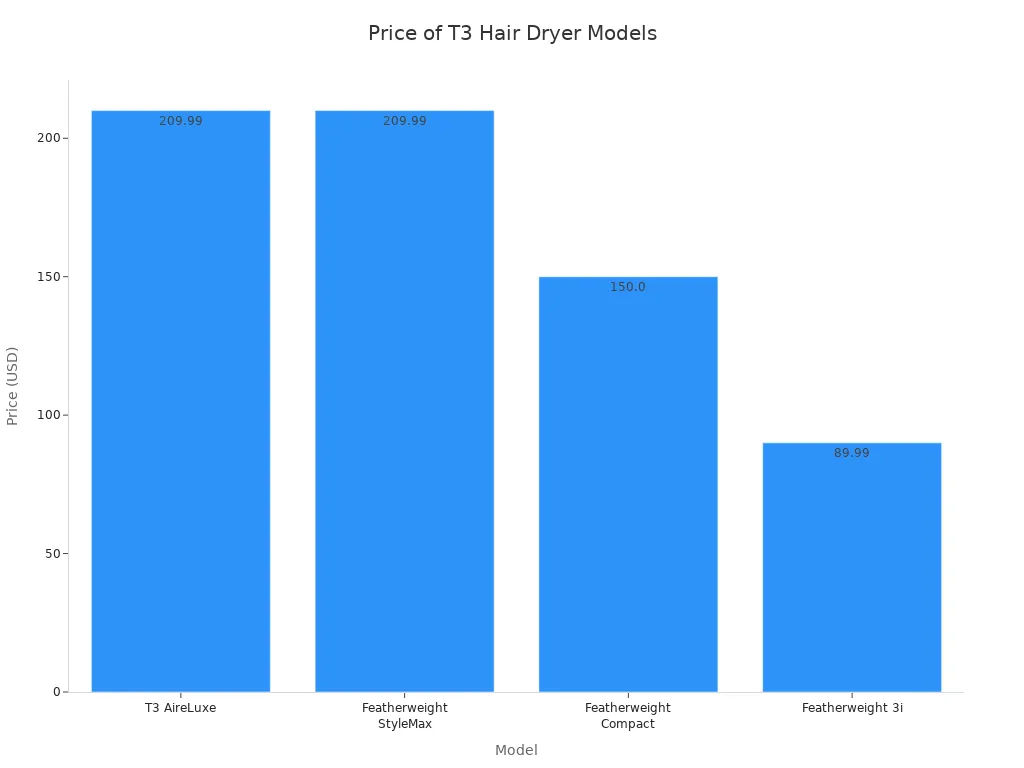
T3 offers a range of high-quality hair dryers at different premium price points. This allows users to select a model that fits their specific budget. The best budget options provide access to T3 technology at a more accessible price.
| Model | Price |
|---|---|
| T3 AireLuxe | $209.99 |
| Featherweight StyleMax | $209.99 |
| Featherweight Compact | $150.00 |
| Featherweight 3i | $89.99 |
Which Offers Better Long-Term Value?
Long-term value extends beyond the initial purchase price. It includes time saved and potential savings on other hair care expenses.
Is the Revair Worth the High Price?
For its target user, the Revair offers significant value that can justify its cost.
- Verified buyers praise its ability to dry thick or multi-textured hair much faster than traditional methods.
- This time savings is a major benefit for both home users and professional stylists.
- Some users report long-term savings on reparative hair treatments due to reduced breakage from minimal heat exposure.
Is the T3 a Better All-Around Value?
The T3 blow-dryer presents a strong case for all-around value. Its lower initial cost makes it a more manageable investment for a wider audience. As a versatile tool for daily styling, it serves multiple functions, from simple drying to creating volume. This flexibility makes it a practical choice for those who do not need the specialized straightening function of the Revair. For many, it is the best budget-friendly path to a premium hair drying experience.
Warranty and Customer Support
A strong warranty protects the investment and provides peace of mind. Both companies offer robust support for their products.
T3 Warranty and Support Policy
T3 provides a comprehensive warranty that covers defects and performance issues.
- The standard warranty covers manufacturing defects for 24 months.
- This includes parts and labor for repairs or a complete unit replacement.
- Users can extend this coverage to 36 months by registering their product within 60 days of purchase.
Revair Warranty and Support Policy
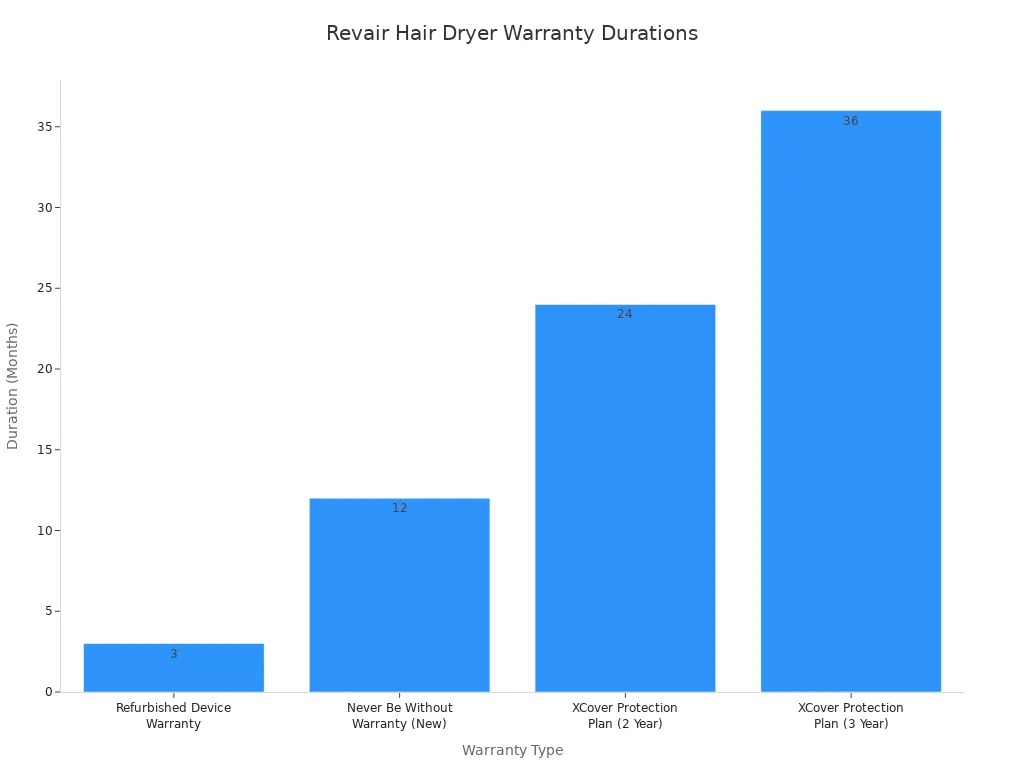
Revair offers several warranty options to protect its high-end device. The “Never Be Without” warranty for new devices is particularly notable, as it ensures users receive a replacement before sending their faulty unit back.
| Warranty Type | Duration | Coverage Details |
|---|---|---|
| Never Be Without Warranty | 12 months | Covers defects; Revair sends a new device before the faulty one is returned. |
| Refurbished Device Warranty | 90 days | Ensures the device is free from defects. |
| XCover Protection Plan | 2 or 3 years | Covers accidental damage and breakdowns after the initial warranty expires. |
Choosing the right blow-dryer depends on your hair type and primary goal. The best investment saves time and supports your natural hair health. This final summary clarifies which tool is right for you.
- The Revair Buyer: A person with thick, curly, or coily natural hair should choose the Revair. It straightens natural hair with low heat, saving significant time. This tool is perfect for a user whose natural hair routine takes a long time.
- The T3 Buyer: A user wanting a versatile, lightweight blow-dryer for daily styling should select the T3. It creates volume and smooth finishes, making it a great all-around tool that saves time for many natural hair types.
FAQ
Can the Revair be used on fine or straight hair?
Yes, the Revair works on all hair types, including fine and straight hair. Users can adjust the tension and heat settings to lower levels. This customization provides a gentle, fast dry without causing damage or tangles, though its primary benefit is for thicker hair.
Which dryer is better for travel?
The T3 is the superior choice for travel. Its compact, lightweight design makes it easy to pack and store. The Revair system is bulky and heavy, consisting of a large base unit and hose. It is best suited for stationary, at-home use.
Does the T3 work well on thick, curly hair?
The T3 effectively dries thick, curly hair. It may take longer than the Revair. For best results, users should work in sections and use a concentrator nozzle for a smooth blowout or a diffuser attachment to define natural curls without creating frizz.
Can the Revair create curls or waves?
No, the Revair is not a styling tool for creating curls or waves. Its reverse-air technology is specifically engineered to dry, stretch, and straighten hair. Users seeking to create texture should choose the T3, which works well with round brushes for styling versatility.
Which hair dryer is quieter?
The T3 operates more quietly than the Revair. T3 dryers are engineered for a lower-pitched, less disruptive sound. The Revair’s motor produces a noise level similar to that of a household vacuum cleaner, which some users may find loud.
Do I still need a heat protectant with the Revair?
Yes, experts recommend using a heat protectant with any heat tool.
While the Revair uses very low heat, applying a protectant provides an extra layer of defense. This simple step helps ensure maximum hair health and moisture retention during the drying process.
Which is a better investment for a professional stylist?
Both tools offer value for professionals, but for different services.
- Revair: An excellent investment for stylists specializing in natural hair. It dramatically cuts drying and straightening time for thick, coily textures.
- T3: A versatile, essential tool for everyday blowouts, styling, and finishing on a wide range of clients.