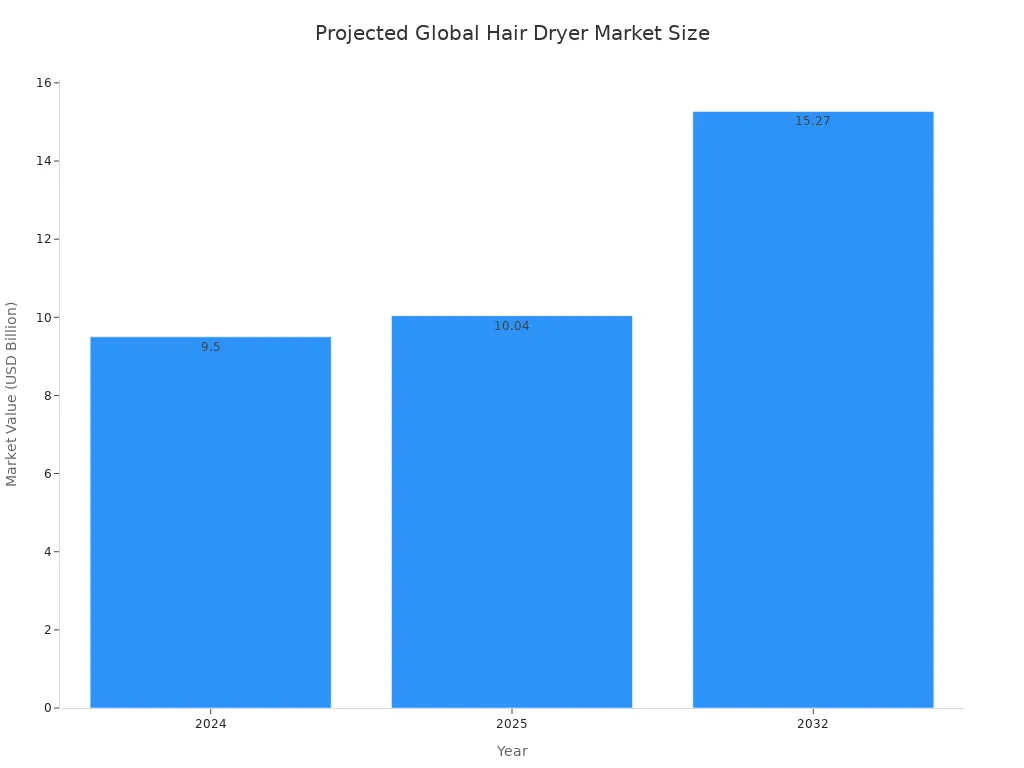
The global hair dryer market is expanding rapidly, with projections showing significant growth. Brands entering this competitive space must partner with the right hair dryer manufacturers. The choice often comes down to two primary models: OEM or ODM.
An OEM (Original Equipment Manufacturer) partnership involves a hair dryer manufacturer producing a tool based on your brand’s unique design. Conversely, an ODM (Original Design Manufacturer) approach lets you select a market-ready model, like a BLDC hair dryer or AC hair dryer, from a hair dryer factory‘s catalog for rebranding.
The OEM Model: Building Your Unique Hair Dryer
The Original Equipment Manufacturer (OEM) model offers brands the ultimate control over their product’s destiny. This path involves commissioning a manufacturer to produce a hair dryer based entirely on a brand’s exclusive design, specifications, and technological requirements. It is the route for visionaries aiming to introduce a truly unique product to the market.
What is OEM Manufacturing?
The Core Concept of OEM
The OEM model is a partnership where a brand brings a fully realized product concept to a manufacturer for production. The brand dictates every detail, from the motor’s power and the heating element’s material to the handle’s ergonomics and the shell’s finish. The manufacturer’s role is to execute this vision with precision. This approach ensures complete design control and allows for the integration of proprietary features, but it demands a significant upfront investment and a longer development timeline. The high consumer demand for innovative beauty tools often justifies this investment.
Your Role vs. The Manufacturer’s Role
Clarity in roles and responsibilities is critical for a successful OEM partnership. The brand acts as the architect, while the manufacturer serves as the expert builder. This division of labor ensures a focused and efficient workflow.
| Role | The Brand (Your Company) | The OEM Manufacturer |
|---|---|---|
| Design | Provides 100% of the design, schematics, and specifications. | Executes the provided design without alteration. |
| IP | Owns all intellectual property for the design and technology. | Owns the manufacturing process IP. |
| Tooling | Funds and owns the custom molds and tooling. | Creates, maintains, and operates the tooling. |
| R&D | Conducts initial research and development for the concept. | Provides engineering feedback and prototyping services. |
| Costs | Covers all development, tooling, and prototyping costs. | Provides a per-unit cost for mass production. |
The Step-by-Step OEM Process
The OEM journey is a structured, multi-stage process that transforms an idea into a mass-produced reality. Each step requires close collaboration and meticulous attention to detail to meet market demand.
Ideation and Specification The process begins with the brand developing a detailed product requirements document (PRD). This document outlines everything: target performance metrics, materials, color codes, desired user experience, and any cutting-edge technology to be included.
Engineering and Prototyping The manufacturer’s engineering team reviews the PRD to assess feasibility. They then develop functional prototypes. This stage involves rigorous testing and refinement to ensure the final product’s performance and safety, representing a key phase of technological innovation.
Tooling and Mold Creation Once the prototype is approved, the manufacturer creates the custom tooling and injection molds needed for mass production. This is often the most time-consuming and expensive part of the OEM process, as these tools are unique to the brand’s product.
Mass Production and Quality Control With the molds ready, mass production begins. The manufacturer implements a strict quality control protocol, defined by the brand, to test products at various stages. This ensures every unit meets the required standards for performance and enhances the overall user experience.
When to Choose the OEM Path
Opting for the OEM model is a strategic decision that aligns with specific long-term business goals. It is not for every brand, but it is essential for those with a particular vision for their place in the market.
Note: The OEM path is a commitment to building a lasting brand asset. The initial investment in design and tooling pays dividends through market exclusivity and strong brand identity, meeting the high demand for unique luxury products.
For Maximum Brand Differentiation
Brands choose OEM to create a product that is impossible to replicate. When the market is saturated with similar-looking dryers, a unique design and superior user experience can capture consumer attention and justify a premium price. This differentiation is crucial for meeting the demand of discerning customers.
When You Own Unique Technology
If a brand has developed proprietary heating elements, a revolutionary motor, or other advanced technologies, OEM is the only viable path. It allows the brand to protect its intellectual property while bringing its technological innovation to life. This is how brands introduce cutting-edge technology to the market.
For Building a Premium Brand
Luxury is built on exclusivity and superior quality. The OEM model allows a brand to control every element that contributes to a high-end user experience, from the weight and balance of the dryer to the sound of its motor. This meticulous control is fundamental to achieving premium brand association and commanding a luxury price point, satisfying a specific market demand for high-performance, luxury tools.
The ODM Model: Fast-Tracking Your Market Entry
The Original Design Manufacturer (ODM) model provides a streamlined path for brands to enter the hair dryer market. It allows a company to launch a product quickly by selecting a pre-designed hair dryer from a manufacturer’s existing portfolio and rebranding it. This approach prioritizes speed and cost-efficiency over unique design development.
What is ODM Manufacturing?
The “White Label” Approach
At its core, the ODM model is a “white label” or “private label” solution. Manufacturers invest their own R&D to create a range of market-ready hair dryers. Brands then select a product that meets their needs, apply their own branding, and introduce it as their own. This ODM partnership eliminates the need for extensive design and engineering, making it an attractive option for many businesses. The manufacturer handles the technical complexities, allowing the brand to focus on marketing and sales.
Navigating a Manufacturer’s Catalog
The ODM process begins with a brand exploring a manufacturer’s product catalog. These catalogs are often filled with models that reflect current market trends and address existing consumer demand. A brand can find everything from high-performance professional dryers to compact travel models. The manufacturer provides detailed specifications for each product, helping the brand evaluate which option best aligns with its target audience and desired user experience.
The Streamlined ODM Process
The ODM journey is designed for efficiency, moving from concept to delivery in a fraction of the time required for OEM. This accelerated timeline provides significant value for wholesale buyers.
Product Selection and Evaluation
The first step is for the brand to select a base model from the catalog. This decision is critical. Brands must rigorously evaluate the product’s build quality, safety certifications, and real-world performance. A great user experience is paramount, so obtaining samples for testing is a non-negotiable part of the process. This evaluation ensures the chosen product meets the brand’s standards and will satisfy customer demand.
Customization and Branding
While the core design is fixed, ODM allows for surface-level customization. Brands can typically specify:
- Color: Applying brand-specific colors.
- Material Finish: Choosing between matte, gloss, or soft-touch finishes.
- Branding: Adding logos and other brand marks.
- Packaging: Designing custom boxes and inserts.
These changes, while simple, can elevate a standard product to create a near-luxury feel and a distinct user experience, enhancing its appeal.
Order Placement and Production
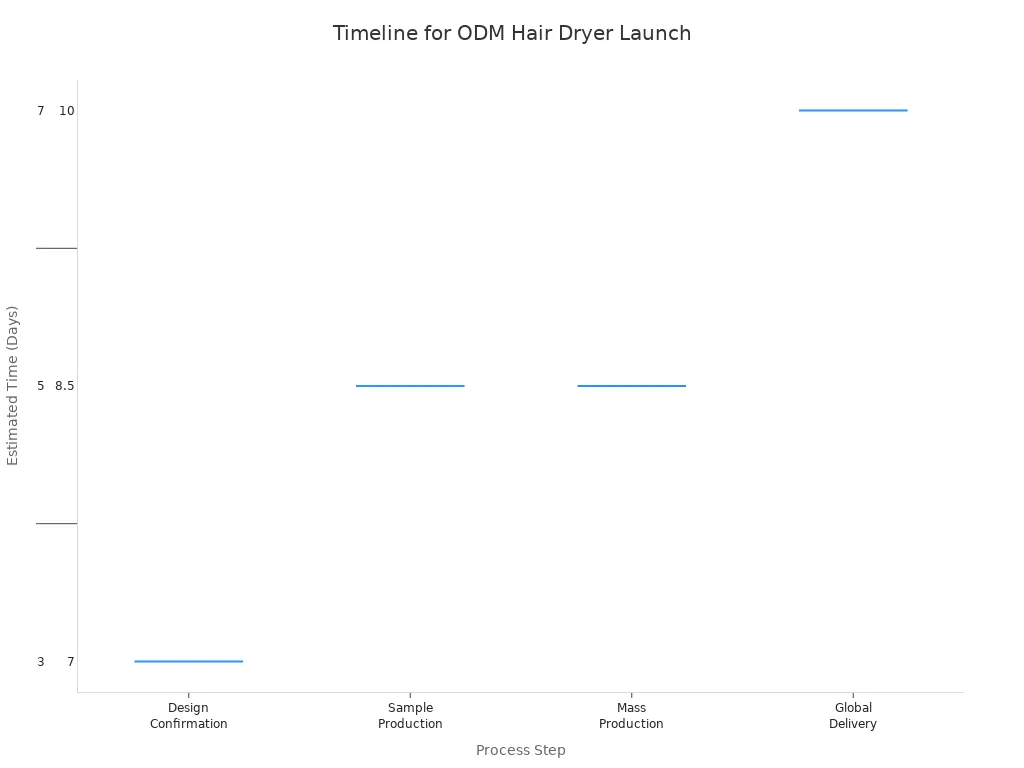
Once the brand approves the customized sample, it places a mass production order. The ODM manufacturer then begins production. Because the tooling and engineering are already complete, this phase is remarkably fast. The focus is on efficient assembly and quality control to maintain consistent performance and meet the expected demand. The timeline for an ODM launch is significantly shorter than for an OEM project.
| Step | Estimated Time |
|---|---|
| Design Confirmation | 3–7 days |
| Sample Production | 7–10 days |
| Mass Production | 25–35 days |
| Global Delivery | 7–15 days |
Final Delivery
After production and final quality checks, the manufacturer packages the hair dryers and ships them to the brand’s designated location. The entire ODM process, from selection to delivery, can be completed in just a few months.
When to Choose the ODM Path
The ODM model is a strategic choice best suited for specific business goals and circumstances.
Pro Tip: The ODM path offers incredible value for wholesale buyers and new brands. It lowers the barrier to entry by providing access to proven, high-performance products without the high upfront investment, allowing brands to quickly meet market demand.
For Speed and Efficiency
When time to market is the top priority, ODM is the clear winner. By skipping the lengthy R&D, prototyping, and tooling phases, a brand can launch a new hair dryer in months, not years. This speed allows a brand to capitalize on trends quickly.
When on a Limited Budget
ODM manufacturing avoids the substantial costs associated with custom tooling and engineering, which can run into tens or even hundreds of thousands of dollars. This makes it the ideal choice for startups, small businesses, or brands with limited capital. It allows them to offer a high-quality user experience and a touch of luxury without a luxury budget.
For Market Testing
The ODM model is an excellent, low-risk tool for market testing. A brand can launch a product to gauge consumer demand and test its position in the competitive hair dryer market. If the product is successful, the brand can consider a larger investment or even a future OEM project. This approach validates a product’s performance and user experience before committing significant resources.
OEM vs. ODM: A Direct Comparison for Hair Dryer Brands
Choosing between an OEM and ODM manufacturer is one of the most critical decisions a hair dryer brand will make. This choice directly impacts product uniqueness, financial investment, and speed to market. Understanding the fundamental differences helps a company align its manufacturing strategy with its core business goals and meet consumer demand effectively.
Design Control and Uniqueness
The level of creative control a brand can exercise is a primary distinction between the two models. This factor determines how much a product can stand out in a crowded marketplace.
Full Control with OEM
The OEM path grants a brand absolute authority over its product’s design. A company provides the manufacturer with exact blueprints and technical requirements. This total control allows for true innovation and differentiation. Brands can dictate every aspect of the hair dryer.
- Motor Configuration: Specifying custom-wound motors for superior power or quiet operation.
- Heating Elements: Designing proprietary heating technologies for faster, safer drying.
- Ergonomics and Aesthetics: Creating a unique shape, weight, and feel that defines the brand’s identity.
- Proprietary Features: Integrating exclusive technology that competitors cannot replicate.
This approach is essential for brands aiming to build a lasting reputation for quality and innovation, especially in the luxury market where unique features justify a premium price. The oem model is the only way to bring a truly novel concept to life and meet the demand for high-end, bespoke tools.
Limited Customization with ODM
The ODM model offers a more constrained, yet efficient, approach to design. Brands select a pre-designed product from a manufacturer’s catalog. While the core engineering is fixed, the odm manufacturer allows for several surface-level customizations to align the product with the brand’s identity.
These modifications are crucial for creating a distinct market presence without the deep investment of a full custom build. For brands targeting the luxury segment, selecting premium finishes and sophisticated packaging can elevate a standard model significantly.
Common customization options include:
- Color and Finish: Applying brand-specific colors and choosing between matte, gloss, or soft-touch textures.
- Branding: Adding logos and brand marks to the dryer and its accessories.
- Packaging: Designing custom boxes and inserts for a unique unboxing experience.
- Specialized Features: Requesting the inclusion of existing technologies like ionic or ceramic heating, if available for that model.
Working directly with manufacturers for large wholesale orders can sometimes unlock more extensive customization, but the fundamental design remains the manufacturer’s intellectual property.
Investment and Costs
The financial implications of OEM versus ODM are starkly different. The required upfront capital and overall cost structure shape which path is viable for a brand.
High Upfront Costs in OEM
The oem process requires a substantial initial investment. A brand must fund the entire research, development, and engineering phases. The most significant expense is tooling, which involves creating custom molds for the hair dryer’s components. These costs can easily reach tens or even hundreds of thousands of dollars before a single unit is produced. This high barrier to entry is a trade-off for creating a unique product that can command a luxury price point and meet a specific market demand.
Low Development Costs in ODM
The odm model is far more accessible from a financial standpoint. Since the manufacturer has already covered the R&D and tooling costs for its catalog products, the brand has no development expenses. The primary costs are the per-unit price and any fees for minor customizations. This low-cost entry point allows startups and smaller businesses to compete in the market, test product-market fit, and respond to consumer demand without risking significant capital. It democratizes access to the market, allowing more brands to offer products with a touch of luxury.
Time to Market
The timeline from initial concept to product launch varies dramatically between the two manufacturing models. This can be a deciding factor for brands looking to capitalize on emerging trends.
Longer Timelines for OEM
Developing a product from scratch is a lengthy process. The oem journey involves multiple stages, each requiring time for development, testing, and refinement.
| Stage | Typical Duration |
|---|---|
| Design & Engineering | 2–6 months |
| Prototyping & Refinement | 1–3 months |
| Tooling & Mold Creation | 2–4 months |
| Mass Production & QC | 1–2 months |
This extended timeline, often a year or more, is necessary to perfect a unique product. It is a strategic investment for brands focused on long-term market leadership rather than short-term speed. The goal is to meet future demand with a truly superior product.
Rapid Launch with ODM
Speed is the hallmark of the odm process. By leveraging an existing, market-proven design, a brand can bypass the most time-consuming stages of product development. The timeline is compressed significantly, focusing only on customization and production. A brand can move from product selection to having inventory ready to ship in just a few months. This agility allows companies to quickly respond to sudden shifts in consumer demand or enter the market to capture a trend, offering a near-luxury experience without the wait.
Intellectual Property (IP) Ownership
The ownership of intellectual property (IP) is a defining difference between the oem and odm models. This factor has long-term implications for a brand’s competitive advantage and market position.
Brand Owns the IP in OEM
In an oem partnership, the brand retains 100% ownership of the product’s design, schematics, and any proprietary technology. The brand provides the blueprint, and the manufacturer is contracted solely to build it. This ownership is a powerful asset.
- Exclusivity: It legally prevents any other company from selling the same product.
- Brand Equity: It allows a brand to build its reputation on a unique design, which is essential for establishing a
luxuryidentity. - Long-Term Value: The design IP becomes a valuable company asset that can be licensed, sold, or used as a foundation for future products.
This control is fundamental for brands that want to meet the market demand for true innovation and protect their investment in research and development.
Manufacturer Owns the IP in ODM
The odm model operates on the opposite principle. The manufacturer owns the intellectual property for the product’s design, engineering, and tooling. The brand essentially licenses a pre-existing product for rebranding. This arrangement has significant consequences.
Key Consideration: While an odm product can be customized with colors and logos, the core design is not exclusive. The same base model can be sold to competing brands, potentially diluting a brand’s market presence.
This model is designed to satisfy immediate market demand efficiently. However, it offers no long-term protection against copycat products, a critical risk for brands aiming for a premium or luxury market segment.
Minimum Order Quantities (MOQs)
Minimum Order Quantity (MOQ) refers to the smallest number of units a manufacturer is willing to produce in a single production run. This number varies significantly between manufacturing models and directly impacts a brand’s initial financial outlay.
Typically Higher MOQs for OEM
The oem process inherently requires higher MOQs. A manufacturer must set up a dedicated production line, calibrate machinery for custom components, and manage unique raw materials. To make this effort financially viable, they need a large initial order. These MOQs often start in the thousands of units. A brand must be confident in its sales forecast and the consumer demand for its unique product. This larger commitment is a standard part of creating a bespoke product, especially in the luxury appliance space where quality control and unique tooling justify the scale.
Often Lower MOQs for ODM
The odm path offers far more flexibility with order quantities, lowering the barrier to entry for many brands. Since manufacturers are already producing these models, they can add a branded run for a new client without significant setup changes. This efficiency allows for much lower MOQs.
Many suppliers offer flexible terms to meet fluctuating market demand. While mass production MOQs for an odm hair dryer may start from 500 units, manufacturers often support small batch trial orders. Some products even have MOQs as low as 50 units, allowing a brand to test the waters. For standard orders, the MOQ typically ranges from 200 to 500 units per model. This flexibility is invaluable for startups or brands testing a new luxury concept, as it enables them to meet initial consumer demand without a massive inventory investment.
Special Considerations for a Professional Hair Dryer
The demands of a professional salon environment are far more rigorous than those of home use. Professional stylists require tools that offer durability, ergonomic comfort, and superior performance. The choice between OEM and ODM manufacturing directly impacts a brand’s ability to meet these specialized needs.
OEM for Performance Innovation
The OEM path is the premier choice for brands aiming to introduce true technological innovation into the professional market. It allows for the ground-up creation of high-performance hair dryers that set new industry standards.
Developing Custom Motors and Heating
A brand can collaborate with an OEM manufacturer to engineer components that deliver superior performance. This process involves creating custom, high-speed motors, such as BLDC motors that reach up to 110,000 RPM for rapid drying. It also enables the integration of advanced technologies.
- Low-noise features for a quieter, more peaceful salon experience.
- Blue light technology designed to promote healthier hair.
- Customizable ionic outputs for personalized hair care.
This level of technological innovation ensures the final product performance is unmatched.
Ergonomics for Salon Use
Professional stylists use their tools for hours each day, making ergonomics a critical factor. The OEM model allows a brand to design a hair dryer with a unique shape, weight, and balance. This custom design minimizes hand fatigue and improves usability for the professional user. Creating a tool that is both powerful and comfortable is essential for high-end salons where efficiency and stylist well-being are paramount.
ODM for Proven Salon-Grade Models
The ODM model offers a practical route for brands to launch reliable, professional-grade tools without the extensive development timeline of OEM. This approach focuses on selecting and customizing existing designs that are already built for heavy-duty use.
Pro Tip: When reviewing an ODM catalog, prioritize models with a proven track record in professional settings. Look for detailed specifications on motor life, material durability, and safety features to ensure the product can withstand constant use.
Selecting High-Durability Options
Brands should carefully evaluate a manufacturer’s catalog for features that indicate professional quality. A truly professional tool should have a powerful motor, typically between 1800W and 2200W, for fast drying. Other key indicators include:
- Durable, heat-resistant body materials.
- An extended power cord (1.8–2.5 meters) for mobility.
- A lightweight design (under 1.5 lbs) to reduce strain.
Selecting a model with these features ensures the product delivers the superior performance expected by a professional.
Certifications for Professional Use
Safety is non-negotiable in a professional environment. An ODM partner must provide products that meet stringent international standards. Brands must verify that the hair dryers carry essential certifications like UL, CE, and RoHS. This compliance guarantees the product is safe for professional use and protects the brand from liability. It is a fundamental requirement for any brand selling cutting-edge technology to the professional market.
Navigating the Global Landscape of Hair Dryer Manufacturers
Selecting the right partner is a global decision. Brands must evaluate the distinct advantages offered by hair dryer manufacturers in different regions. The two primary hubs for production are China and Western countries, each presenting unique strengths for building a professional product line.
Working with Chinese Hair Dryer Brands
Chinese hair dryer brands have become a dominant force in the industry. Their capabilities extend far beyond simple production, offering a blend of innovation, quality, and affordability. In 2021 alone, China exported 131 million hair dryers, a testament to their global reach and trusted manufacturing prowess.
Strengths in ODM Flexibility
Many Chinese hair dryer brands excel at the odm model. They offer extensive catalogs of market-ready professional tools. Their strong R&D teams support new ideas and can quickly adapt existing designs. This flexibility allows brands to launch a professional product with a low MOQ, ensuring even small orders meet exact specifications. This approach provides a fast and efficient path to market for a professional brand.
Cost-Effective OEM Solutions
Beyond ODM, Chinese hair dryer brands provide highly cost-effective oem solutions. Their modern facilities and efficient production lines reduce the overall cost of creating a custom professional tool. They maintain strict quality control, with comprehensive testing for every component and finished unit. This ensures a high-quality professional product without the premium price tag often associated with custom engineering.
Navigating Communication and Culture
A successful partnership with Chinese hair dryer brands requires clear communication. Brands should provide highly detailed specification documents to avoid misunderstandings.
Tip: Working with a local sourcing agent or a manufacturer with a dedicated international sales team can bridge cultural and language gaps. This ensures a smooth workflow for any professional project.
Partnering with Western Hair Dryer Brands
Western hair dryer brands are often synonymous with high-end engineering and cutting-edge innovation. These partners are an excellent choice for brands building a premium professional identity.
Strengths in High-End Engineering
Western hair dryer brands typically lead in developing highly specialized technologies. They are ideal partners for creating a truly bespoke professional tool with proprietary features. Their engineering focus is on performance and luxury, which appeals to the top tier of the professional market. Many Western hair dryer brands are pioneers in this space.
Proximity and Regulatory Alignment
Working with Western hair dryer brands offers logistical advantages for companies in the same region. Shared time zones simplify collaboration. Furthermore, these manufacturers are already aligned with local safety standards like UL, which is critical for professional-grade electronics. This proximity makes Western hair dryer brands a reliable choice.
Comparing Cost Structures
The primary difference lies in cost. Western hair dryer brands generally have higher labor and operational expenses, leading to a higher per-unit price. However, brands may save on shipping costs and import tariffs. The investment in Western hair dryer brands often translates to unparalleled engineering for a specific type of professional tool, justifying the expense for luxury market positioning.
Making the Final Decision for Your Brand
Choosing a manufacturing partner is a defining moment for any brand entering the competitive hair dryer market. The decision between OEM and ODM shapes a company’s financial future, brand identity, and market trajectory. A structured approach helps clarify which path aligns best with a brand’s unique circumstances and long-term vision.
A Framework for Your Choice
A clear framework removes guesswork from the decision-making process. Brands should evaluate four critical areas to determine the most suitable manufacturing model for their goals.
Assess Your Development Budget
Financial resources are often the most significant constraint. The OEM path requires substantial upfront capital for research, engineering, and custom tooling. This investment is necessary for creating a unique professional product. Brands must determine if they can afford these high initial costs. In contrast, the ODM model eliminates development expenses, making it ideal for startups or businesses with limited budgets. This low-cost entry allows a brand to allocate more funds toward marketing and inventory.
Define Your Brand Strategy
A brand’s long-term strategy is a fundamental factor. The choice between manufacturing models is a strategic decision that dictates market positioning.
- OEM supports a strategy built on brand uniqueness and long-term differentiation. It is the path for brands whose core value is product superiority and innovation. This approach is essential for building a defensible, high-margin professional brand that avoids price wars.
- ODM supports a strategy focused on speed, efficiency, and market testing. It is perfect for brands whose strength lies in marketing and distribution rather than product engineering.
A smart hybrid strategy involves starting with an ODM model to test the market and meet initial consumer demand. Once the brand establishes a foothold and understands customer needs, it can transition to OEM to develop a proprietary professional product line.
Evaluate Your Timeline
Time to market can be a decisive advantage. Brands must consider how quickly they need to launch their product. The OEM process is methodical and lengthy, often taking a year or more from concept to shelf. This extended timeline is a trade-off for creating a truly innovative professional tool. The ODM process, however, is built for speed. A brand can launch a product in just a few months, allowing it to capitalize on trends and respond quickly to shifting consumer demand.
Consider Your Team’s Expertise
A brand must honestly assess its internal capabilities. Does the team include skilled designers and engineers? A strong in-house or contracted design team is crucial for a successful OEM partnership. If a brand’s core strength is marketing, sales, and brand building, the ODM model is a more logical fit. This approach allows the team to focus on what it does best while relying on the manufacturer’s technical expertise to deliver a quality professional product.
Real-World Scenarios
Examining how different types of brands leverage these models provides practical insight. Each scenario highlights a strategic alignment between a brand’s goals and its manufacturing choice.
OEM: The Tech-Forward Startup
A tech-forward startup with a revolutionary idea for a hair dryer must choose the oem path. This brand’s value proposition is its unique technology, such as a patented airflow system or smart features. Manufacturers like Sincere Tech exemplify this model, having built their success on integrating cutting-edge technology like Bluetooth connectivity and infrared heating. For this type of startup, protecting its intellectual property is paramount. The high upfront investment is a necessary step to create a defensible professional product that can disrupt the market and meet consumer demand for genuine innovation.
ODM: The E-commerce Market Entrant
An e-commerce brand aiming for a fast and low-risk market entry will find the odm model ideal. This brand can select a high-quality, professional-grade hair dryer from a manufacturer’s catalog and customize it with unique branding and packaging. This strategy minimizes initial investment and accelerates the launch timeline. A great example is TINECO, a brand that originated from an OEM/trading company and successfully expanded into various home appliances, including hair dryers. By leveraging existing designs, an e-commerce entrant can focus its resources on digital marketing and building a strong online presence to capture a share of the professional and consumer markets.
Hybrid: The Established Brand Expansion
An established brand looking to expand its product line can use a hybrid approach. This strategy combines the speed of ODM with the uniqueness of OEM. The brand might start with a proven ODM professional hair dryer as a base. Then, it provides significant, OEM-level specifications to modify and improve it, such as requesting a custom motor or integrating a proprietary heating element. This allows the brand to launch a differentiated professional product faster and with less risk than a full OEM build. This evolutionary model provides a pathway toward a more independent product portfolio while satisfying immediate market needs.
How to Find and Vet Your Manufacturing Partner
Identifying the right manufacturing partner is a crucial step toward launching a successful professional hair dryer. A brand must first source potential partners and then rigorously vet them. This process ensures the chosen supplier can meet quality standards and production demands for a professional product.
Sourcing Potential Partners
Brands can discover potential partners through several effective channels. Each channel offers unique advantages for connecting with qualified suppliers.
B2B Online Marketplaces
Digital platforms are a primary resource for sourcing suppliers. B2B websites like Alibaba.com and BeauteTrade.com connect buyers with global hair dryer manufacturers. These marketplaces list numerous companies, facilitating direct communication and making it easier to find partners for private label or bulk professional orders.
International Trade Shows
Industry trade shows provide an invaluable opportunity for face-to-face interaction. Brands can physically inspect products, observe demonstrations, and discuss capabilities directly with factory representatives. This hands-on approach helps in assessing the real-world quality of a potential professional tool.
Using Sourcing Agents
A sourcing agent can be a strategic asset, especially when working with international suppliers. These agents navigate cultural and language barriers, manage logistics, and help ensure project specifications for a professional product are clearly understood.
Essential Vetting Criteria
Thorough vetting is essential to avoid significant quality differences between samples and the final production run. A brand must evaluate every potential partner against a strict set of criteria to secure a reliable professional relationship.
Reviewing Certifications and Compliance
Compliance with international safety standards is non-negotiable for any professional electronic device. A manufacturer must provide documentation for key certifications.
| Market | Mandatory Certifications/Compliance |
|---|---|
| US | UL Certification, CPSC Compliance |
| EU | CE Marking (LVD, EMC, RoHS Directives) |
Verifying these certifications protects the brand and ensures the product is safe for professional use.
Assessing Production Capacity
A brand must confirm that a manufacturer can handle its order volume. Key indicators include factory size, the number of employees, and dedicated departments for R&D and quality control. This assessment guarantees the supplier can scale production to meet future demand for a successful professional product.
Evaluating Quality Control Systems
A robust quality control system prevents inconsistencies and ensures superior product performance. Brands should insist on receiving physical samples to verify craftsmanship and spot potential quality differences. Reputable suppliers, like Sokany, demonstrate their commitment to quality through rigorous testing and low minimum order quantities for trial orders, which is a great benefit for a new professional brand.
Checking Communication and Transparency
Clear and prompt communication is the foundation of a successful partnership. A responsive manufacturer who provides transparent updates is a reliable partner. This is especially important for complex professional projects where details matter. Strong communication helps build trust between a brand and its chosen hair dryer manufacturers.
A brand’s final decision must align with its core strategy. The oem path enables a brand to create a truly unique professional product, offering unparalleled control for long-term advantage. The odm model provides a faster route to market, allowing brands to launch a proven professional tool with lower investment. Choosing the right odm partner is crucial for delivering a quality professional experience. This strategic choice determines a brand’s ability to meet consumer demand for superior professional tools in the competitive hair dryer market.
FAQ
What is the main difference between OEM and ODM?
OEM (Original Equipment Manufacturer) involves a manufacturer producing a brand’s unique, custom-designed product. ODM (Original Design Manufacturer) allows a brand to select a pre-designed product from a factory’s catalog and rebrand it. The primary difference is design ownership and the level of customization.
Which model is better for a new brand?
The ODM model is often better for new brands. It requires less capital and offers a faster entry into the hair dryer market. This approach allows companies to test products and build a market presence with significantly lower financial risk.
Can a brand customize an ODM hair dryer?
Yes, brands can customize ODM products. Common modifications include:
- Brand-specific colors and finishes
- Logo application
- Custom packaging design
The core engineering and shape of the hair dryer, however, remain fixed as the manufacturer’s original design.
How much does OEM tooling cost?
OEM tooling costs vary widely. The investment can range from tens of thousands to over one hundred thousand dollars. The final price depends on the product’s design complexity, the materials used, and the specific manufacturer’s pricing structure.
Who owns the design in an ODM partnership?
The manufacturer retains full intellectual property (IP) ownership of the product design in an ODM partnership. The brand essentially licenses the product for rebranding. This means the manufacturer can sell the same base model to other companies.
How can a brand ensure product quality?
Brands ensure quality by thoroughly vetting potential manufacturers. This process includes reviewing safety certifications, assessing production capacity, and testing physical samples. Clear communication and detailed product specifications are essential for success in the competitive hair dryer market.