
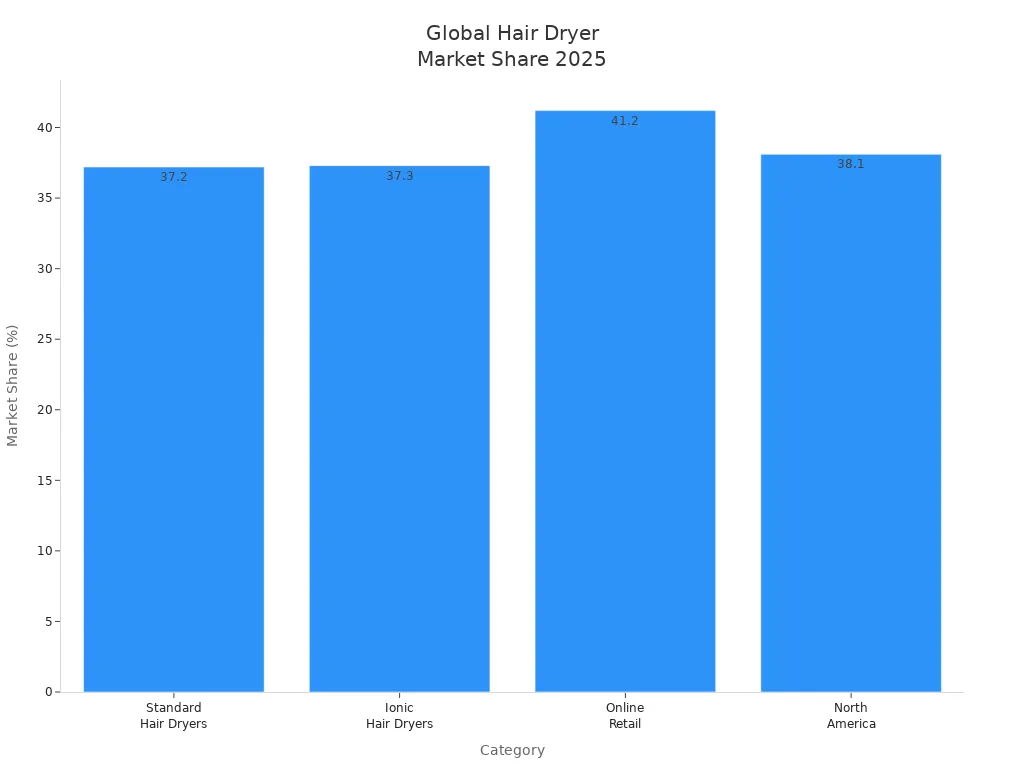
The year 2025 brings significant shifts in hair dryer manufacturing as brands focus on smart features, eco-conscious designs, and advanced hair dryer technology. Ionic, ceramic, and cordless innovations drive demand for premium models, offering faster drying and improved hair health. The rise of the BLDC hair dryer and continued use of the AC hair dryer reflect ongoing innovation in the market. Hair dryer manufacturer strategies now include expanding product lines and leveraging technology to meet evolving consumer needs. The following table highlights key market trends:
| Category | Market Share (%) | Reason for Trend |
|---|---|---|
| Standard Hair Dryers | 37.2% | Largest share due to consumer preference for reliability. |
| Ionic Hair Dryers | 37.3% | Growing awareness of hair health and damage prevention. |
| Online Retail | 41.2% | Convenience and ease of purchase driving sales. |
| North America | 38.1% | High consumer spending and disposable income. |
Rising awareness of personal grooming and at-home styling influences innovation at every hair dryer factory, shaping the future of the industry.
Smart Features and Connectivity in Hair Dryer Technology
Integration of AI and Sensors
Adaptive heat and airflow control
Smart hair dryers in 2025 showcase a leap in innovation with the integration of artificial intelligence and advanced sensors. These devices use intelligent control systems to analyze hair type, moisture level, and environmental conditions. AI-powered sensors adjust heat and airflow in real time, protecting hair from excessive heat and reducing the risk of damage. For example, the Dreame Pilot AI hair dryer modifies its operation based on hair thickness and moisture, ensuring efficient drying. Machine learning algorithms in models like the T3 Aire IQ create personalized drying profiles, adapting settings for each user. This trend reflects a broader shift toward technology that prioritizes both safety and performance.
Personalized styling recommendations
Smart hair dryers now offer personalized styling recommendations. Robotic arms and sensors assess hair before styling, providing tailored advice for optimal results. These devices suggest the best temperature, speed, and styling techniques based on individual hair characteristics. Users benefit from a customized experience that enhances hair health and styling efficiency. The demand for ionic, ceramic, and tourmaline technologies continues to rise, as these features help reduce frizz and minimize heat damage by breaking down water molecules more efficiently.
App Connectivity and Remote Control
Mobile app integration
Recent advancements in hair dryer technology include seamless app connectivity. Users can connect their smart hair dryers to mobile applications via Bluetooth. These apps offer customizable styling presets and real-time hair analysis, allowing users to tailor their routines. The integration of mobile apps enables users to save preferred settings, access tutorials, and receive updates on the latest trends in hair care.
Usage tracking and maintenance alerts
Smart hair dryers also provide usage tracking and maintenance alerts through their connected apps. Users receive notifications when it is time to clean filters or perform routine maintenance. This feature extends the lifespan of the device and ensures consistent performance. Usage data helps users understand their styling habits and make informed decisions about hair care.
Voice Control and Smart Home Compatibility
Voice-activated functions
Manufacturers now equip smart hair dryers with voice control integration. This feature allows hands-free operation, making it easier to multitask during busy mornings or while using other styling tools. Users can adjust settings, turn the device on or off, and select presets using simple voice commands.
| Feature | Benefit |
|---|---|
| Voice Control Integration | Allows hands-free operation, enhancing convenience during busy mornings or when using styling tools. |
Integration with smart home ecosystems
Smart hair dryers now connect with popular smart home ecosystems. Users can synchronize their devices with home assistants, creating a seamless grooming routine. Integration with smart home platforms enables automation, such as scheduling drying sessions or adjusting settings based on daily routines. This level of connectivity represents a significant step forward in intelligent control systems for personal care devices.
Eco-Friendly and Sustainable Hair Dryer Manufacturing

Energy-Efficient Technologies
Low-power motors
Manufacturers in 2025 prioritize eco-friendly solutions by introducing energy-efficient motors in their latest hair dryer models. These motors, often brushless, operate with less friction and consume less power than traditional designs. The adoption of energy-efficient motors not only reduces electricity usage but also extends product lifespan. Brands focus on efficiency by optimizing airflow and incorporating advanced insulation, which further minimizes energy loss during operation.
| Technology | Description |
|---|---|
| Brushless Motors | Operate with less friction, consume less power, and last longer than traditional motors. |
| Intelligent Temperature Control | Automatically adjusts temperature to prevent overheating and optimize energy use. |
| Advanced Heating Elements | Use ceramic or tourmaline technology to distribute heat evenly, reducing drying time and energy use. |
| Optimized Airflow Design | Maximizes drying efficiency with less heat, allowing for faster results with lower energy input. |
Automatic shut-off features
Many eco-friendly hair dryers now include automatic shut-off features. This smart technology detects inactivity and powers down the device, conserving energy and enhancing safety. Multiple heat and speed settings allow users to customize energy use, while lightweight construction reduces motor strain. These innovations reflect a broader trend toward efficiency and responsible energy consumption.
Recyclable and Biodegradable Materials
Use of recycled plastics
The use of recyclable materials has become a defining characteristic of eco-friendly hair dryer manufacturing. Leading brands incorporate recycled plastics into product casings and components, reducing reliance on virgin resources. This shift aligns with consumer demand for sustainable products and helps manufacturers enhance their reputation.
Biodegradable packaging
Eco-friendly packaging solutions have gained traction in 2025. Companies now use biodegradable materials for boxes and inserts, minimizing environmental impact after purchase. The industry also reduces harmful chemicals in both products and packaging, further supporting sustainable production methods. The prevalence of recyclable and biodegradable materials signals a significant move toward responsible manufacturing.
Reduced Carbon Footprint Manufacturing
Green manufacturing processes
Hair dryer manufacturers implement green manufacturing processes to lower their environmental impact. These processes include the use of sustainable production methods, advanced insulation, and optimized airflow designs. Companies also design products for longevity and repairability, which reduces waste over time.
| Practice | Description |
|---|---|
| Use of recycled materials | Manufacturers are incorporating recycled materials into their products. |
| Energy-efficient motors | Adoption of motors that consume less energy during operation. |
| Designs for longevity | Products are designed to last longer and be repairable, reducing waste. |
| Eco-conscious manufacturing | Processes that minimize environmental impact during production. |
Supply chain sustainability
Supply chain sustainability has emerged as a critical focus for the industry. Companies select recyclable and bio-based materials with verified sustainability credentials. They implement digital tracking systems to ensure transparency throughout the supply chain. Many brands pursue environmental certifications such as EPEAT Climate+ and ISO 14001, which validate their commitment to eco-friendly practices. Geographic sourcing strategies help reduce transportation emissions by locating suppliers closer to manufacturing sites. Lifecycle cost analysis allows manufacturers to balance upfront costs with long-term benefits, supporting both efficiency and innovation.
Note: Consumers increasingly prioritize energy-efficient and eco-friendly appliances, driving manufacturers to adopt sustainable practices and recyclable materials at every stage of production.
Advanced Drying Technologies and Innovations
Ionic and Ceramic Hair Dryer Technology
Enhanced ionic technology
Manufacturers in 2025 continue to prioritize rapid product innovation in ionic hair dryer technology. Ionic hair dryers release negative ions that break down water molecules, which speeds up drying and reduces frizz. This process helps maintain hair moisture and shine. The latest models use advanced sensors to monitor airflow and adjust ion output for optimal results. These improvements support a wide range of hair types, offering a safer and more efficient drying experience.
Advanced ceramic heating elements
Ceramic heating elements represent another area of rapid product innovation. These elements distribute heat evenly, preventing hot spots and minimizing the risk of heat damage. The combination of ceramic and ionic technologies addresses common issues faced by different hair types. The table below highlights how ceramic technology benefits various hair types compared to traditional dryers:
| Hair Type | Traditional Dryer Issues | Ceramic Technology Benefits |
|---|---|---|
| Fine Hair | Over-drying, heat damage | Gentle drying, volume retention |
| Thick Hair | Uneven drying, hot spots | Thorough, consistent drying |
| Curly Hair | Frizz, curl disruption | Enhanced curl definition, reduced frizz |
| Chemically Treated | Color fading, structural damage | Color protection, treatment preservation |
| Damaged Hair | Further deterioration | Gentle restoration, strength building |
Ceramic and ionic hair dryers now feature smart controls that adapt to the user’s hair condition, ensuring a personalized and protective drying process. These advancements reflect broader trends in the industry, where technology and innovation drive better outcomes for consumers.
Cordless and Portable Hair Dryer Innovations
Battery advancements
Cordless hair dryers have gained popularity as consumers seek greater convenience and flexibility. Recent battery advancements allow these devices to deliver powerful airflow without being tethered to a power outlet. The rechargeable segment leads the market, enabling users to dry or style hair anywhere. Improved battery life and charging efficiency make cordless models more appealing to both home users and salon professionals. This shift supports the growing demand for portable solutions and aligns with sustainability goals.
- Cordless hair dryers are gaining interest due to consumer demand for portability and convenience.
- Technological improvements in battery life and charging efficiency are making cordless models more appealing.
- The rechargeable segment is leading the market, providing users the ability to dry or style hair anywhere without needing a power outlet.
- This convenience is especially valued by home users and salon professionals, driving growth in this segment.
- Battery-operated models are expected to grow rapidly, appealing to consumers looking for portability and ease of use.
- The U.S. market for cordless portable hair dryers shows significant growth potential driven by consumer demand for convenience and innovation.
- Sustainability is also a key factor influencing market trends.
Lightweight, travel-friendly designs
Manufacturers focus on lightweight, travel-friendly designs to meet the needs of modern consumers. Compact models fit easily into luggage or gym bags, making them ideal for travel or on-the-go use. These designs often feature foldable handles and protective cases, enhancing portability. The combination of battery advancements and ergonomic design ensures that users enjoy powerful performance without sacrificing convenience.
Fast-Drying and Low-Noise Solutions
High-speed motors
High-speed drying systems have transformed the hair dryer market. Brushless motor technology stands out as a key driver of efficiency and performance. These motors deliver strong airflow while consuming less energy, resulting in faster drying times. Many models now include sensors that detect humidity levels and adjust airflow and temperature accordingly. This approach ensures quick drying while minimizing heat damage.
As Dr. Emily Chen, a well-respected expert from the Hair Technology Institute, points out, “The Brushless Hair Dryer cuts down drying time quite a bit, and it also helps prevent heat damage—pretty much what today’s consumers want: quick & safe styling.”
- Brushless motor technology enhances efficiency and reduces noise levels.
- Smart features adjust airflow and temperature based on individual hair types, ensuring quick drying while minimizing heat damage.
- The demand for brushless hair dryers is expected to increase at an annual rate of about 12% from 2023 through 2028.
- Many models come equipped with sensors that detect humidity levels and adjust airflow and temperature accordingly.
Noise reduction engineering
Noise reduction engineering has become a priority for manufacturers. Companies like HUIPU produce quiet, efficient hair dryers that meet the needs of hotels and shared living spaces. Advanced airflow design and insulation materials help reduce operational noise without compromising performance. These improvements create a more comfortable styling experience for users at home and in professional settings.
- HUIPU has produced quiet, efficient hair dryers that are perfect for hotel use, addressing the need for low-noise solutions.
The integration of advanced heating technologies, smart controls, and efficient airflow design demonstrates how innovation continues to shape the hair dryer industry. These developments respond to consumer demand for faster, quieter, and more convenient styling tools.
Hair Dryer Market Growth and Consumer Preferences
Shifting Demographics and Demand
Preferences among Gen Z and Millennials
The global hair dryer market in 2025 reflects the influence of younger consumers. Millennials and Gen Z drive consumer demand by seeking products that support self-expression and personal style. Their interest in hair styling tools grows as digital platforms make tutorials and recommendations more accessible. Social media and influencer culture encourage experimentation, leading to a preference for versatile devices. Many in these demographics also prioritize eco-friendliness, choosing hair dryers made from recyclable materials and featuring energy-efficient designs. The integration of smart technology, such as sensors and mobile app connectivity, appeals to their tech-savvy nature. Customization and personalization remain important, with many seeking products that fit their unique routines and values.
Professional vs. home use trends
The hair dryer market continues to evolve as both professional and home users seek advanced features. Professionals look for durable, high-performance models with digital controls and sustainable components. Home users invest in premium devices to achieve salon-quality results without leaving their homes. The demand for versatile tools that adapt to different hair types and styles remains strong. The global hair dryer market responds by offering products that balance performance, sustainability, and convenience.
- The global hair dryer market is expected to generate USD 8.70 billion in revenue in 2025.
- This reflects a growth rate of 4.2% compared to the previous year.
Premiumization and Customization in Hair Dryer Manufacturing
High-end product features
Premiumization shapes hair dryer manufacturing as consumers seek advanced features. High-end models now include AI-driven controls, digital displays, and enhanced heat protection. The integration of IoT technology creates smart, connected devices that cater to evolving preferences. Many consumers invest in these products to minimize heat damage and enhance shine, reflecting a growing awareness of hair health.
Customizable aesthetics and functions
Customization stands out as a key trend in hair dryer manufacturing. Consumers gravitate toward products that offer interchangeable attachments, adjustable settings, and personalized color options. The global hair dryer market sees increased demand for devices that allow users to tailor their experience, whether for daily styling or special occasions. Manufacturers respond by developing models that combine innovation, convenience, and individual expression.
Health and Safety Focus in Hair Dryer Technology
Heat protection technologies
Health and safety remain top priorities in hair dryer manufacturing. Modern devices feature overheat protection, voltage regulation, and short circuit safeguards. Built-in sensors monitor temperature and motor status, shutting off the device if it detects excessive heat. These features ensure safe operation and protect hair from damage.
Allergen and pollution reduction
Manufacturers address consumer demand for cleaner air by incorporating filters that reduce allergens and pollutants. Advanced filtration systems help maintain a healthier environment during styling. The global hair dryer market continues to innovate, offering solutions that support both safety and well-being.
Forecasts indicate sustained growth as manufacturers adapt to changing consumer needs and preferences. The global hair dryer market demonstrates resilience and adaptability, driven by ongoing innovation and a focus on health, safety, and customization.
Influence of Social Media and E-Commerce on Hair Dryer Market
Viral Product Launches and Reviews
Social media marketing strategies
Social media platforms have become essential tools for brands to reach consumers and shape purchasing decisions in the hair dryer market. Companies use targeted campaigns and engaging content to highlight the latest technology and trends. Influencers and bloggers share styling tips and product recommendations, which increases consumer awareness and drives demand for high-quality hair dryers. As more people learn about the benefits of advanced features, they seek products that minimize heat damage and improve drying efficiency.
Influencer partnerships
Brands often collaborate with influencers to generate buzz around new product launches. These partnerships help products go viral and quickly gain popularity. For example, the RevAir hair dryer gained attention for its unique innovation and effectiveness.
- The RevAir hair dryer reduced drying time to just 16 minutes, compared to the usual 30 to 45 minutes.
- Users reported less hair damage and frizz, making it appealing for those concerned about hair health.
- The product’s setup was quick and easy, enhancing user satisfaction.
- Reviews described the RevAir as the ‘Rolls-Royce of hair dryers,’ highlighting its quality and desirability.
- The dryer handled thick, wavy hair effectively, which is a common concern among consumers.
Direct-to-Consumer Sales Models
Online exclusive products
Direct-to-consumer sales models have changed how consumers access hair dryers. Brands now offer online exclusive products, which allows them to eliminate middleman costs and provide competitive pricing. This approach improves accessibility to high-speed hair dryers and enables companies to respond quickly to consumer preferences.
Subscription and bundle offerings
Many companies introduce subscription services and bundle offerings to enhance customer loyalty. These options provide convenience and value, encouraging repeat purchases. Direct feedback from customers through these channels supports ongoing product development and helps brands stay ahead in the market.
User-Generated Content and Feedback
Community-driven product improvements
User-generated content plays a vital role in shaping product development and brand reputation. Consumers share authentic insights about what they value most, such as lightweight, compact, and energy-efficient designs. There is a noticeable shift toward eco-friendly models and smart features, reflecting evolving expectations.
Real-time consumer feedback integration
Brands use real-time feedback to align their offerings with consumer needs. The table below shows how user-generated content influences the industry:
| Evidence Type | Description |
|---|---|
| User Insights | UGC provides authentic consumer insights and feedback that influence design and marketing strategies. |
| Brand Alignment | Integration of UGC allows brands to align offerings with consumer preferences and expectations. |
| Brand Loyalty | Enhances brand loyalty and reputation through consumer engagement. |
As social media and e-commerce continue to evolve, they drive innovation and shape the future direction of the hair dryer industry.
Regional Insights and Segmentation Analysis in Hair Dryer Manufacturing
North America Trends
Popular features and brands
North America remains a leader in hair dryer adoption, with consumers showing a strong preference for high-performance and innovative products. The region’s top brands focus on delivering powerful drying capabilities, often ranging from 1800 to 2600 watts. Many users value styling versatility, so manufacturers include multiple attachments to accommodate different hair types and styles. Brand reputation plays a significant role in purchasing decisions, as consumers seek reliability and advanced technologies such as ionic and ceramic systems. The table below highlights key preferences in this region:
| Preference Type | Description |
|---|---|
| High-wattage performance | 1800-2600W for powerful drying |
| Innovative features | Valued for brand reputation |
| Pricing | Mid-range with premium options |
| Styling versatility | Multiple attachments included |
| Advanced technologies | Ionic and ceramic technologies used |
Regulatory influences
Regulatory standards in North America shape product development and safety requirements. Agencies enforce strict guidelines on electrical safety and energy efficiency. Manufacturers must comply with these regulations, which drives continuous improvement in product design. These standards also encourage the integration of energy-saving features and environmentally responsible materials.
Europe and Sustainability Leadership
Eco-friendly product adoption
Europe leads the way in sustainability, setting the pace for eco-friendly hair dryer manufacturing. Regulatory frameworks promote the adoption of energy-efficient technologies, pushing brands to innovate with lightweight, durable materials and advanced motor designs. Consumers in Europe demand products that minimize environmental impact, so manufacturers prioritize sustainable practices throughout the production process.
- Regulatory frameworks encourage energy-efficient technologies.
- Consumer demand for eco-friendly products drives sustainable manufacturing.
- Brands shift toward lightweight, durable materials and energy-efficient motors.
Market growth statistics
The European hair dryer market continues to expand, reflecting strong demand for both traditional and innovative products. Projections indicate that the market will reach approximately USD 3,719.4 million by 2033. The compound annual growth rate is expected to reach 8.1% from 2026 to 2033. Corded hair dryers currently dominate the market, but cordless models are emerging as the fastest-growing segment.
- Market revenue projected at USD 3,719.4 million by 2033.
- CAGR expected to be 8.1% from 2026 to 2033.
- Corded dryers hold the largest share, while cordless dryers show rapid growth.
Asia-Pacific Innovation in Hair Dryer Technology
Technological advancements
Asia-Pacific stands out for its rapid adoption of new technologies and evolving consumer preferences. Manufacturers in this region focus on integrating smart features, such as IoT connectivity and personalized heat settings, to enhance the user experience. Sustainability also plays a key role, with brands introducing energy-efficient motors and eco-friendly materials as competitive differentiators. The table below summarizes the main drivers of innovation in Asia-Pacific:
| Technological Advancement | Description |
|---|---|
| Smart Features | IoT connectivity and personalized heat settings for enhanced user experience |
| Sustainability | Energy-efficient motors and eco-friendly materials |
| Changing Consumer Preferences | Rising disposable incomes and urbanization drive demand for premium, feature-rich products |
| E-commerce Growth | Direct consumer engagement and rapid market adaptation through online channels |
Emerging consumer preferences
Consumers in Asia-Pacific increasingly seek premium, feature-rich hair dryers that offer both performance and convenience. Rising disposable incomes and urbanization contribute to this shift. E-commerce platforms play a significant role, enabling brands to reach a wider audience and adapt quickly to changing trends. As a result, the region experiences robust growth and continuous innovation in hair dryer technology.
Latin America and Middle East & Africa Hair Dryer Market
Unique trends such as affordability and multifunctionality
Manufacturers in Latin America and the Middle East & Africa respond to local needs by prioritizing affordability and multifunctionality in hair dryer design. Consumers in these regions often seek products that deliver reliable performance at accessible price points. Many brands introduce hair dryers with multiple attachments, allowing users to style, dry, and even treat hair with one device. This approach appeals to families and individuals who value versatility and cost-effectiveness.
In Latin America, urbanization drives demand for hair dryers that suit busy lifestyles. Compact models with energy-saving features gain popularity among city dwellers. Localized manufacturing and flexible financing options help brands reach a wider audience. In the Middle East & Africa, industrial adoption of negative ion hair dryers marks a shift toward premium technology. Public-private partnerships and projects led by the Gulf Cooperation Council (GCC) support the expansion of digital ecosystems in major cities. These initiatives encourage the adoption of smart hair dryers and advanced styling tools.
Tip: Consumers in these regions often prefer hair dryers that combine multiple functions, such as styling and treatment, to maximize value.
The following table highlights key trends and opportunities, as well as challenges and risks in both regions:
| Region | Trends and Opportunities | Challenges and Risks |
|---|---|---|
| Middle East & Africa | – Industrial adoption of negative ion hair dryers | – Political instability |
| – Public-private partnerships and GCC-led projects | – Infrastructure gaps | |
| – Expanding digital ecosystems in major cities | – Complex import regimes | |
| Latin America (LATAM) | – Growth through urban adoption and public infrastructure | – Macroeconomic volatility (currency, political risk) |
| – Opportunities in localized manufacturing and financing | – Fragmented logistics and long receivable cycles |
Market challenges including infrastructure and distribution
The hair dryer market in Latin America and the Middle East & Africa faces several challenges. Political instability and infrastructure gaps in the Middle East & Africa can disrupt supply chains and limit product availability. Complex import regimes add to the difficulty of distributing hair dryers across borders. In Latin America, currency fluctuations and fragmented logistics create uncertainty for manufacturers and retailers. Long receivable cycles and complex tax systems further complicate business operations.
Manufacturers address these challenges by investing in localized production and distribution networks. Flexible financing options and public-private partnerships help brands overcome barriers to entry. Companies also focus on energy modernization and premium projects to attract consumers seeking advanced technology. Expanding digital ecosystems in major cities supports the growth of smart hair dryers and innovative styling tools.
Middle East & Africa:
- Opportunities: public-private partnerships, energy modernization, premium projects.
- Risks: political instability, infrastructure gaps, complex import regimes.
Latin America:
- Opportunities: infrastructure modernization, localized manufacturing, flexible financing.
- Risks: currency instability, long receivable cycles, complex taxes.
Manufacturers who adapt to local conditions and invest in multifunctional, affordable products position themselves for success in these emerging markets.
Leading Companies and Products Driving Hair Dryer Innovations
Top Manufacturers in 2025
Market share leaders
The hair dryer market in 2025 features several dominant manufacturers who set the pace for innovation and quality. These companies invest heavily in research and development, consistently delivering innovative products that shape global trends. The following table highlights the leading brands recognized for their market share and influence:
| Manufacturer |
|---|
| Dyson Ltd |
| Conair Corporation |
| Parlux S.p.A. |
| ghd Limited |
| Revlon, Inc. |
| Panasonic Holdings Corporation |
| Koninklijke Philips N.V. |
| Spectrum Brands Holdings, Inc. |
| Sharp Corporation |
| Groupe SEB S.A. |
Innovation highlights
Dyson Ltd continues to lead with advanced motor technology and smart heat control systems. Conair Corporation and Panasonic Holdings Corporation focus on energy efficiency and ergonomic design. Parlux S.p.A. and ghd Limited introduce lightweight models with enhanced ionic and ceramic features. These manufacturers prioritize sustainability, integrating recycled materials and eco-friendly packaging. Their commitment to innovation ensures that consumers receive reliable, high-performance hair dryers.
Notable Product Launches in Hair Dryer Technology
Flagship models
Manufacturers unveil flagship models that redefine user expectations. These products incorporate cutting-edge technologies, offering superior performance and convenience. The table below summarizes the most notable launches in 2025:
| Innovation Type | Description |
|---|---|
| Infrared Light Systems | Offers 30% faster drying with 31% energy reduction, preserving moisture in hair strands. |
| AI Sensors | Monitors temperature 1,000 times per second, adjusting heat to maintain optimal styling temps. |
| Cordless Models | Provides 4-hour battery life with professional-grade performance, enhancing mobility. |
| App Connectivity | Allows for personalized experiences and continuous improvement through smartphone integration. |
| High-Speed Motors | Reaches 120,000 RPM for superior drying performance. |
Award-winning designs
Design excellence remains a priority for leading brands. Flagship models receive industry awards for ergonomic form, quiet operation, and sustainability. Infrared light systems and AI sensors stand out for their ability to protect hair health while reducing energy consumption. Cordless models gain recognition for mobility and convenience, meeting the needs of professionals and home users alike.
Note: Award-winning designs often feature smart controls and app connectivity, reflecting the industry’s focus on personalized styling and continuous improvement.
Startups and Disruptors in Hair Dryer Manufacturing
New entrants
The hair dryer manufacturing industry experiences rapid change as startups enter the market with bold ideas. These new entrants challenge established brands by introducing longer battery life and smarter connectivity. Their focus on research and development accelerates the pace of innovation, compelling all manufacturers to adapt quickly.
Unique value propositions
Startups differentiate themselves by offering unique value propositions. They prioritize features such as extended battery performance, advanced app integration, and modular designs. The fast-paced innovation cycle means new models frequently replace older ones, driving companies to balance technological advancement with efficient supply chain management. This dynamic environment encourages continuous improvement and ensures that consumers benefit from the latest advancements in hair dryer technology.
The hair dryer market in 2025 showcases rapid progress, driven by smart features, eco-friendly designs, and advanced drying systems. Manufacturers focus on high-speed drying, scalp care, and multi-functional solutions. The table below highlights key advancements shaping these trends:
| Feature | Description |
|---|---|
| High-Speed Drying Systems | Faster drying with enhanced performance |
| Scalp Care Solutions | Nourishing options for improved hair health |
| Evaluation Metrics | 12 indicators for performance and user experience |
| Testing Conditions | Standardized methods for reliable results |
- Automatic adjustment systems optimize ion concentration.
- Wireless connectivity enables remote monitoring.
- Enhanced brushless motors deliver high RPM.
These innovations set new standards for user satisfaction and efficiency, guiding future directions in personal care technology.
FAQ
What are the most important features in hair dryers for 2025?
Manufacturers focus on smart controls, energy efficiency, and advanced drying technologies. Many models now include AI sensors, app connectivity, and eco-friendly materials. These features help users achieve faster drying, better hair health, and a more personalized styling experience.
How do smart hair dryers improve the styling process?
Smart hair dryers use sensors and AI to adjust heat and airflow. These devices analyze hair type and moisture, then optimize settings for each user. This technology helps prevent heat damage and delivers consistent, salon-quality results at home.
Are cordless hair dryers as powerful as traditional models?
Recent battery advancements allow cordless hair dryers to deliver strong airflow and fast drying. Many cordless models now match the performance of plug-in devices. Users benefit from increased mobility and convenience, especially when traveling or styling hair away from home.
What makes a hair dryer eco-friendly?
Eco-friendly hair dryers use energy-efficient motors, recycled plastics, and biodegradable packaging. Manufacturers also adopt green production methods and design products for longevity. These practices reduce environmental impact and support sustainability goals in the personal care industry.
How do ionic and ceramic technologies benefit hair health?
Ionic technology reduces frizz by breaking down water molecules, while ceramic elements distribute heat evenly. These features help maintain hair moisture and shine. Users experience less heat damage and smoother results, making these technologies popular choices in modern hair dryers.
Why do consumers prefer customizable hair dryers?
Customizable hair dryers offer interchangeable attachments, adjustable settings, and unique color options. These features allow users to tailor their styling experience. Many consumers value the ability to personalize their tools to match their hair type, routine, and aesthetic preferences.
How do social media and e-commerce influence hair dryer purchases?
Social media platforms and online reviews shape consumer opinions and drive demand for new products. Brands use influencer partnerships and direct-to-consumer sales to reach wider audiences. Real-time feedback from users helps manufacturers respond quickly to changing trends and preferences.
What challenges do manufacturers face in emerging markets?
Manufacturers in Latin America and the Middle East & Africa encounter challenges such as infrastructure gaps, political instability, and complex import regulations. They address these issues by investing in local production, flexible financing, and multifunctional products that meet regional needs.