

The global hair dryer market shows significant growth. Projections for 2026 indicate a robust industry landscape.
| Metric | Value |
|---|---|
| Market Size in 2026 | USD 12.21 Billion |
| Growth Rate from 2026 to 2035 | CAGR of 6.04% |
A modern hair dryer factory produces both the powerful AC hair dryer and the efficient BLDC hair dryer. Each hair dryer manufacturer leverages this technology differently. The best hair dryer suppliers distinguish themselves through specific strengths. These notable companies lead the market in 2026:
- Dyson: Best for Technological Innovation
- BaBylissPRO: Best for Professional Salon Use
- Conair: Best for Mass Market & Value
- GHD: Best for Luxury & Brand Prestige
- Philips: Best for Hair Health & Sustainability
- Shark: Best for Performance & Versatility
Detailed Review of the Top Hair Dryer Suppliers for 2026
Choosing a supplier requires a deep dive into what makes each brand a leader. The market’s key players differentiate themselves through technology, target audience, and supply chain mastery. This detailed review examines the top contenders to help you identify the ideal partner for your business needs.
Dyson: Unmatched for Technological Innovation
Dyson fundamentally reshaped the hair care industry with its engineering-first approach. The brand represents the pinnacle of consumer-facing hair tool innovation, commanding a premium price and a loyal following.
Core Strengths: Digital Motors and Air Multiplier Tech
Dyson’s competitive edge comes from its proprietary technology. The company develops compact, powerful digital motors that spin significantly faster than traditional motors. This power, combined with Air Multiplier™ technology, draws in surrounding air to produce a high-velocity, focused jet of air for rapid drying without relying on extreme heat.
2026 Product Spotlight: The Supersonic Series
The Supersonic™ hair dryer remains Dyson’s flagship product in 2026. Its defining feature is intelligent heat control, which measures air temperature over 40 times a second. This system prevents extreme heat damage, protecting natural shine and making it a top choice for health-conscious consumers. The series also features a suite of magnetic attachments engineered for different hair types, including flyaway smoothers and diffusers.
Target Market & Partnership Suitability
Dyson targets affluent consumers who prioritize technology, design, and hair health. The brand’s premium positioning makes it an ideal partner for:
- High-end department stores (e.g., Nordstrom, Selfridges)
- Luxury beauty retailers (e.g., Sephora, Ulta Beauty)
- Flagship salons aiming to offer a premium client experience
Partnership Tip: Businesses partnering with Dyson benefit from its immense brand gravity. Co-marketing efforts and in-store demonstrations can drive significant foot traffic and sales.
Supply Chain & Global Distribution Network
Dyson operates a sophisticated global supply chain with advanced manufacturing facilities in countries like Malaysia and the Philippines. Its direct-to-consumer model and selective retail partnerships give it tight control over branding and pricing. This structure ensures a consistent, premium experience worldwide but offers limited flexibility for wholesale or private-label arrangements.
BaBylissPRO: The Go-To Choice for Salon Professionals
For decades, BaBylissPRO has been a fixture in salons across the globe. The brand built its reputation on creating powerful, reliable, and durable tools that withstand the demands of continuous professional use.
Core Strengths: High-Performance Motors and Durability
BaBylissPRO tools are engineered for longevity and performance under pressure. The brand’s commitment to quality is evident in its construction and results.
- Robust Construction: BaBylissPRO uses high-performance brushless motors and industrial-grade materials designed for all-day salon use.
- Withstands Rigors: These tools are built to endure drops, constant use, and the varied conditions of a busy salon environment.
- Longevity: Professionals consistently report years of reliable service from their BaBylissPRO dryers, a testament to their durability.
- Warranty: A 4-year limited warranty underscores the company’s confidence in its build quality, reducing long-term costs for salon owners.
The dryers also excel in managing difficult hair types.
- Effectiveness on Challenging Hair: The tools successfully style very thick, coarse, and curly hair where other dryers may fail.
- Broad Temperature Range: A guidance system with temperatures from 285°F (for fragile hair) to 430°F (for coarse hair) accommodates every client.
- Dual Ionic System: This feature helps manage frizz on thick textures or can be deactivated to allow for better heat penetration on stubborn hair.
2026 Product Spotlight: Ferrari Engine Dryers
The brand’s collaboration with Ferrari continues to set performance benchmarks. The BaBylissPRO Volare and other models featuring Ferrari-designed engines deliver unparalleled power and airflow.
- The engine utilizes a ball-bearing design for smoothness and an “ultra-efficient” build.
- It delivers intense air pressure, enabling a super-quick blow-dry.
- A turbo button boosts power by approximately 15%, maximizing airflow on demand.
- The powerful 2000-watt motor provides maximum performance for faster drying times.
Target Market & Partnership Suitability
BaBylissPRO exclusively serves the professional market. Its target audience includes licensed cosmetologists, salon owners, barbers, and beauty school students. The brand is an excellent partner for professional beauty distributors and suppliers who cater directly to the salon industry.
Supply Chain & Professional Distribution
The company maintains a strict, professional-only distribution network. Products are sold through authorized distributors like SalonCentric and Cosmoprof, preventing mass-market saturation. This strategy protects brand value and ensures that only trained professionals have access, reinforcing its status as a true salon-grade supplier.
Conair: Leading in Affordability and Market Accessibility
Conair is a dominant force in the mass-market hair appliance sector. As one of the best hair dryer suppliers for volume and value, its strength lies in a vast portfolio, retail dominance, and an accessible pricing strategy that appeals to a broad consumer base.
Core Strengths: Broad Portfolio and Retail Dominance
Conair’s product catalog is extensive, offering everything from basic, budget-friendly dryers to more advanced models with ceramic and ionic technology. This wide range ensures a Conair product is available at nearly every price point. The brand’s long-standing relationships with major retailers like Walmart, Target, Walgreens, and Amazon give it unparalleled shelf space and market penetration.
2026 Product Spotlight: InfinitiPRO Line
The InfinitiPRO by Conair® line represents the brand’s “masstige” (mass prestige) offering. These dryers incorporate features typically found in more expensive models, such as AC motors for faster drying and ceramic technology for gentle heat. While some models like the InfinitiPRO brush are priced higher, many popular dryers in this line, such as the 1875W model, offer a premium feel for an average retail price of around $35 to $39.
Target Market & Partnership Suitability
Conair’s primary market is the everyday consumer seeking reliable performance at an affordable price. However, market data reveals high price sensitivity in this segment.
| Product | Price | Monthly Sales | Avg Rating |
|---|---|---|---|
| Revlon One-Step Volumizer | $33.05 | 49,423 | 4.6 |
| Revlon One-Step PLUS 2.0 | $37.73 | 49,129 | 4.6 |
| Revlon Improved Motor | $35.97 | 48,214 | 4.6 |
| Hot Tools 24K Gold | $40.54 | 3,835 | 4.4 |
| Conair Infinitipro | $114.37 | 176 | 4.4 |
As the data shows, products priced above $40 see a dramatic drop in sales volume.
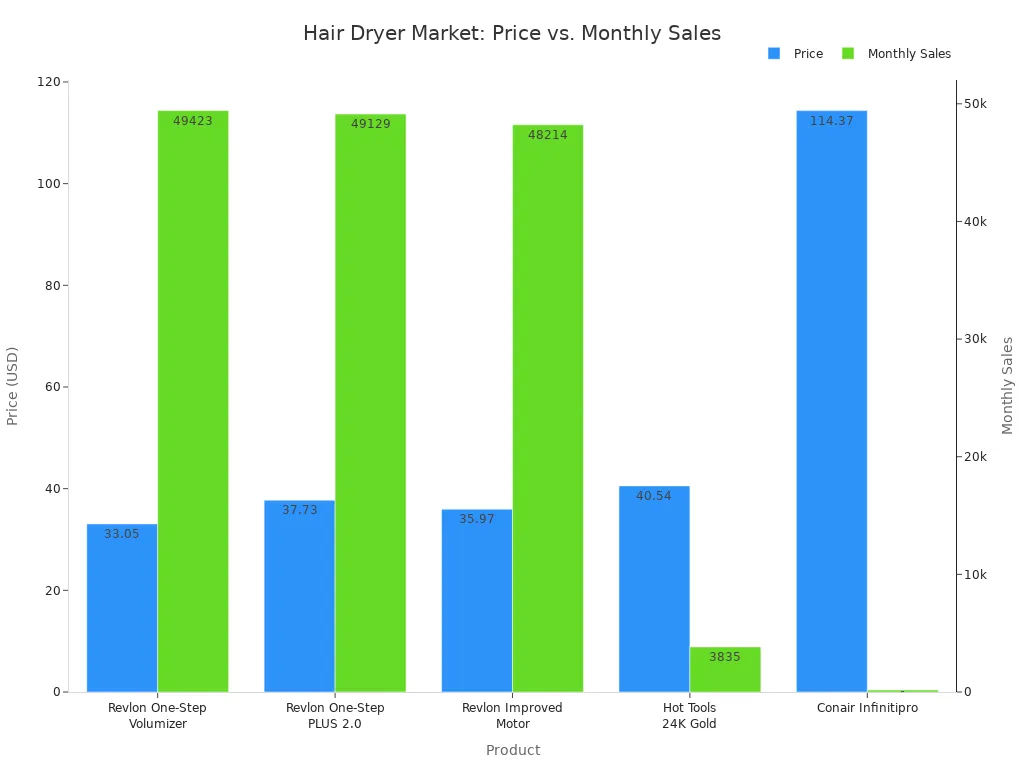
This illustrates that while Conair’s premium-priced models exist, its success and partnership suitability are strongest for mass-market retailers, discount chains, and large-scale e-commerce platforms focused on the high-volume, value-driven segment.
Supply Chain & Mass-Market Logistics
Conair’s supply chain is a model of efficiency, designed for high-volume manufacturing and distribution. The company has the logistical infrastructure to manage large orders, meet the stringent requirements of big-box retailers, and maintain consistent inventory levels across thousands of storefronts and online channels.
GHD (Good Hair Day): Best for Luxury Styling and Brand Prestige
GHD, which stands for “Good Hair Day,” has cultivated an identity synonymous with luxury, salon-quality styling. The brand built its reputation in professional salons before expanding into the premium consumer market. It is a top choice for those who view hair tools as an investment in their personal style.
Core Strengths: Brand Loyalty and Styling Performance
GHD’s primary strength is its powerful brand equity. Consumers and stylists trust GHD to deliver consistent, high-performance results, particularly for creating smooth, sleek, and polished looks. This loyalty is built on years of proven performance. The tools feel substantial and well-balanced, reinforcing their premium positioning and justifying the higher price point for its dedicated user base.
2026 Product Spotlight: The Helios Dryer
The GHD Helios™ remains the cornerstone of its dryer lineup in 2026. It is engineered for speed, control, and a smoother finish. Its success comes from a combination of internal aerodynamics and a powerful motor.
- Aeroprecis™ Technology: This feature combines a brushless DC motor with a contoured nozzle to create a highly concentrated, powerful airflow traveling at 75 mph.
- Advanced Ionic Technology: The dryer reduces frizz and flyaways, contributing to a noticeably smoother and shinier finish.
- Ergonomic Balance: The design is lightweight and ergonomically balanced for comfortable use, a crucial feature for stylists who use it all day.
Target Market & Partnership Suitability
GHD targets style-conscious consumers and high-end salon professionals who prioritize results and brand prestige over budget. The company is an ideal partner for businesses that cater to a luxury clientele.
Partnership Insight: GHD is highly selective with its partners. It thrives in environments that can properly showcase its premium nature, such as luxury department stores, authorized high-end salons, and premium beauty retailers like Bluemercury.
Supply Chain & Premium Retail Channels
GHD maintains tight control over its distribution to protect its premium image. The company utilizes a selective network of authorized professional distributors and upscale retail partners. This strategy prevents market dilution and ensures the brand is always presented in a premium context. Unauthorized online sales are actively policed, preserving price integrity and exclusivity.
Philips: Excelling in Hair Health and Sustainable Technology
Philips distinguishes itself in the crowded hair care market by focusing on consumer well-being and technological innovation rooted in health. The company leverages its vast experience in consumer electronics and healthcare technology to create hair dryers that prioritize hair protection and energy efficiency.
Core Strengths: SenseIQ Technology and Energy Efficiency
Philips’s key differentiator is its intelligent, responsive technology. The company leads with features designed to protect hair from heat damage.
- SenseIQ Technology: An infrared sensor actively scans the hair’s surface temperature up to 12,000 times per drying session. The microprocessor then analyzes this data and continuously adjusts the airflow temperature. This process prevents overheating and helps hair retain up to 95% of its natural moisture.
- Energy Efficiency: Philips designs its motors and heating elements for optimal performance with lower energy consumption compared to traditional high-wattage dryers. This appeals to environmentally conscious consumers.
2026 Product Spotlight: 7000 & 9000 Series Dryers
The 7000 and 9000 Series dryers embody the company’s commitment to personalized hair care. These models are packed with smart features that adapt to the user’s hair. The dryers come with multiple intelligent attachments that automatically trigger tailored drying modes. For example, attaching the diffuser will activate a specific temperature and airflow setting optimized for curls. This makes Philips one of the best hair dryer suppliers for users seeking automated, health-focused results.
Target Market & Partnership Suitability
Philips targets health-conscious consumers who are concerned about heat damage and seek products backed by scientific research. The brand is also a strong fit for consumers interested in sustainability. It is an excellent partner for retailers that focus on wellness, technology, and eco-friendly products, including electronics stores and large-format retailers with dedicated personal care sections.
Supply Chain & Focus on Sustainable Practices
As a global electronics giant, Philips operates a highly sophisticated and resilient supply chain. The company places a strong emphasis on sustainability throughout its manufacturing and packaging processes. It actively incorporates recycled materials into its products and packaging and adheres to stringent international environmental and safety standards, making it a reliable and responsible supply partner.
Shark: A Top Contender in Performance and Versatility
Shark, a brand under the SharkNinja umbrella, has rapidly emerged as a formidable competitor in the premium hair care space. It challenges established leaders by offering innovative, high-performance products that provide exceptional versatility and value.
Core Strengths: HyperAIR IQ and Multi-Styler Attachments
Shark’s strategy centers on intelligent technology and multi-functionality. The HyperAIR IQ technology intelligently sets heat and airflow settings based on the attached styler, removing the guesswork for users. This smart system, combined with a powerful motor, ensures fast drying without extreme heat. The brand’s main appeal is its ecosystem of attachments, allowing one tool to perform multiple functions, from drying to curling.
2026 Product Spotlight: The SpeedStyle & FlexStyle Systems
In 2026, Shark’s market presence is defined by its dual-pronged product strategy with the SpeedStyle and FlexStyle.
- Shark SpeedStyle™: This system is built for rapid drying and styling simultaneously. It is a powerful, lightweight tool designed for users who prioritize speed and a smooth finish.
- Shark FlexStyle™: This is the ultimate multi-styler, designed as a direct competitor to the Dyson Airwrap. It features a unique twisting wand that transforms from a powerful dryer into a versatile styling tool for curling, straightening, and volumizing.
The success of these systems is undeniable. The FlexStyle alone generated $16.4 million in Earned Media Value (EMV) in a single year. On Amazon, its revenue surged by an incredible 1,797% in the first half of 2023, demonstrating massive consumer adoption and market disruption.
Target Market & Partnership Suitability
Shark targets tech-savvy consumers who want premium performance and versatility without the absolute highest price tag. These buyers are often comparing Shark directly with Dyson, seeking similar results with added flexibility. Shark is an ideal partner for major beauty retailers like Sephora and Ulta, as well as large electronics and department stores that can effectively demonstrate its multi-functional capabilities.
The following tables highlight how Shark’s technology and attachment strategy create a compelling value proposition.
Attachment Flexibility: Shark vs. Dyson
| Attachment Feature | Shark HyperAIR | Dyson Supersonic |
|---|---|---|
| Included Attachments | 2-3 attachments | 5 attachments |
| Additional Attachments | Available for purchase ($30 each) | Not available |
| Customization | High flexibility | Fixed set |
| Feature | Shark HyperAIR IQ | Dyson Supersonic | GHD Helios |
|---|---|---|---|
| Core Technology | Intelligent heat/airflow based on attachment | Air Multiplier, Intelligent Heat Control | Aeroprecis™ technology |
| Temperature Monitoring | 1,000 times/second | 40 times/second | Not specified |
| Ionic Technology | Negative ion generation | Not specified | Advanced ionic technology |
| Cord Length | 8.2 ft | 9 ft | 9.8 ft |
Supply Chain & Competitive Retail Strategy
Shark leverages SharkNinja’s robust global supply chain to manufacture its products at scale. Its retail strategy is aggressive and competitive. The company places its products in the same premium retail channels as its top competitors. This direct placement allows consumers to compare features and value side-by-side, a strategy that has proven highly effective in capturing market share from more established players.
Comparative Analysis: Finding the Best Hair Dryers from Top Suppliers

Understanding a supplier’s product performance requires direct comparison. In-depth hair dryer testing reveals key differences in speed, technology, and design that define each brand’s market position. This analysis breaks down how leading models stack up against one another.
Performance and Drying Speed
Drying speed is a critical metric for both consumers and professionals. It often comes down to a combination of motor power and airflow engineering.
Dyson Supersonic vs. Shark SpeedStyle
This matchup represents the battle for high-tech, rapid drying. Both brands use powerful, compact motors to generate high-velocity airflow. Shark, in particular, engineered its SpeedStyle for maximum speed, directly challenging the established players.
| Brand | Model | Airflow Speed (MPH) |
|---|---|---|
| Shark | SpeedStyle Pro Hair Dryer | 0-100 |
The data shows Shark’s focus on achieving top-tier airflow. While Dyson’s Air Multiplier creates a focused jet of air, Shark’s system delivers raw speed, making both excellent choices for users who prioritize a quick drying time.
BaBylissPRO Portofino vs. GHD Helios
This comparison highlights the difference between professional workhorses. The BaBylissPRO Portofino is known for its powerful Italian AC motor, delivering robust and reliable heat. The GHD Helios, however, uses Aeroprecis™ technology to create a more concentrated and controlled airflow, prioritizing a smooth, polished finish over sheer force.
Technology and Hair Protection
Modern suppliers differentiate themselves with smart features that protect hair health. The best hair dryers now incorporate sensors to prevent heat damage.
Philips SenseIQ vs. Dyson’s Heat Control
Philips and Dyson lead the market in intelligent heat protection, but their methods differ significantly. Each technology offers a unique approach to preserving hair integrity.
| Feature | Philips SenseIQ | Dyson Intelligent Heat Control |
|---|---|---|
| Measurement Target | Hair temperature (digital infrared sensor) | Air temperature |
| Measurement Frequency | Over 12,000 times per drying session | Over 40 times a second |
| Primary Goal | Prevent overheating, lock in up to 95% moisture | Prevent extreme heat damage |
Key Takeaway: Philips’s technology is reactive to the hair itself, making it ideal for moisture retention. Dyson’s system proactively controls the air leaving the tool, ensuring it never reaches a damaging temperature.
Ionic and Ceramic Features Across Brands
Nearly all top-tier suppliers integrate ionic and ceramic technologies. Ceramic components ensure even heat distribution, while ionic generators release negative ions to neutralize static, reduce frizz, and enhance shine. This has become a standard feature, not a differentiator, among premium brands.
Ergonomics and Design
A tool’s physical design impacts user comfort and efficiency, especially for stylists who use it for hours.
Weight and Balance Comparison
Weight is a crucial factor in user fatigue. Brands like BaBylissPRO build durable but heavier tools, while Dyson and Shark place their smaller motors in the handle to improve balance. A typical professional dryer’s specifications illustrate the design considerations.
- Rated Wattage: 1875W
- Length of AC Cord: 7.9 ft | 2.4 m
- Total Unit Weight: 1.5 lb | 693 g
This weight, if poorly balanced, can cause strain over a long workday.
User Interface and Ease of Use
Control schemes vary widely. Professional brands like BaBylissPRO often use robust rocker switches that are durable and easy to operate without looking. In contrast, tech-focused brands like Dyson and Shark use sleek digital buttons and LED indicators to manage precise heat and speed settings, appealing to a more consumer-tech audience.
Value and Total Cost of Ownership
The value of a hair dryer extends far beyond its initial price tag. Total cost of ownership (TCO) provides a more complete picture, factoring in durability, warranty, and long-term performance. A low-cost dryer that fails after a year offers poor value compared to a more expensive model that lasts for five. Suppliers cater to different value propositions, from mass-market affordability to premium, long-term investments.
Conair’s Affordability vs. T3’s Mid-Range Luxury
Conair and T3 Micro represent two distinct approaches to value in the hair dryer market. Conair built its empire on affordability. The brand’s value proposition is clear: provide functional, reliable tools at a price point accessible to nearly every consumer. This strategy makes it a leader for high-volume retailers targeting budget-conscious shoppers.
T3 Micro, in contrast, occupies the “mid-range luxury” space. It bridges the gap between mass-market brands and ultra-premium suppliers like Dyson. T3 offers advanced technology, sleek design, and superior materials at a price that is an investment but not prohibitive. This positioning appeals to consumers who want a premium experience without the highest market price. T3’s product lineup illustrates this mid-range luxury positioning with varied price points:
- AIRE IQ: $299.99
- AIRE 360: $249.99
- FEATHERWEIGHT STYLEMAX: $209.99
- FEATHERWEIGHT 3i: $89.99
This strategy allows T3 to capture a discerning customer base willing to pay more for tangible benefits in performance and design.
Warranty and Durability Considerations
A supplier’s warranty is a direct reflection of its confidence in a product’s durability. It is a critical component of TCO, as it protects the buyer from costs associated with defects and premature failure. This long-term perspective is essential when searching for the best hair dryers that balance cost and quality.
Supplier Insight: A strong warranty reduces risk for both consumers and retail partners, making it a key selling point for premium and professional brands.
T3 Micro provides a clear example of this commitment. The company offers a twenty-four (24) month limited product warranty on its dryers and styling irons, covering defects in workmanship or materials. This two-year guarantee gives buyers peace of mind and reinforces the brand’s quality claims. In comparison, professional-grade suppliers like BaBylissPRO often provide even longer warranties (up to four years) to meet the demands of salon use. Conversely, many budget-friendly models may only come with a standard one-year warranty. Evaluating a supplier’s warranty policy is therefore a crucial step in assessing the true, long-term value of their products.
Key Criteria for Selecting the Best Hair Dryer Suppliers
Selecting the right partner in the competitive hair dryer industry requires a thorough evaluation of several key factors. A supplier’s technological prowess, product flexibility, and logistical reliability directly impact a retailer’s success. These criteria help businesses identify partners that align with their strategic goals.
Technological Advancement and R&D Investment
A supplier’s commitment to research and development is a primary indicator of its market leadership. True innovation separates top-tier suppliers from the rest. For example, a leading company like Dyson allocates a significant portion of its revenue to R&D, investing millions each week to push the boundaries of engineering.
Motor Technology: Brushless vs. AC/DC Motors
Motor type defines a dryer’s performance and lifespan.
- Brushless DC (BLDC) Motors: These are lightweight, efficient, and durable. Brands like Dyson and Shark use them to create powerful airflow in compact designs.
- AC Motors: These are powerful and robust, favored by professional brands like BaBylissPRO for their longevity in salon environments.
- DC Motors: These are lighter and more cost-effective, commonly found in mass-market and travel dryers.
Heating Elements: Ceramic, Tourmaline, and Titanium
The material of the heating element affects heat distribution and hair health. Ceramic provides even, gentle heat. Tourmaline is a gemstone crushed into the components that emits negative ions to reduce frizz. Titanium heats up quickly and maintains a consistent temperature, making it ideal for professional styling.
Smart Features: AI and Heat Sensor Integration
The most advanced suppliers integrate smart sensors. These features monitor air or hair temperature thousands of times per second to prevent heat damage. This technology is a key selling point for health-conscious consumers and justifies a premium price point.
Ionic, Infrared, and Light-Based Technologies
Beyond basic heating, modern dryers use other technologies to improve results. Ionic generators are now standard for reducing static. Some suppliers are exploring far-infrared or even light-based technologies (like Zuvi) to dry hair more gently from the inside out.
Product Portfolio and Customization
The best hair dryer suppliers offer a flexible product portfolio. This allows partners to meet specific market needs and build a unique brand identity. A supplier’s reputation often grows from its ability to provide tailored solutions.
OEM/ODM Capabilities for Private Labels
Original Equipment Manufacturer (OEM) and Original Design Manufacturer (ODM) services are crucial for private label brands. Suppliers like AirBlis offer comprehensive support from design to production. Customization options often include:
- Adding a private label logo to the tool and packaging.
- Selecting custom colors for the hair dryer body.
- Designing new molds for a completely unique tool.
- Choosing specific materials or display screens (LED/LCD).
Range of Models and Price Points
A strong supplier provides a tiered range of models. This portfolio should span from entry-level tools to premium, feature-rich dryers. This allows a retail partner to cater to different consumer segments, from budget-shoppers to luxury buyers.
Accessory and Attachment Ecosystems
An ecosystem of magnetic or click-on attachments adds significant value. Diffusers, concentrators, and specialty stylers increase a product’s versatility. Suppliers who offer a robust accessory lineup enable customers to customize their styling experience.
White-Labeling and Branding Support
White-labeling allows a business to apply its own brand name to a pre-existing, tested product. This is a fast and cost-effective way to enter the market. Quality suppliers provide support to ensure the final product aligns with the partner’s brand image.
Supply Chain Reliability and Global Reach
A supplier’s logistical capabilities are as important as its products. An unreliable supply chain can lead to stockouts, lost sales, and damaged customer trust.
Manufacturing Capacity and Production Lead Times
Businesses must understand a supplier’s production capacity. For many professional-grade tools manufactured in Asia, lead times are a key consideration.
Production Timeline Example:
- Sample Development: 15–30 days
- Mass Production: 30–60 days after sample approval
Global Logistics and Distribution Networks
Established suppliers like Conair and BaBylissPRO have sophisticated global distribution networks. They leverage contract manufacturers and logistics partners to ship products worldwide efficiently. This global reach is essential for international retailers and brands.
Inventory Management and Support Systems
Top suppliers offer robust support systems. This includes inventory management assistance, clear communication channels, and responsive customer service. These systems help partners manage stock levels and resolve issues quickly.
Risk Mitigation and Supply Chain Resilience
A resilient supply chain can withstand disruptions. The best suppliers have contingency plans, diverse manufacturing locations, and transparent processes. This stability provides partners with confidence and protects their business from unforeseen challenges.
Pricing Strategy and Value Proposition
A supplier’s pricing model directly reflects its market position and value proposition. Businesses must analyze these strategies to find a partner whose financial structure aligns with their own retail goals. A comprehensive pricing strategy goes beyond the unit cost to include discounts, order requirements, and long-term support.
Tiered Pricing Structures and Volume Discounts
Most suppliers implement tiered pricing to encourage larger purchase orders. This structure provides volume discounts, reducing the per-unit cost as the order size increases. This benefits buyers by improving their profit margins. It also helps suppliers achieve economies of scale in production and logistics.
Minimum Order Quantities (MOQs)
Minimum Order Quantities (MOQs) vary significantly among suppliers and are a critical factor for buyers of all sizes. Some manufacturers demonstrate flexibility to accommodate different business needs. For instance, certain suppliers have flexible MOQ policies to work with various order sizes. Others may support small batch trial orders, with some products available for as few as 50 units. For full-scale mass production, the MOQ often begins at 500 units, though this number can change depending on the product’s complexity.
Warranty, Repairs, and After-Sales Support
A strong after-sales program is a key indicator of a supplier’s confidence in its product quality. Leading suppliers offer comprehensive warranties, clear repair processes, and responsive customer support. This commitment reduces the total cost of ownership for the buyer and builds long-term partner loyalty.
Balancing Unit Cost with Perceived Brand Value
Ultimately, buyers must balance the supplier’s unit cost with the product’s perceived brand value. A low-cost item from a mass-market supplier serves a different purpose than a premium product from a luxury brand. The right supplier helps a business achieve its desired market positioning, whether that is based on affordability or prestige.
Commitment to Sustainability and Compliance
In 2026, a supplier’s dedication to ethical and sustainable practices is a major differentiator. Consumers increasingly favor brands that demonstrate environmental and social responsibility. Therefore, partnering with a compliant and transparent supplier is essential for market success.
Use of Recycled and Sustainable Materials
Forward-thinking suppliers actively incorporate sustainable materials into their products and packaging. This includes using post-consumer recycled (PCR) plastics for the dryer housing and opting for recyclable, minimalist packaging. These actions reduce environmental impact and appeal to eco-conscious shoppers.
Energy Efficiency Ratings and Power Consumption
Energy efficiency is a powerful selling point. Top suppliers design their hair dryers with efficient motors and heating elements that deliver high performance with lower power consumption. Highlighting energy efficiency ratings helps attract customers looking to reduce both their carbon footprint and electricity bills.
International Safety Certifications: CE, UL, RoHS
Compliance with international safety standards is non-negotiable. Certifications prove a product has undergone rigorous testing and is safe for consumer use.
Key Certifications:
- CE: Required for products sold within the European Economic Area.
- UL: A North American safety standard from Underwriters Laboratories.
- RoHS: Restricts the use of specific hazardous materials. These certifications are fundamental to a supplier’s trustworthiness and global market access.
Ethical Sourcing and Transparent Labor Practices
Ethical considerations extend to the entire supply chain. Reputable suppliers maintain transparent labor practices and ensure their manufacturing partners adhere to fair wage and safe working condition standards. This commitment to ethical sourcing protects brand reputation and resonates with modern consumers.
Matching Supplier to Your Specific Needs in 2026
Choosing the right supplier is not a one-size-fits-all decision. The best partner for a luxury salon is vastly different from the ideal supplier for a mass-market chain. Aligning a supplier’s strengths with your business model is the most critical step toward success. This guide matches top suppliers to specific business needs.
For High-End Retailers & Salons
Recommended Suppliers: Dyson, GHD, T3
Key Considerations: Brand prestige and in-store experience
High-end retailers and premier salons thrive on exclusivity and a premium customer experience. Suppliers like Dyson, GHD, and T3 are ideal partners in this segment. These companies command significant brand prestige that attracts affluent consumers. Retailers like Nordstrom and Sephora benefit from selling these premium products, as it enhances their own luxury appeal.
Partnership Advantage: The selective distribution strategy of these suppliers ensures proper product presentation and customer education. This approach protects the premium positioning for both the manufacturer and the retailer, creating a mutually beneficial relationship built on quality and exclusivity.
For Bulk Distributors & Mass Market Chains
Recommended Suppliers: Conair, Revlon, Remington
Key Considerations: Volume, pricing, and retail logistics
Bulk distributors and large retail chains prioritize volume, competitive pricing, and logistical efficiency. Suppliers such as Conair, Revlon, and Remington are masters of this domain. Their business models are built for economies of scale, allowing them to produce reliable products at accessible price points. These companies possess the robust supply chain infrastructure necessary to manage large-scale orders and maintain consistent inventory across thousands of retail locations. Their expertise in mass-market logistics makes them dependable partners for businesses focused on high-volume sales.
For Boutique Brands Seeking Innovation
Recommended Suppliers: Philips, Shark, Panasonic
Key Considerations: Unique tech and co-branding potential
Boutique businesses looking to stand out need a supplier that offers unique technological advantages. Philips, Shark, and Panasonic are excellent choices for this purpose. These suppliers invest heavily in R&D, creating proprietary features that can become a key differentiator for a smaller brand. A partnership can provide access to cutting-edge innovations that would be too costly to develop independently.
This collaboration offers a path to market distinction. For example, a boutique company could co-brand a product line featuring:
- Philips’s SenseIQ: Technology that actively scans hair temperature to prevent moisture loss.
- Shark’s Scalp Shield™: A specialized feature designed to protect the scalp from heat damage during drying.
Leveraging these unique technologies allows a boutique business to offer a compelling, high-performance product without the massive R&D overhead.
For E-commerce Startups and Drop-shippers
E-commerce startups and drop-shippers operate within a unique business model. They require a procurement strategy that minimizes upfront investment and logistical complexity. Success in this space depends on finding reliable suppliers through platforms designed for agility and scalability. These businesses prioritize low financial risk and seamless operational integration over holding physical inventory.
Recommended Platforms & Suppliers: Alibaba, SaleHoo, Spocket
Several platforms serve as gateways for startups to source hair dryers without large capital outlays. Each platform offers distinct advantages depending on the business’s specific strategy, from private labeling to simple drop-shipping.
- Alibaba: A global marketplace connecting businesses directly with manufacturers, mostly in Asia. It is the premier platform for sourcing products for private labeling. Startups can find suppliers to create custom-branded hair dryers, though this often requires negotiating Minimum Order Quantities (MOQs).
- SaleHoo: This platform functions as a vetted supplier directory. It provides access to a database of pre-screened drop-shippers, wholesalers, and manufacturers. This curation process reduces the risk of partnering with unreliable suppliers, a common challenge for new entrepreneurs.
- Spocket: A drop-shipping app that integrates directly with e-commerce platforms like Shopify and WooCommerce. Spocket focuses heavily on suppliers based in the US and EU. This focus enables significantly faster shipping times to Western markets, a key competitive advantage.
Platform Comparison for Startups
| Platform | Best For | Key Feature | Typical MOQ |
|---|---|---|---|
| Alibaba | Private Labeling | Direct manufacturer access | 100-500+ units |
| SaleHoo | Finding Vetted Suppliers | Curated supplier directory | Varies (low to high) |
| Spocket | Fast Drop-shipping | US/EU supplier base | 1 unit (drop-shipping) |
Key Considerations: Low MOQs and fulfillment integration
Two factors are paramount for the success of an e-commerce startup: low MOQs and automated fulfillment. These elements directly address the core needs of a lean business model.
Startup Strategy: Low MOQs are essential. They allow a new business to test a product in the market with minimal financial risk. This flexibility prevents startups from tying up capital in bulk inventory that may not sell.
Fulfillment integration is the technological backbone of a successful drop-shipping operation. It connects a startup’s online storefront directly to the supplier’s inventory system. When a customer places an order, the system automatically forwards it to the supplier. The supplier then ships the product directly to the customer. This automation eliminates manual order processing, reduces errors, and allows the business to scale efficiently.
Emerging Trends and Future-Forward Suppliers
The hair dryer industry is evolving rapidly. Key trends are shaping the next generation of tools, with a focus on personalization, sustainability, and portability. These advancements define what makes the best hair dryers of the future.
The Rise of AI-Driven Personalization
Artificial intelligence is transforming hair care from a manual process into an adaptive, automated experience. This innovation creates tools that respond to individual hair needs in real time.
Suppliers to Watch: Zuvi, Laifen
Emerging brands like Zuvi and Laifen are at the forefront of this movement. Zuvi uses a patented light-based technology, LightCare™, to dry the surface of the hair while protecting internal moisture. Laifen, on the other hand, has gained attention for its high-speed brushless motors that deliver powerful airflow in a compact design, significantly reducing drying time.
Impact on Product Development and User Experience
AI-driven personalization is changing product development. Future dryers will use advanced sensors to analyze hair type, texture, and moisture levels. The tool will then automatically adjust heat and airflow for optimal results, minimizing damage and improving hair health. This creates a highly customized user experience that removes guesswork from the styling process.
Hyper-Sustainability in Manufacturing
Environmental responsibility is no longer an option but a core business principle. Manufacturers are adopting circular economy models to reduce waste and environmental impact.
Suppliers Leading the Charge: Philips, Panasonic
Global electronics leaders like Philips and Panasonic are leveraging their extensive R&D capabilities to pioneer sustainable manufacturing. They are responding to global environmental regulations, such as the EPA’s Energy Star framework, which incentivize energy-efficient appliances and closed-loop production.
Impact on Consumer Choice and Brand Marketing
This focus on sustainability directly influences consumer behavior. Brands now market their eco-friendly credentials as a key selling point. The industry is moving toward a future defined by:
- Products designed for easy disassembly, repair, and recycling.
- Increased use of recycled plastics and biodegradable components.
- Expanded manufacturer take-back and recycling programs.
- Advanced partnerships to create closed-loop systems where old tools become new ones.
The Compact and Travel-Friendly Revolution
Consumers now demand high performance on the go. This has sparked a revolution in creating powerful, portable hair tools that do not compromise on results.
Key Innovators in Portability: T3, Dyson
Premium brands are leading the charge in miniaturization. T3 offers lightweight dryers like the T3 Afar, which is designed to be the ultimate companion best for travel with its folding handle and dual voltage. Dyson applied its engineering prowess to create the Supersonic Nural™, which packs immense power and intelligent features into a compact and balanced form factor.
Market Opportunities in Travel and On-the-Go Styling
The demand for high-quality travel tools creates a significant market opportunity. Consumers are no longer satisfied with weak, hotel-provided dryers. They seek compact versions of their favorite at-home tools. This trend opens doors for suppliers to develop premium, travel-sized versions of their best hair dryers, catering to frequent travelers, gym-goers, and anyone with a busy lifestyle.
In 2026, the best hair dryer suppliers distinguish themselves through clear specializations. Each brand offers a distinct advantage for potential partners.
- Dyson: Technological innovation
- BaBylissPRO: Professional power
- Conair: Mass-market scale
- GHD: Luxury prestige
- Philips: Hair health and sustainability
- Shark: Versatile performance
The most critical factor for selection involves aligning a supplier’s core strengths with specific business goals. Future market growth will be shaped by AI-driven personalization, sustainable manufacturing, and advanced light-based drying technologies.
FAQ
What is the main difference between motor types?
Brushless (BLDC) motors are lightweight and energy-efficient, common in tech-focused brands like Dyson. AC motors are heavier but extremely durable, making them the standard for professional brands like BaBylissPRO. Each motor type serves a different market need for performance and longevity.
What do OEM and ODM mean for suppliers?
OEM (Original Equipment Manufacturer) means a supplier makes a product based on a buyer’s design. ODM (Original Design Manufacturer) means a buyer rebrands a supplier’s existing product design. Both options allow businesses to create private-label hair tools without their own factory.
Why are safety certifications like UL and CE important?
These certifications confirm a product meets strict safety and quality standards.
Key Certifications:
- UL: Ensures safety for the North American market.
- CE: Required for products sold in Europe. A supplier with these credentials demonstrates reliability and global market compliance.
Which supplier type is best for a small startup?
Startups should seek suppliers offering low Minimum Order Quantities (MOQs) or drop-shipping services. Platforms like Spocket or SaleHoo connect businesses with such suppliers. This strategy minimizes financial risk and avoids holding large amounts of inventory, which is ideal for new ventures.
How does ionic technology benefit hair?
Ionic technology generates negative ions that neutralize the positive charge in wet hair. This process helps to break down water molecules faster, reduce frizz, and seal the hair cuticle. The result is a smoother, shinier finish with less static. (sparkles emoji)
Does higher wattage always mean a better hair dryer?
Not necessarily. While wattage indicates power, airflow engineering is equally important. A well-designed dryer with a powerful motor can dry hair faster and more efficiently than a high-wattage model with poor airflow design. Brands like Dyson and Shark prove this principle.