
A standard hair dryer, such as a powerful AC hair dryer from a trusted hair dryer factory, uses concentrated airflow for rapid drying. It can cut a one-hour air-dry time down to just 15-30 minutes. In contrast, hair dryers with diffusers utilize a diffuser attachment to gently disperse air. This method helps define natural texture and reduce frizz. A quality BLDC hair dryer from a top hair dryer manufacturer supports both styling approaches effectively.
The essential difference between the hair dryers is their airflow. One delivers speed and smoothness; the other provides texture and protection.
This distinction is important for a large part of the population.
- Over 40% of people have some degree of wavy or curly hair.
- Approximately 11% of the population has distinctly curly hair.
The Standard Hair Dryer: Power and Precision
A standard hair dryer is an engine of efficiency, designed to generate a powerful, focused stream of air. Its primary goal is to dry and style hair quickly by using a combination of heat and high-velocity airflow.
What is a Standard Hair Dryer?
At its core, a standard hair dryer combines a motor-driven fan with an electric heating element. The fan pulls in cool air, passes it over the heated element, and expels hot air at high speed.
The Role of the Concentrator Nozzle
Most standard hair dryers come with a key attachment: the concentrator nozzle. This flat, narrow accessory funnels the wide stream of air from the barrel into a targeted, high-pressure jet. This precision is crucial for directing heat exactly where it is needed, making it an indispensable tool for controlled styling.
The Science of Concentrated Airflow
The heat inside a hair dryer is generated by passing an electric current through a resistive heating element. Modern tools use various materials to optimize performance and protect hair health.
| Material | Key Characteristic |
|---|---|
| Nichrome wire | Industry standard, high heat tolerance (up to 1000°C), corrosion resistance |
| Ceramic elements | Even heat distribution, gentle drying (400-500°C) |
| Tourmaline | Generates negative ions for frizz reduction and faster drying |
| OCR25AL5 alloy | Enhanced durability, used alongside nichrome |
Consumer-grade models typically operate within a power range of 800 to 1800 watts. A typical hair dryer will consume approximately 1500 watts on a high heat setting. This high power enables the rapid heating and forceful airflow that define the tool’s performance.
Key Functions and Benefits
The design of a standard hair dryer delivers distinct advantages for specific styling goals. Its power and precision are its greatest assets.
Unmatched Drying Speed
This focused power translates to unmatched drying speed. The high-velocity, heated air rapidly evaporates water from the hair’s surface, significantly cutting down on drying time compared to air-drying or diffusing.
Achieving Sleek, Straight Styles
The tool excels at creating sleek, straight styles. When aimed down the hair shaft, the concentrated airflow helps flatten and seal the hair’s cuticles. This process results in a smooth, shiny, and frizz-free finish.
Precision Control for Styling
The concentrator nozzle offers stylists and users exceptional control. This level of control is essential for achieving specific looks beyond simple drying.
- Creating defined curls or waves on straight hair with a round brush.
- Adding significant volume and lift directly at the roots.
- Controlling frizz by smoothing individual sections of hair.
Who Should Use a Standard Hair Dryer?
While versatile, standard hair dryers are particularly suited for certain hair types and styling preferences.
Ideal for Straight or Fine Hair
Individuals with naturally straight or fine hair often find this tool ideal. It provides the power needed to dry hair quickly without disrupting its natural texture.
For Those Prioritizing Speed
People prioritizing speed will appreciate the efficiency of a standard hair dryer. Its ability to dry hair in minutes makes it a practical choice for busy morning routines.
Creating Specific Smooth Hairstyles
Anyone aiming to achieve a classic blowout, glass hair, or other polished, smooth hairstyles will need a standard hair dryer. Its directed heat is fundamental for manipulating hair into these sleek shapes.
Understanding Hair Dryers with Diffusers
Where a standard hair dryer uses force, hair dryers with diffusers use finesse. This tool is designed not to fight your hair’s natural texture but to embrace and enhance it through gentle, dispersed airflow.
What is a Hair Dryer Diffuser?
A hair dryer diffuser is a specialized attachment that fundamentally changes how a hair dryer interacts with your hair. It transforms a concentrated jet of hot air into a soft, wide current.
The Anatomy of a Diffuser
A diffuser is typically a round, bowl-shaped attachment that connects to the end of a hair dryer. Its surface contains small holes and often features prongs or “fingers” that stick out. While the cup diffuser is the most popular design, other types exist.
- Cup Diffusers: These spread air over a wide area. Models with prongs help lift hair at the root for more volume.
- Hand Diffusers: Shaped like a hand, these allow air to flow through “fingers” to lift and separate curls.
- Sock Diffusers: An older style, these fabric attachments soften airflow for an exceptionally gentle drying experience.
How Dispersed Airflow Works
The primary function of a diffuser is to spread out, or “diffuse,” the air stream. Instead of a single, powerful blast, the air exits through multiple openings across a larger surface area. This method slows the airflow and distributes heat more evenly, preventing the force that can disrupt curl patterns and cause frizz.
Key Functions and Benefits
Using a blow dryer diffuser offers unique advantages that a standard nozzle cannot replicate, particularly for those with textured hair.
Enhancing Natural Curls and Waves
The gentle airflow is perfect for enhancing curls. It allows curls and waves to dry in their natural shape without being blown apart. This process encourages defined, bouncy curl clumps instead of a frizzy, undefined mass.
Reducing Frizz and Flyaways
A key benefit of using a diffuser is its ability to reduce frizz. Curl specialists note that it mimics air-drying in a faster, more controlled way. The softer airflow is less aggressive on the hair cuticle, which is the secret to a smoother finish.
Adding Volume and Lift at the Roots
The prongs on many diffusers are designed to add volume. Users can gently lift sections of hair at the scalp while drying. This technique directs warm air to the roots, creating lasting lift and fullness without disturbing the ends.
Who Should Use a Blow Dryer Diffuser?
This attachment is a game-changer for specific hair types and styling goals. It provides a level of care and control that other tools lack.
Essential for Curly and Coily Hair
A diffuser is indispensable for individuals with Type 3 (curly) and Type 4 (coily) hair. It drastically cuts drying time while protecting the delicate curl structure from heat damage and shrinkage. This controlled drying process helps set the curl pattern for a more defined and healthy look.
Great for Wavy Hair Textures
People with wavy hair (Type 2) also benefit greatly. A blow dryer diffuser can coax out and define natural waves that a powerful, direct hair dryer would otherwise straighten and flatten.
Beneficial for Fine or Damaged Hair
The gentle, indirect heat makes a diffuser a safer choice for anyone with fine or damaged hair. It minimizes the risk of heat damage and breakage, allowing for safe drying that protects hair health.
Side-by-Side: Diffuser vs. Standard Nozzle
Choosing the right hair dryer attachment comes down to understanding how each tool manipulates airflow to produce a specific result. The standard concentrator nozzle and the diffuser offer two distinct paths to a finished style, each with its own set of rules and outcomes.
Airflow and Its Impact
The most significant difference between these two tools lies in how they handle the air exiting the dryer. This single factor dictates their function, from drying speed to the final texture of the hair.
Dispersed vs. Concentrated
A standard nozzle concentrates the dryer’s entire output into a single, high-powered jet of air. This focused stream is designed for precision and intensity. In contrast, a diffuser does the opposite. It takes that same powerful airflow and disperses it across a much wider area through multiple small openings, creating a gentle, soft current.
Velocity and Pressure Differences
The design of each attachment directly alters the air’s speed (velocity) and pressure, a concept rooted in physics. A standard nozzle is a convergent nozzle, meaning it narrows the airflow path. This process converts pressure into speed. A diffuser is a divergent nozzle, widening the airflow path to convert speed back into pressure.
This relationship is key to their performance.
| Nozzle Type | Air Pressure Effect | Air Velocity (m/s) | Mechanism |
|---|---|---|---|
| Standard (Convergent) | Decreases | Increases | Air accelerates through the narrowing opening, converting pressure into high-speed kinetic energy. |
| Diffuser (Divergent) | Increases | Decreases | Air decelerates through the widening bowl, converting kinetic energy back into gentle static pressure. |
The high velocity from a standard nozzle is designed to blast water off the hair shaft, while the low velocity from a diffuser surrounds the hair with warm air to gently evaporate moisture.
Styling Outcomes
The differences in airflow lead to dramatically different styling results. One tool is built for smoothing and straightening, while the other is engineered to enhance natural texture.
Curl Definition vs. Sleekness
A standard nozzle excels at creating sleekness. When aimed down the hair shaft, its high-velocity air forces the hair’s cuticles to lie flat, resulting in a smooth, reflective surface. This action effectively straightens waves and eliminates frizz.
A diffuser, however, is the champion of curl definition. Its gentle, dispersed air dries curls without blowing them apart. This allows curl clumps to form and set in their natural pattern, producing bouncy, well-defined curls and waves that are free from the disruptive force of direct air.
Volume Creation vs. Smoothing
The primary goal of a standard nozzle is smoothing, which often reduces natural volume in favor of a polished finish. A diffuser, on the other hand, is an exceptional tool for creating volume, especially at the roots.
A diffuser builds body by allowing hair to dry without the disruptive force of a direct airstream. This gentle approach is fundamental to achieving lift and fullness.
Key techniques for volume with a diffuser include:
- Starting the drying process at the roots, which take the longest to dry and provide the foundation for lift.
- Gently lifting hair at the scalp with the diffuser’s prongs to direct warm air underneath.
- Flipping the head over and using a “shake-out” motion to build volume from the nape of the neck upward.
Drying Time and Efficiency
When choosing a tool, users must often decide between the competing priorities of speed and gentleness. Each attachment offers a clear advantage in one of these areas.
Gentleness vs. Speed
The trade-off is straightforward. A standard nozzle prioritizes speed. Its intense, direct airflow rapidly evaporates moisture, but this intensity can increase the risk of heat damage if not used carefully. A diffuser prioritizes gentleness. Its slow, indirect airflow protects delicate hair textures and minimizes heat stress, but this careful approach extends the overall drying time.
Which Method is Faster?
Unquestionably, the standard nozzle provides a faster drying time. The high-velocity airflow it produces is more efficient at carrying moisture away from the hair’s surface. This rapid moisture removal significantly shortens the total drying time compared to the slower, more deliberate process of diffusing. For anyone prioritizing a quick routine, the standard nozzle is the superior choice.
Hair Health: Which Method is Gentler?
When it comes to hair health, the method of drying is just as important as the temperature. The choice between a standard nozzle and a diffuser directly impacts the potential for heat damage, making one a significantly gentler option.
The Risk of Heat Damage from Hair Dryers
All heat styling carries some risk. However, the intense, focused nature of a standard hair dryer nozzle presents specific challenges to maintaining healthy hair.
How Concentrated Heat Affects Hair
A standard nozzle directs a powerful stream of hot air onto a small section of hair. This concentrated heat can rapidly raise the temperature of the hair shaft, causing water inside the hair’s cortex to boil. This process creates tiny, damaging bubbles within the hair structure, weakening its internal keratin proteins and leading to brittleness over time.
Impact on Hair Cuticles
The hair’s outermost layer, the cuticle, consists of overlapping scales. High-velocity, hot air from a standard nozzle can blast these cuticles open, leaving them raised and frayed. A damaged cuticle layer struggles to hold moisture and fails to reflect light, resulting in hair that appears dull, frizzy, and prone to tangling and breakage.
How a Diffuser Minimizes Damage
Hair dryers with diffusers are engineered to mitigate these risks through a gentler approach. The design fundamentally alters the delivery of heat and air for a safer drying experience.
Even Heat Distribution
A diffuser prevents the formation of damaging “hot spots” by spreading the airflow over a much wider surface area. This ensures a more even and consistent heat distribution, which significantly reduces the potential for heat damage to any single section of hair. Some diffusers enhance this effect by using materials like porcelain ceramic, which guarantees gentle, even heating. This makes them more beneficial for delicate curls compared to materials like titanium that can become excessively hot.
Protecting the Natural Curl Pattern
The soft, indirect airflow from a diffuser is crucial for preserving the integrity of curls and waves. A powerful hair dryer can easily blow apart natural curl clumps and disrupt their pattern. A diffuser dries the hair with minimal disturbance, allowing curls to form and set naturally without being stretched or blasted into a frizzy state.
The Importance of Low Heat Settings
The protective benefits of a diffuser are maximized when used correctly. Pairing the attachment with low or medium heat and speed settings provides the gentlest possible drying method, effectively mimicking air-drying but with more control and speed.
This combination protects hair from thermal stress while still achieving a beautifully styled result.
How to Use a Standard Hair Dryer for a Flawless Blowout
Achieving a salon-quality blowout at home requires technique and proper preparation. Using a standard hair dryer with a concentrator nozzle can create a sleek, polished finish when the correct steps are followed. The process begins long before the dryer is even turned on.
Prepping Your Hair for Heat
Proper preparation is the foundation of a successful and healthy blowout. These initial steps protect the hair from damage and make the styling process more effective.
Applying Heat Protectant
Before any heat touches the hair, individuals should apply a heat protectant spray or serum. This product creates a thermal barrier on the hair shaft, shielding it from potential damage caused by high temperatures. It should be distributed evenly from roots to ends on damp hair for comprehensive protection.
Towel-Drying Correctly
Aggressively rubbing hair with a towel creates friction, which ruffles the hair cuticle and leads to frizz. The correct method is to gently squeeze or blot excess water from the hair using a soft towel or a microfiber cloth. Hair should be about 70-80% dry before styling begins, as this reduces the total time it is exposed to heat.
Step-by-Step Guide to a Smooth Finish
With the hair properly prepped, the styling process can begin. Following a systematic approach ensures a smooth, consistent result across the entire head.
Sectioning Your Hair
Working with the entire head of hair at once is inefficient and leads to an uneven finish. Users should divide their hair into at least four to six manageable sections and secure them with clips. This allows for focused attention on one area at a time, providing greater control.
Using a Round Brush
The round brush is the key tool for creating tension, which is necessary to smooth the hair. To begin, a stylist places the round brush underneath a section of hair at the root. They pull the brush down the length of the hair while following it closely with the hair dryer. Rotating the brush slightly as it moves generates the tension needed to smooth the hair cuticle effectively.
For superior results, the choice of brush matters. Brushes with wave-shaped or uniquely crimped bristles are designed to lock into the hair, providing greater tension for faster drying and styling from root to tip.
Directing Airflow Down the Hair Shaft
The concentrator nozzle is essential for this step. The airflow from the hair dryer must always be aimed downward, from the root toward the ends. This motion encourages the hair’s cuticles to lie flat and seal shut. A sealed cuticle reflects more light, resulting in a shinier, smoother, and less frizzy appearance.
Finishing with a Cool Shot
After a section is completely dry and smooth, a blast of cool air sets the style. The “cool shot” button on most dryers rapidly cools the hair, locking the smoothed cuticle in place. This final step ensures the blowout lasts longer and enhances its sleek, shiny finish.
Common Mistakes When Using a Standard Hair Dryer
Even with the right technique, common mistakes can undermine a blowout, leading to frizz, damage, and a less-than-perfect finish. Understanding these pitfalls is the key to mastering the standard hair dryer and protecting hair health.
Using a Heat Setting That’s Too High
One of the most frequent errors is defaulting to the highest heat setting. While tempting for a faster dry, excessive heat can dehydrate the hair, making it brittle and weak. The correct temperature depends entirely on the user’s hair type.
Experts recommend matching the heat setting to the hair’s texture to prevent unnecessary damage.
- Fine or Thin Hair: Individuals should use low to medium heat. This gentle approach removes moisture without weakening the delicate hair shaft.
- Medium Hair: A medium heat and speed setting offers the best balance. It provides enough power for efficient styling without the risk of damage from too much intensity.
- Thick or Coarse Hair: This hair type can handle a high heat setting, but users must keep the dryer moving constantly to avoid overheating any single area.
Holding the Dryer Too Close to Hair
Maintaining a safe distance between the hair dryer and the hair is critical. Holding the nozzle too close concentrates intense heat on a small area, which can scorch the hair and scalp. Research shows a direct link between proximity and temperature.
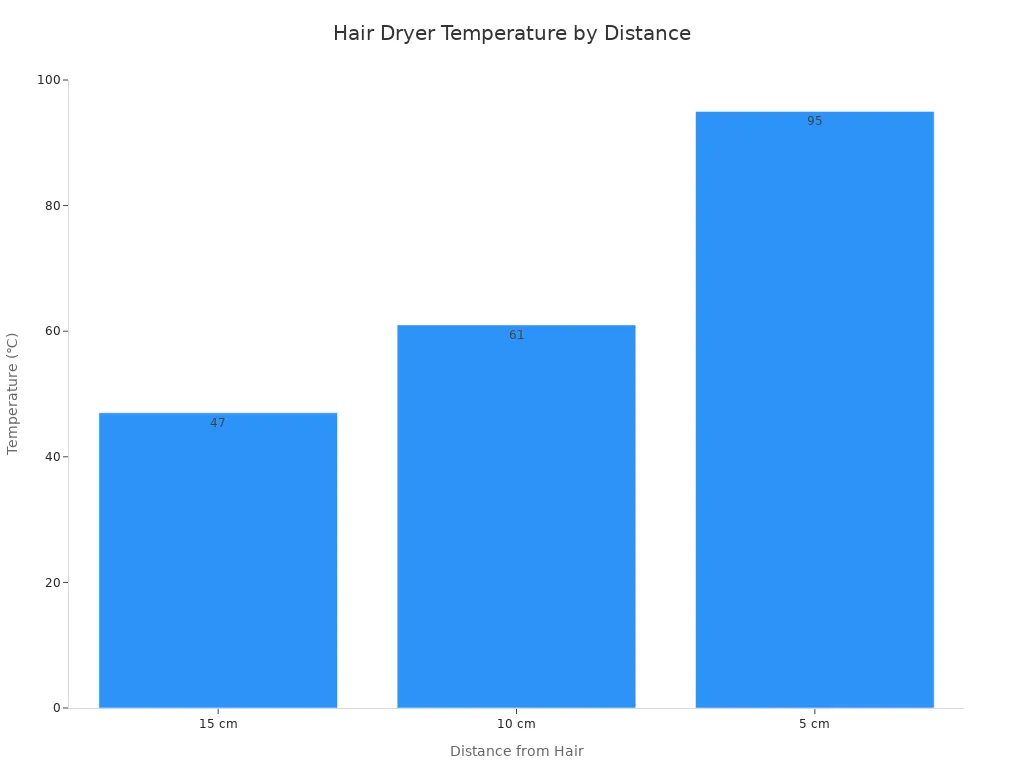
A study on heat’s effect on the hair shaft revealed that distance dramatically impacts damage levels.
| Drying Method | Distance | Temperature | Hair Surface Damage |
|---|---|---|---|
| Hair dryer | 15 cm | 47℃ | Less damage than natural drying |
| Hair dryer | 10 cm | 61℃ | Increased damage |
| Hair dryer | 5 cm | 95℃ | Significantly increased damage |
Interestingly, the study concluded that using a dryer at a distance of 15 cm with continuous motion causes less damage than letting hair dry naturally. The ideal distance is about six inches (15 cm) away from the hair.
Forgetting the Concentrator Nozzle
Many users toss the concentrator nozzle aside, viewing it as an optional accessory. This is a significant mistake. Without the nozzle, the dryer expels a wide, chaotic torrent of air that ruffles the hair cuticle, creating frizz and flyaways. The concentrator is essential for a smooth finish. It funnels the airflow into a controlled stream, allowing for the precision needed to direct heat down the hair shaft and seal the cuticle for a sleek, polished look.
Drying Soaking Wet Hair
Applying a hair dryer directly to dripping wet hair is a common but damaging mistake. Many people believe this approach saves time. In reality, it prolongs the drying process and inflicts significant harm on the hair’s structure. Hair is at its most vulnerable when saturated with water, making it highly susceptible to thermal damage.
The science behind this issue is straightforward. When hair is soaking wet, its internal keratin bonds are temporarily weakened. Applying intense, direct heat from a standard nozzle forces the water inside and outside the hair shaft to heat up rapidly. This process can cause the water within the hair’s cortex to boil, creating tiny steam-filled bubbles. This phenomenon, known as “flash drying,” permanently damages the hair’s internal structure, leading to extreme brittleness.
The primary goal before using a hair dryer is to remove excess moisture gently. Starting with hair that is 70-80% dry minimizes its exposure to direct heat, protecting its health and integrity.
Attempting to style soaking wet hair leads to several negative consequences:
- Increased Frizz: The forceful, hot air disrupts the hair cuticle on a water-logged strand, causing it to fray and resulting in a frizzy, unmanageable finish.
- Longer Styling Time: A hair dryer must work much harder and longer to evaporate a large volume of water. This extended heat exposure is not only inefficient but also compounds the potential for damage.
- Breakage and Weakness: The combination of heat and the hair’s fragile, wet state makes it more likely to snap and break during the styling process with a brush.
The correct procedure involves pre-drying the hair. After washing, individuals should gently squeeze out excess water with their hands. Then, they should use a microfiber towel or a soft cotton t-shirt to blot and absorb more moisture. Aggressively rubbing the hair with a rough towel should be avoided, as the friction can cause cuticle damage. Only when the hair is damp, not dripping, should the hair dryer be used for styling. This simple change in routine dramatically improves hair health and the final look of a blowout.
Mastering the Blow Dryer Diffuser Technique
Using a diffuser effectively is a skill that transforms frizzy, undefined hair into perfectly formed curls and waves. Success depends on a combination of proper hair preparation and specific drying techniques. Following a structured method ensures a beautiful, healthy, and consistent result.
Prepping Your Curls for Success
The diffusing process begins long before the dryer is turned on. These initial steps create the foundation for a frizz-free, defined style.
Applying Curl Cream or Mousse
After washing, individuals should apply a styling product like a curl cream or mousse to damp hair. These products provide essential moisture, hold, and frizz control. An even distribution from roots to ends helps curl clumps form and stay intact throughout the drying process.
The “Plopping” Technique Explained
Plopping is a gentle pre-drying method that significantly enhances curl definition. Instead of using a rough towel, a person uses a soft cotton t-shirt or a microfiber towel to scrunch the hair. This technique offers several key advantages for textured hair.
- Enhanced Curl Definition: It helps define the natural curl pattern by encouraging curls to dry in a scrunched, compact position.
- Reduced Frizz: The smooth fabric minimizes friction against the hair cuticle, which is a primary cause of frizz and flyaways.
- Faster Drying Time: The absorbent material removes excess water efficiently, which shortens the overall time needed with the blow dryer diffuser.
- Increased Volume: Plopping lifts the roots away from the scalp as the hair begins to dry, creating natural lift and fullness.
Step-by-Step Guide to Diffusing
With the hair properly prepped, the drying phase can begin. The right settings and methods are crucial for achieving the desired outcome without causing damage.
Choosing the Right Temperature and Speed
The cardinal rule of diffusing is to use low-to-medium heat and speed settings. High heat can create frizz and damage delicate curls, while high speed can blow curl patterns apart. A gentle airflow is essential for a controlled, healthy finish.
The “Pixie” Diffusing Method
This popular technique involves placing a section of hair into the diffuser bowl. The user then brings the diffuser up to the scalp, holding it there for 30-60 seconds before turning the dryer off and moving to a new section. This method is excellent for encouraging tight curl clumps and building volume from the ends upward.
The “Hover” Diffusing Method
The hover method provides a gentler approach. Here, the user holds the blow dryer diffuser several inches away from the hair, moving it around the head. This technique is ideal for setting the “cast” from styling products without disturbing the curl pattern. It is also effective for drying the roots first to create lift.
Drying in Sections for Even Results
For a uniform finish, it is best to work in sections. An individual can divide their hair with clips and dry one section at a time. This systematic approach ensures that all layers of hair, including the dense underlayers, are completely dry. It prevents the common problem of having a dry outer canopy with damp hair hidden underneath.
Common Diffusing Mistakes to Avoid
Achieving perfect curls with a diffuser requires avoiding common pitfalls that can lead to frizz and damage. Mastering the technique involves understanding what not to do just as much as knowing the correct steps. These errors can easily sabotage an otherwise successful styling routine.
Using High Heat or High Speed Settings
A primary mistake many users make is selecting high heat or high speed settings. The core purpose of a diffuser is to provide gentle, dispersed airflow. Using high settings directly contradicts this principle. Intense heat can scorch delicate curl patterns, while a powerful blast of air will blow curl clumps apart, creating frizz and flyaways. This approach negates the benefits of the diffuser and mimics the harsh effects of a standard nozzle.
The golden rule for diffusing is “low and slow.” Individuals should always opt for low-to-medium heat and speed to protect the hair’s integrity and allow curls to form naturally without disruption.
Touching Your Hair Too Much While Drying
Patience is a virtue when diffusing. Many people have a habit of running their fingers through their hair or constantly moving the diffuser around. This is a critical error. Aggressively touching the hair and moving the diffuser too quickly creates friction. This friction disturbs the delicate curl clumps as they are setting, which directly leads to frizz and can even cause damage. The natural oils and moisture on one’s hands can also weigh curls down and disrupt the styling product’s hold. For the best results, users should adopt a hands-off approach, allowing the diffuser to do the work with minimal physical contact.
Over-Drying Your Curls
Another frequent mistake is drying the hair until it is 100% bone-dry. While it seems logical, over-drying strips curls of essential moisture, leaving them brittle, crunchy, and prone to frizz. Curls thrive on hydration. Removing every last drop of water can compromise their health and definition. The goal is to dry the hair until it is about 80-90% dry. At this stage, the styling products have formed a protective “cast” around the curls.
Leaving this small amount of moisture allows the curls to finish air-drying naturally. This process helps them retain their softness and bounce. Once the hair is completely dry, a person can gently scrunch out the cast to reveal soft, defined, and healthy-looking curls. This final step breaks the stiff hold of the product without sacrificing the curl’s shape.
Not Using Enough Product
A frequent and critical error in the diffusing process is being too conservative with styling products. Many individuals fear that using a generous amount of curl cream, gel, or mousse will weigh their hair down, leaving it greasy or crunchy. This apprehension often leads to under-application. In reality, curly hair requires a substantial amount of product to create a successful, long-lasting style. Styling products are the essential foundation for a frizz-free and defined finish.
For textured hair, styling products are not an optional enhancement. They are a foundational necessity that provides moisture, structure, and protection against the environment.
These products perform several non-negotiable functions. They infuse the hair with hydration, which is vital for curl health and elasticity. More importantly, they form a protective layer, or “cast,” around each curl clump. This cast is what shields the hair from humidity, prevents frizz from forming during the drying process, and locks the curl pattern in place. Without a sufficient product barrier, the gentle airflow from a diffuser can still disrupt the hair cuticle and lead to a halo of frizz.
The consequences of skimping on product become apparent almost immediately.
- Lack of Definition: Curls fail to form into defined, cohesive clumps and instead dry into a soft, indistinct mass.
- Uncontrolled Frizz: Without a protective cast, flyaways and frizz develop as the hair dries, undermining the entire styling effort.
- Poor Hold: The finished style will have little to no longevity and may fall flat or lose its shape within hours.
The correct technique involves applying product to soaking wet hair. This ensures even distribution and helps the product coat every strand. A person should use a generous amount, often more than they think is necessary. The hair should feel slippery and fully saturated. An effective method is to emulsify the product in the hands and then use the “praying hands” technique, smoothing it down the length of the hair sections. This approach coats the hair shaft without disturbing the natural curl pattern. Only with adequate product can a diffuser work its magic to produce bouncy, defined, and resilient curls.
How to Choose: Do You Need a Hair Dryer Diffuser?
Deciding between a standard nozzle and a diffuser comes down to two key factors: hair type and styling goals. While most modern hair dryers come with multiple hair dryer attachments, understanding which one to use is crucial for achieving the desired look while maintaining hair health. This guide helps individuals determine if a hair dryer diffuser is a necessary addition to their styling toolkit.
Assess Your Hair Type
The natural texture of one’s hair is the most important factor in choosing the right tool. Different hair types have unique needs that specific attachments are designed to meet.
For Type 2 (Wavy) Hair
Individuals with wavy hair often find themselves in a middle ground. Their hair is not straight, but it also lacks the tight curl of other types. A standard nozzle can easily blow these delicate waves straight, resulting in a frizzy, undefined finish. A blow dryer diffuser is an excellent tool for this hair type. It gently encourages the wave pattern, reduces frizz, and adds volume.
The specific characteristics of Type 2 hair influence how it responds to different attachments.
| Hair Type | Visual Characteristics |
|---|---|
| 2a | Hair is fine and thin with a loose, S-shaped wave pattern. It’s easy to straighten but can lack volume. |
| 2b | Hair is medium-thick with a more defined S-shaped wave pattern that starts closer to the scalp. It can be a bit more resistant to styling and may experience some frizz. |
| 2c | Hair is thick and coarse with a very defined S-shaped wave pattern, sometimes with a few loose curls. It’s prone to frizz and can be difficult to style. |
For all these wavy variations, a diffuser helps coax out and set the natural texture without the disruptive force of direct air.
For Type 3 (Curly) Hair
For anyone with Type 3 hair, characterized by well-defined, springy curls, a diffuser is an essential tool. The structure of curly hair prevents natural scalp oils from traveling down the hair shaft, making it prone to dryness and frizz. A standard nozzle’s powerful airflow can blast these curls apart, creating a halo of frizz and disrupting the curl pattern. A blow dryer diffuser preserves the curl clumps, allowing them to dry in their natural shape for a defined, bouncy finish.
For Type 4 (Coily) Hair
Type 4 hair has the tightest coil pattern and is the most fragile of all hair types. It is extremely prone to dryness, shrinkage, and breakage. For this reason, using a standard nozzle is generally not recommended. Hair dryers with diffusers are a necessity for coily hair. The gentle, dispersed heat helps dry the hair without causing damage or significant shrinkage.
Key differences highlight the need for specialized care and attachments:
- Moisture Needs: Type 4 coils require richer conditioners and more intensive moisture routines than Type 3 curls because the tight pattern makes it difficult for products to coat the hair shaft.
- Fragility: The delicate nature of Type 4 hair necessitates minimal manipulation. A diffuser allows for hands-off drying that protects the fragile strands from breakage.
For Type 1 (Straight) Hair
Individuals with naturally straight hair typically do not need a diffuser for their primary styling goal of a smooth finish. The standard concentrator nozzle is the ideal tool for them. It provides the directed airflow needed for a sleek, polished blowout. However, a diffuser can still be a useful accessory for adding root volume or creating a soft, tousled texture without adding curls.
Define Your Styling Goals
Beyond hair type, a person’s desired outcome dictates the best tool for the job. The two primary attachments—the diffuser and the concentrator nozzle—are engineered for opposite results.
| Styling Goal | Diffuser | Standard Nozzle (Concentrator) |
|---|---|---|
| Primary Function | Enhances natural texture, defines curls/waves | Achieves sleek/polished styles, straightens |
| Airflow | Disperses air evenly for gentle drying | Narrows airflow for targeted styling |
| Desired Outcome | Defined curls, reduced frizz, added volume | Sleek finish, straightened strands, enhanced shine |
Goal: Embrace Natural Texture
If the goal is to enhance and celebrate natural curls, waves, or coils, a diffuser is the only choice. Its primary purpose is to dry hair while preserving its inherent texture. It promotes curl definition and minimizes frizz, allowing the hair’s natural beauty to shine through.
Goal: Achieve a Fast, Smooth Finish
For those aiming for a sleek, straight, and polished look, the standard concentrator nozzle is the correct tool. It channels air into a focused stream, which, when paired with a round brush, creates the tension needed to smooth the hair cuticle. This process results in a shiny, frizz-free finish.
Goal: Maximize Volume and Lift
Both attachments can create volume, but they do so differently. A diffuser builds soft, all-over volume by lifting hair at the root and drying it without weight. A concentrator nozzle is used to create targeted lift directly at the scalp for a more structured, voluminous blowout.
The Hybrid Approach: Using Both Tools
Advanced users can achieve highly customized styles by using both attachments during a single drying session. This hybrid approach offers the best of both worlds, combining the speed and precision of a nozzle with the gentle, texture-enhancing properties of a diffuser.
Drying Roots with a Nozzle, Ends with a Diffuser
For individuals with very thick or dense curly hair, drying time can be a significant challenge. One effective hybrid technique involves using the concentrator nozzle on a low setting to partially dry the roots first. This speeds up the overall process. Once the roots are about 50% dry, the user can switch to the diffuser attachment to gently dry the mid-lengths and ends, preserving the curl pattern and preventing frizz.
When to Switch Between Attachments
Knowing when to swap attachments allows for ultimate styling flexibility. A person might use different attachments for different sections of their hair.
- For Bangs or Face-Framing Pieces: Use the concentrator nozzle to smooth and style bangs or front sections, then switch to the diffuser for the rest of the hair.
- For Mixed Textures: Some people have curlier hair underneath and wavier hair on top. They can use a diffuser on the curlier sections and a nozzle to smooth the top layer for a polished look.
- For Root Lift and Defined Ends: Start with the nozzle aimed at the roots for a quick lift, then finish with the diffuser to define the curls on the ends.
This versatile use of attachments transforms the hair dryer into a multi-functional styling device, capable of creating a wide range of looks.
The choice between a standard nozzle and a diffuser ultimately depends on an individual’s hair type and styling goals. Standard hair dryers with a concentrator nozzle provide the speed and precision needed for sleek, straight looks. In contrast, hair dryers with diffusers are essential for enhancing natural curls, boosting volume, and minimizing heat damage.
Understanding how to use each tool correctly empowers a person to achieve healthy, beautiful hair every day.
FAQ
Can a person use a diffuser on straight hair?
Yes, a person with straight hair can use a diffuser. It is an excellent tool for adding gentle, all-over volume and creating soft, tousled waves. It provides lift at the roots without the intense, direct heat of a standard nozzle, making it great for fine hair.
Is a diffuser really necessary for curly hair?
A diffuser is essential for individuals wanting to enhance their natural curl pattern. It dries curls gently without blowing them apart, which prevents frizz and promotes definition. While air-drying is an option, a diffuser significantly speeds up the process and provides more control over the final style.
What is the purpose of the cool shot button?
The cool shot button provides a blast of cool air to set a finished hairstyle. After styling a section with heat, the cool air rapidly lowers the hair’s temperature. This action locks the hair cuticle in place, enhancing shine and ensuring the style lasts longer.
Does a diffuser take longer to dry hair?
Yes, diffusing generally takes longer than using a standard concentrator nozzle. A diffuser uses a slower, more dispersed airflow to protect the hair’s texture. The trade-off for this gentle approach is a longer drying time compared to the high-velocity airflow of a standard nozzle.
Is a heat protectant necessary with a diffuser?
Absolutely. A person should always apply a heat protectant before using any heat styling tool, including a diffuser.
Even though a diffuser uses gentler, indirect heat, the product creates a crucial barrier that shields hair from potential thermal damage and helps retain moisture.
Can a person buy a diffuser attachment separately?
Yes, many manufacturers sell universal diffusers designed to fit a wide range of hair dryer models. Before purchasing, individuals should check the compatibility of the attachment with their specific hair dryer to ensure a secure fit. This is a cost-effective way to upgrade an existing tool.
Why do diffusers have prongs or “fingers”?
The prongs on a diffuser serve a specific purpose. They help lift hair at the root while drying, which creates significant volume and fullness. These “fingers” also assist in separating curl clumps for better definition and ensure that air circulates evenly throughout the hair.