
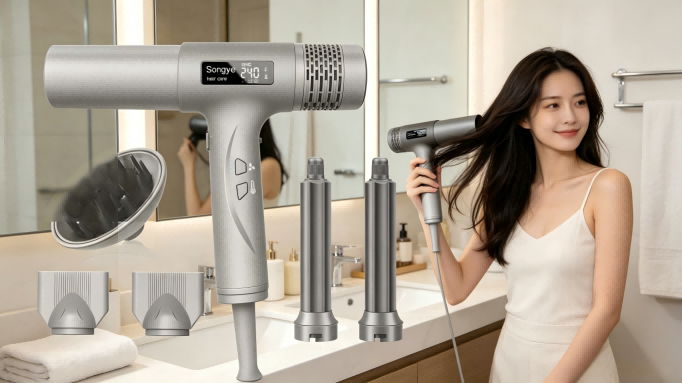
LCD screen high-speed hair dryers have become a distinct product category. For brand owners, distributors, and salon buyers, the appeal is straightforward: a brushless motor for faster drying, a display that makes settings visible and repeatable, and a richer attachment set that upgrades the device from “dryer-only” to a styling kit. The challenge is that many market listings emphasize “high speed” and “smart display” without offering procurement-grade proof—especially around heat stability, compliance scope, and what attachments actually deliver.
Define the buying goal and audience
A strong LCD high-speed dryer specification depends on who uses it and where it sells. A DTC brand typically prioritizes a premium on-camera interface, intuitive controls that reduce returns, and a complete attachment bundle for upsell. A salon channel prioritizes durability, heat stability during long shifts, and serviceability. A distributor prioritizes documentation accuracy and compliance scope to reduce clearance delays and in-market risks.
Before comparing suppliers, buyers should decide the primary objective:
- Faster drying time (airflow-first)
- Temperature control for predictable styling outcomes (temperature precision, heat stability)
- A richer attachment kit to position the SKU as a multi-styler
- Compliance-ready launch speed in multiple regions
When this is not clarified upfront, buyers often see avoidable churn: customers complain airflow is “too strong,” salons find settings insufficiently controlled for fine hair, or importers encounter mismatched certificates late in the process.
LCD screen value: usability, training, and returns
A display is not merely a premium-looking surface. It becomes valuable when it reduces confusion and makes settings repeatable. Instead of relying on ambiguous LED patterns, users can see temperature, airflow level, and statuses such as ionic mode or cool shot. This matters in multi-user environments (salons, hospitality, households), where mis-setting heat is a common driver of dissatisfaction.
The second advantage is brand control. A display can support private label positioning when the interface can show a custom boot logo or brand mark, provided it does not slow operation or hide settings. For global brands, that can improve perceived value and brand recall, especially on social commerce platforms where the UI is constantly visible.
Practical LCD checks for procurement:
- A short demo video showing every heat/speed mode and what the screen displays
- Confirmation of what the “temperature” number represents: setpoint, estimated output, or sensor reading
- Readability notes and cleaning guidance for the display surface
- A written statement on logo customization scope (boot logo only vs. UI elements) and firmware change control
Chart: What buyers typically expect an LCD to communicate (qualitative)
| Feature | Buyer value | Priority level |
|---|---|---|
| Temperature visibility (levels or target °C/°F) | reduces accidental overheating and improves repeatability | High |
| Airflow level visibility (speed 1–3 or equivalent) | improves control for different hair types and styles | High |
| Status indicators (ionic, cool shot, lock, fault) | improves usability and reduces confusion | Medium–High |
| Logo/brand display (boot screen) | supports premium positioning and brand recall | Medium |
This chart is a decision aid. Actual UI requirements should match the market and positioning strategy.
Motor and airflow: what “high speed” should mean
Most LCD high-speed dryers use a BLDC motor and advertise very high RPM. RPM can indicate potential, but it is not a complete performance metric. Procurement should focus on delivered airflow and how it behaves in realistic conditions: with attachments installed, across multiple modes, and after partial filter loading.
What sellers say vs. what buyers should request:
| Claim commonly seen | What to request | Why it matters |
|---|---|---|
| “120,000 RPM” | airflow (m³/h or CFM) + airspeed (m/s), with nozzle and without | RPM alone does not equal usable drying performance |
| “Fast drying” | test method description (hair tress test or practical setup), conditions, and baseline | protects against exaggerated claims and supports credible content |
| “Low noise” | dB(A) at 1m with test conditions | noise perception affects ratings and returns |
LSI keywords buyers should expect in serious specifications: brushless motor, high-velocity airflow, air speed, airflow rate, filter design, noise level, ergonomic weight.
Heat control and constant temperature: what to verify
Fast drying is not the same as maximum heat. In modern dryers, higher airflow can reduce the time hair is exposed to heat. That is why professional buyers evaluate heat stability and controllability, not just wattage.
When a supplier cites PTC constant temperature technology, it should be backed by documentation: sensor type and placement, sampling behavior, temperature tolerance, and safety cutoffs. For EEAT-aligned marketing, it is safer to describe how controlled heat settings support consistent styling rather than promising universal “no damage” outcomes.
Recommended evidence buyers can request:
- Target temperature by mode and a tolerance range
- Time-to-stabilize after mode changes
- Overheat protection behavior and fault indication (if shown on LCD)
- Basic thermal test snapshots or internal QC records for consistency
Chart: Preferred control profile for premium high-speed dryers (conceptual)
| Profile | Practical outcome | Commercial risk |
|---|---|---|
| High airflow + stable mid-heat + multiple modes | predictable styling and better usability across hair types | Low |
| High airflow + inconsistent peak heat | uneven results and more complaints | Medium |
| Low airflow + very high heat | slower feel and harsher user experience | High |
This chart is conceptual and intended for decision-making, not as a lab claim.
Ionic function: responsible claims and evidence
“Ionic” is widely marketed as anti-frizz and smoothing. A professional, EEAT-safe approach avoids absolute promises and frames ionic as a feature that may help reduce static and improve manageability for some users, depending on technique, humidity, and hair condition.
Procurement questions that keep claims honest:
- Ion generator type and placement in airflow path
- Whether ion output is measured and under what conditions
- How ionic status is shown on LCD (and whether it can be switched off)
- Any internal test notes that connect the feature to observable outcomes
LSI keywords that fit naturally here: negative ion hair dryer, anti-static, frizz reduction, shine, smooth finish, humidity.
Attachments: why two air wrap curlers change the value story
Attachments determine whether the SKU is a dryer or a styling system. Two concentrator nozzles support directional airflow and smoothing. A diffuser supports curls and volume. Two left/right air wrap curlers can change the commercial positioning: the product becomes a dryer + styler kit, which increases perceived value and supports bundling strategies.
Key attachment checks that reduce returns:
- Magnet strength and attachment security
- Heat resistance of materials and long-run durability
- Clear left/right labeling for air wrap curlers
- Compatibility of air wrap attachments with heat modes and airflow strength
- Instruction clarity (especially for cross-border markets)
Attachment value map (practical):
| Attachment | Primary use | Buyer note |
|---|---|---|
| Magnetic concentrator nozzles (x2) | smoothing, precision blowouts | verify rotation stability and heat resistance |
| Diffuser (x1) | curls, volume, frizz control | check airflow distribution and fit security |
| Air wrap curlers (x2 left/right) | directional airflow curling | confirm labeling, diameter options, and user guidance |
Global compliance (CE/CB/ROHS/ETL/FCC): procurement checks
For global distribution, compliance is not a marketing badge—it is operational risk control. Buyers should confirm that certificates and reports match the specific model number, ratings, plug, and labeling used for the destination market. A common failure pattern is a certificate that exists but does not match the ordered configuration.
Compliance verification ladder:
| Step | What it includes | Risk level |
|---|---|---|
| 1 | certificates provided as PDFs | Medium |
| 2 | certificates match model + ratings + factory identity | Lower |
| 3 | listing verification where possible + label/manual/photos aligned to the market | Lowest |
For an EEAT-aligned buyer’s guide, a key best practice is transparency: if a certification statement is based on supplier-provided information, it should be presented as “stated by the manufacturer,” unless independently verified.
Factory capability and QC: questions that reduce risk
Manufacturer background should be used carefully and accurately. Songye Electric Appliances Co., Ltd. states it has been in the industry for over 17 years and specializes in hair dryers and other hair tools. The company profile also states that its factory in Hunan, China has three automatic production lines and a production capacity of 100,000 pieces per month, with an in-house R&D team and OEM/ODM support. It states international certifications including CE/CB/ROHS/ETL/FCC, a triple quality inspection process, a defective rate under 0.5%, a 12‑month warranty, and mass production lead times of roughly 15–25 days depending on quantity, with expedited options. These are manufacturer-provided statements and should be used as such in sourcing documentation and public claims.
Procurement topics and evidence to request:
| Topic | Evidence to request | Why it matters |
|---|---|---|
| LCD customization | boot logo scope, UI mockups, firmware change control | prevents launch delays and misaligned expectations |
| Quality control | incoming/in-process/final checklists; defect definitions | supports reliability claims and reduces returns |
| Lead time stability | capacity plan, key component availability, expedited SOP | protects sales calendars and distributor commitments |
| After-sales readiness | spare parts policy, warranty handling flow, failure analysis | improves long-term ratings and support efficiency |
RFQ-ready checklist
This checklist keeps procurement, compliance, and marketing aligned and reduces the risk of over-claiming in SEO content.
- Performance metrics: airflow and airspeed by mode; noise level with test conditions
- Heat behavior: target temperatures by mode, tolerance, time-to-stabilize, safety cutoff behavior
- LCD behavior: what temperature display represents; visibility; mode/status logic; lock/fault indicators
- Customization: boot logo feasibility; UI language options; packaging and manual localization
- Attachments: two magnetic nozzles, diffuser, and left/right air wrap curlers; material and durability confirmation
- Compliance packet: CE/CB/ROHS/ETL/FCC documentation matching the exact SKU and ratings
- Reliability and warranty: motor life statement with test conditions; warranty terms; spare parts availability
- Production plan: MOQ, sample lead time, mass production lead time, QC checkpoints
Required internal links (anchor text placed naturally)
Buyers comparing multiple brushless configurations can review the BLDC catalog: BLDC hair dryer (https://songyehairtools.com/product-category/bldc-hair-dryer/)
For the screen-based SKU reference, see LCD Display High Speed Hair Dryer (https://songyehairtools.com/product/lcd-screen-high-speed-hair-dryerpre-order/)
For brand contact and sourcing entry, the central hub is the hair dryer manufacturer website (https://songyehairtools.com/)
For capacity, certifications, and OEM/ODM background, the hair dryer factory profile provides the stated overview (https://songyehairtools.com/company-profile/)
FAQ
- What makes an LCD display genuinely useful on a hair dryer?
A useful LCD clearly communicates heat and airflow settings and key statuses (ionic, cool shot, lock/fault). It should match the device’s real control logic and remain readable during everyday use. If a custom boot logo is supported, it can strengthen brand differentiation when implemented without slowing operation or obscuring settings. - Is RPM enough to compare “high-speed” dryers?
No. RPM is a partial indicator. Professional comparisons require delivered airflow and airspeed by mode, measured under consistent conditions with the same attachments. This approach supports credible claims and reduces marketing-driven mis-specification. - Why do left/right air wrap curlers matter in a product bundle?
They shift the SKU from “dryer-only” to a styling system, improving perceived value and supporting bundling. Clear labeling and instructions are essential to prevent confusion and returns across global markets. - What documentation should be requested to validate CE/CB/ROHS/ETL/FCC claims?
Certificates and reports should match the exact model number, electrical ratings, factory identity, and labeling for the destination market. Buyers should also request label artwork, manuals, and (where possible) listing verification to reduce compliance disputes.
References & outbound sources
Manufacturer information used in this article (years in industry, capacity, certifications, QC process, warranty and lead time statements) is taken from Songye’s company profile page:
Additional SERP-style context sources (selected for relevance; many domains in the provided list are unrelated to hair dryers):
- New York Times Wirecutter (consumer buying criteria context): https://www.nytimes.com/wirecutter/
- Wikipedia (general background on ions terminology; used to avoid overstating “ionic” outcomes): https://en.wikipedia.org/wiki/Ion
- YouTube (demonstration context; useful for verifying attachment behavior via supplier demos): https://www.youtube.com/