
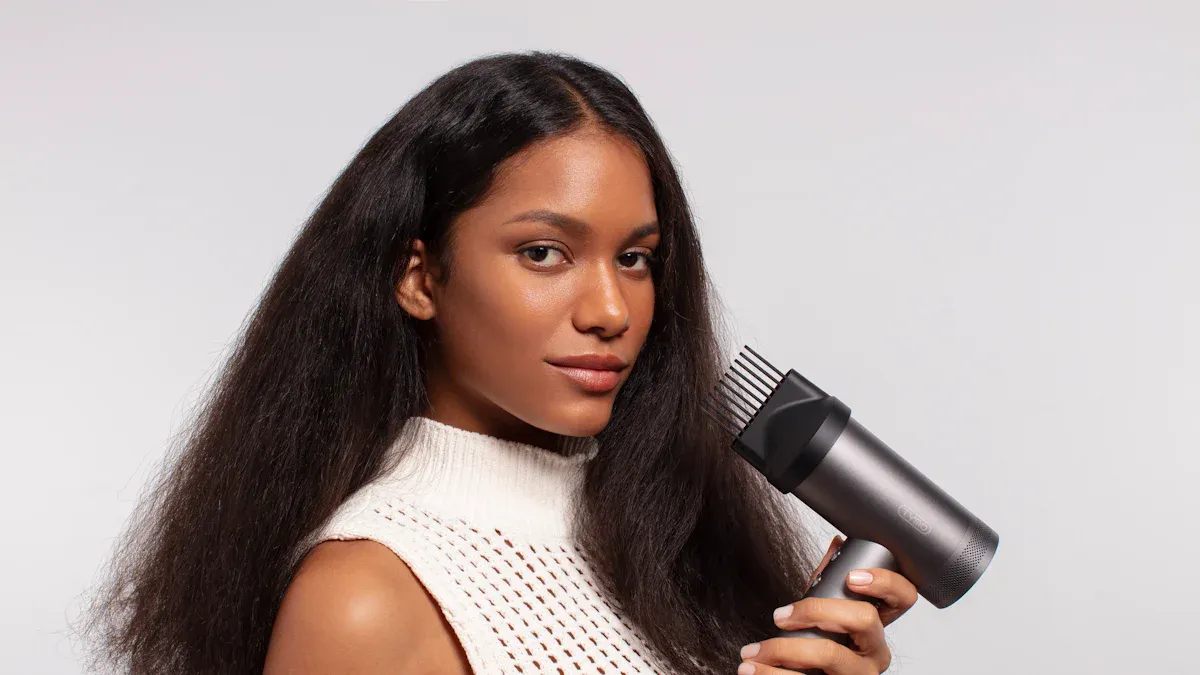
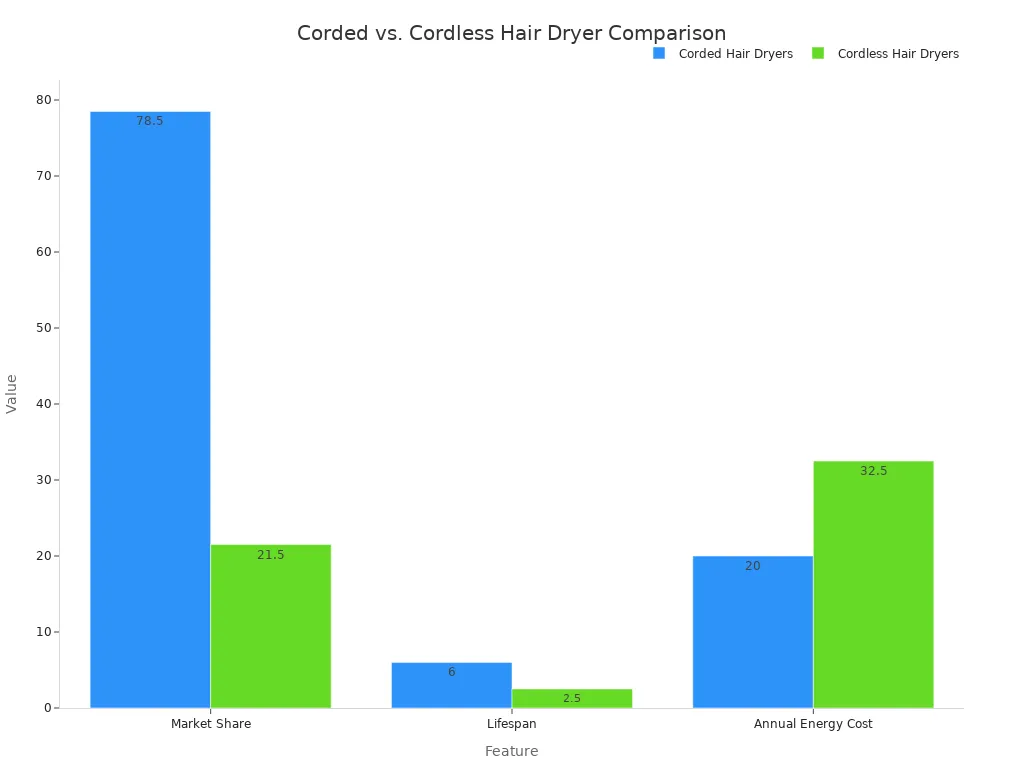
Los secadores de pelo con cable representan el estándar de la industria, manteniendo una participación de mercado dominante del 82,56 %. Un potente secador con cable Secador de pelo AC proporciona calor constante, lo que convierte a los modelos con cable en la opción principal para el peinado diario. En contraste, los secadores de pelo inalámbricos ofrecen una portabilidad y conveniencia superiores. Cualquier de secadores de pelo profesional entiende esta compensación. La conveniencia inalámbrica significa que el secador de pelo a batería tiene límites de rendimiento. Si bien un de secadores de pelo fabricante puede producir un secador inalámbrico eficiente Secador de pelo BLDC, la elección se reduce a la potencia con cable frente a la portabilidad inalámbrica. La decisión prioriza ya sea la fiabilidad de los secadores con cable o la libertad de un dispositivo inalámbrico.
La División Fundamental: Fuente de Alimentación y Rendimiento
La diferencia central entre un secador de pelo con cable y uno inalámbrico radica en su fuente de alimentación. Este único factor determina todo, desde la velocidad de secado y la intensidad del calor hasta la fiabilidad general y la conveniencia para el usuario. Uno proporciona potencia bruta e ininterrumpida, mientras que el otro ofrece libertad a costa del rendimiento.
Secadores de Pelo con Cable: El Estándar de Potencia
Potencia Ilimitada desde el Enchufe
Un secador de pelo con cable obtiene su energía directamente de un enchufe de pared. Esta conexión directa proporciona energía ilimitada, permitiendo que el dispositivo funcione indefinidamente sin ninguna caída en el rendimiento. Los usuarios nunca necesitan preocuparse por una batería agotándose a mitad del peinado.
Explicación del Alto Vatiaje
El vatiaje mide la potencia de un secador de pelo. Los secadores de pelo con cable tradicionales operan en un rango de alto vatiaje, típicamente de 1600 a 2200 vatios. Esta potencia sustancial se traduce en un flujo de aire fuerte y un calor alto y estable, esenciales para descomponer las moléculas de agua en la hebra capilar para un secado más rápido.
| Característica | Secador de Pelo con Cable | Secador de Pelo Inalámbrico |
|---|---|---|
| Potencia de salida | 1600–2200W (constante) | 800–1500W (varía con la batería) |
Calor y Flujo de Aire Constantes
La corriente eléctrica constante de un enchufe garantiza que un modelo con cable proporcione calor y flujo de aire consistentes desde el momento en que se enciende hasta que se apaga. Esta previsibilidad es crucial para lograr resultados suaves y de aspecto profesional sin caídas inesperadas de temperatura.
Fiabilidad para el Uso Diario
Para las rutinas de peinado diario, la fiabilidad es primordial. El rendimiento robusto y el tiempo de funcionamiento infinito de los secadores con cable los convierten en los caballos de batalla indiscutibles del cuidado capilar. Un secador de pelo tradicional está construido para un uso constante y potente día tras día.
El Secador de Pelo Inalámbrico: El Contendiente de la Conveniencia
Los Límites de la Energía de la Batería
Un secador de pelo inalámbrico a batería depende completamente de una batería recargable. Esta tecnología, aunque liberadora, impone limitaciones significativas de rendimiento. Un secador de pelo a batería simplemente no puede igualar el alto vatiaje sostenido de su contraparte con cable, ofreciendo generalmente una potencia máxima de entre 800 y 1500 vatios.
Entendiendo los Vatios-Hora (Wh)
La capacidad de un secador de pelo a batería se mide en Vatios-hora (Wh). Considérelo como el tamaño de su “tanque de combustible”. Una clasificación de Wh más alta generalmente significa un mayor tiempo de funcionamiento, pero también suele resultar en una batería más pesada y costosa.
Rendimiento Variable a Medida que se Agota la Batería
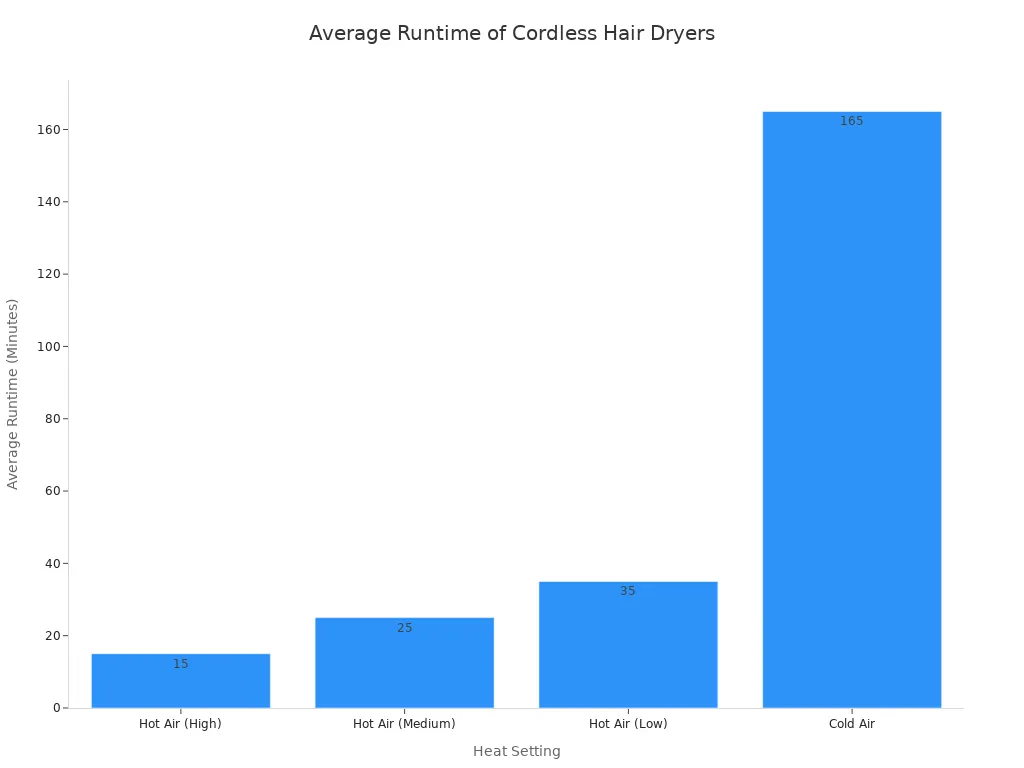
A diferencia de un modelo con cable, el rendimiento de un secador inalámbrico no es constante. A medida que la batería se agota, tanto el calor como el flujo de aire disminuyen. Una batería llena proporciona la salida más fuerte, pero este nivel de potencia disminuirá constantemente durante el ciclo de uso. La mayoría de los modelos inalámbricos ofrecen un tiempo de funcionamiento de 20 a 45 minutos, con el rendimiento variando según la configuración.
La Realidad de las Afirmaciones de “Secado Rápido”
Los fabricantes a menudo promueven la conveniencia de un dispositivo inalámbrico, pero el tiempo de funcionamiento limitado presenta un desafío práctico para muchos usuarios.
Nota: La Compensación del Tiempo de Funcionamiento 📝.
- El tiempo de funcionamiento típico de 10-40 minutos en configuraciones con calor a menudo es insuficiente para secar y peinar completamente el cabello largo o grueso.
- Usar la configuración de calor más alta agotará la batería más rápido, proporcionando la ventana de uso más corta.
- La configuración de “chorro frío” o aire frío ofrece un tiempo de funcionamiento mucho más largo, pero no proporciona poder de secado.
Esto hace que la experiencia tradicional con cable sea superior para sesiones de peinado completas.
Comparación Directa: Secadores de Pelo Inalámbricos vs. Modelos con Cable
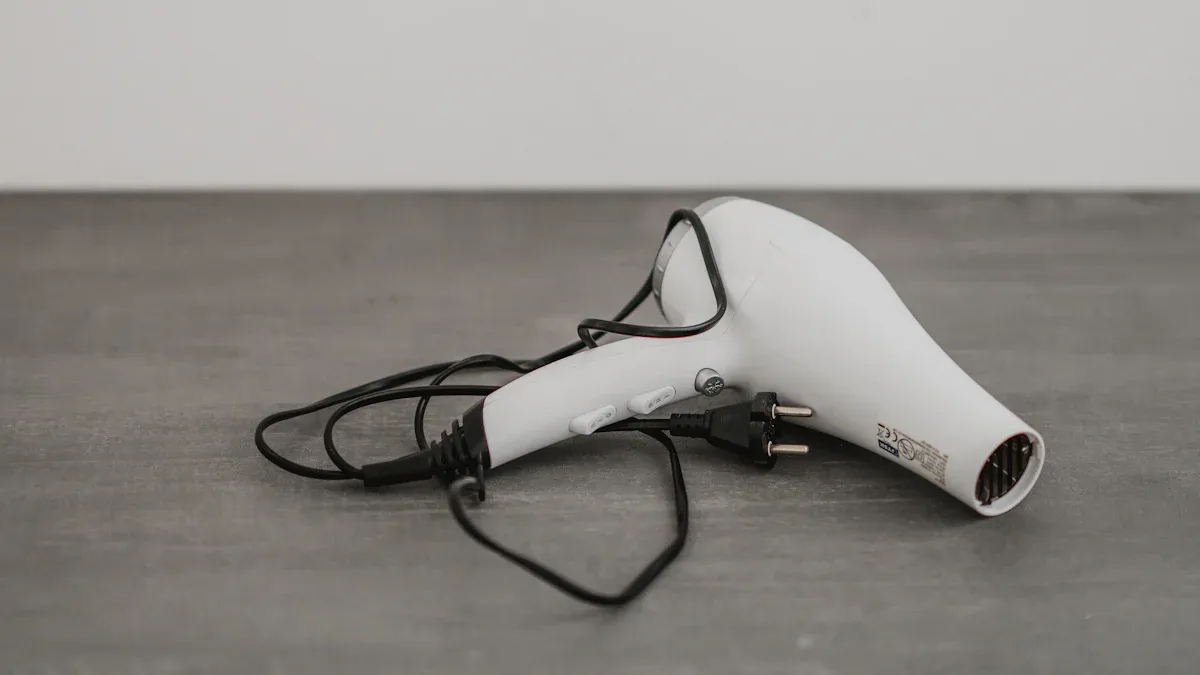
Al elegir un secador de pelo, secador de pelo, una comparación directa revela claras ventajas y desventajas para cada tipo. La decisión a menudo se reduce a la necesidad principal del usuario: rendimiento bruto de secado o portabilidad máxima. Esta sección desglosa cómo se comparan los modelos con cable e inalámbricos en áreas clave.
Potencia y Velocidad de Secado
La diferencia más significativa entre estas herramientas es su capacidad para secar el cabello de manera rápida y efectiva. Este factor está directamente ligado a su fuente de alimentación e ingeniería.
Con Cable: Tiempos de Secado Más Rápidos
Los secadores de pelo con cable ofrecen un rendimiento de secado superior debido a su alto y constante vatiaje. Esta potencia genera un fuerte flujo de aire y alto calor, que trabajan juntos para evaporar el agua del cabello de manera eficiente. Algunos modelos con cable de alta velocidad producen tasas de flujo de aire superiores a 110 km/h, un punto de referencia para un secado efectivo.
Con Cable: Ideal para Cabello Grueso y Largo
Los usuarios con cabello grueso, largo o áspero encontrarán que un modelo con cable ahorra un tiempo significativo. La potencia sostenida puede manejar el cabello denso sin una caída en el rendimiento, asegurando un secado uniforme y completo. Los siguientes datos ilustran la diferencia de tiempo en cabello grueso de longitud media.
| Tipo de Secador | Potencia | Tiempo de Secado (Cabeza Completa) |
|---|---|---|
| Tradicional (Revlon One-Step Volumizer) | 1875W | 10 minutos |
| Cordless (T3 Aero Lite Cordless) | 1200W | 14 minutes |
Cordless: Slower, Lower-Temperature Drying
A cordless dryer’s battery limits its heat and power output. This results in a gentler, lower-temperature airflow and generally longer drying times. While some premium cordless models boast impressive airflow speeds comparable to corded versions, their heat output remains lower to conserve battery life.
Cordless: Best for Short or Fine Hair
The lower heat and airflow of a cordless device can be sufficient for users with short, fine, or thin hair. These hair types require less time and power to dry, making the trade-off for convenience more acceptable. A quick touch-up is where these models excel.
Configuraciones de Calor y Velocidad
Control over heat and airflow is crucial for styling and protecting hair health. Corded and cordless models offer vastly different levels of precision.
Corded: Multiple, Distinct Settings
Traditional corded hair dryers typically feature multiple, separate settings for heat (low, medium, high) and speed (low, high). This separation gives users precise control to tailor the drying experience to their hair type and styling goals, from rough drying to smooth finishing.
Corded: The Essential Cool Shot Button
A key feature on nearly all corded models is the cool shot button. This function provides a blast of cool air to set a finished style.
Why the Cool Shot Matters ❄️
- It locks a style in place for longer-lasting results.
- It seals the hair cuticle, which boosts shine and reduces frizz.
- It helps protect hair from damage by cooling it down after heat exposure.
Cordless: Limited, Often Combined Settings
To maximize battery life, cordless hair dryers usually offer limited settings. Many models combine heat and speed into single modes like “low” and “high,” removing the ability to have high speed with low heat, for example. This simplifies operation but reduces styling versatility.
Cordless: The “Cool” Setting Reality
Most cordless models feature a “cool” or “cold air” mode, but it functions differently from a traditional cool shot. Instead of providing a temporary blast of chilled air, it simply runs the fan without activating the heating element. While this setting offers a very long runtime, it lacks the intensity to rapidly cool hair and set a style effectively.
Portability and Convenience
Here, the roles are reversed. The very feature that limits a cordless dryer’s power is also its greatest strength.
Cordless: Ultimate Freedom of Movement
The primary advantage of a cordless hair dryer is its unmatched portability. Users can dry their hair anywhere, free from the restriction of a power outlet. This freedom is ideal for small bathrooms with poorly placed outlets, styling in front of a better mirror, or even drying hair on a balcony.
Cordless: The Travel and Gym Companion
For those on the move, the convenience of a cordless tool is undeniable. It is a perfect companion for travel, fitting easily into a suitcase for use in hotels, airports, or campsites. Gym-goers can quickly dry their hair in the locker room without searching for a free plug, making it an excellent post-workout tool. The portability advantages are clear.
Corded: The Restriction of the Cord
A corded dryer tethers the user to a wall outlet. The length of the cord dictates the range of motion. Standard at-home models have cords ranging from 1.5 meters (4.9 feet) to 2.5 meters (8.2 feet). While a longer cord offers more flexibility, it can never match the absolute freedom of a cordless device.
Corded: At-Home Convenience King
Despite the cord, traditional corded hair dryers offer a different kind of convenience: reliability. For daily home use, a user can simply plug it in and know it will work at full power for as long as needed. There are no charging times to manage or worries about a battery dying mid-style, making it the undisputed king of at-home dependability.
Autonomía y carga
A hair dryer’s usability is defined by how long it can operate. The power source creates a fundamental difference in runtime and the user’s relationship with the device, separating the endless power of corded models from the finite energy of cordless ones.
Corded: Infinite Runtime
A corded hair dryer offers the ultimate peace of mind with its unlimited runtime. A user simply plugs the device into a wall outlet for an uninterrupted power supply. This feature makes a corded model exceptionally reliable for any task, no matter how long it takes. The concept of a battery dying does not exist. This unlimited runtime is a non-negotiable feature for professional stylists and users with very long or thick hair. The corded dryer guarantees consistent performance from start to finish, every time.
Cordless: The 15-30 Minute Window
The cordless hair dryer operates within a strict time limit. Most models provide a runtime of 15 to 30 minutes when using a heated setting. This window shrinks even further on the highest heat, often lasting only 10-15 minutes. This limited battery life can be a major drawback. A user with long or thick hair may find this is not enough time to fully dry and style their hair in one session. The device is better suited for quick touch-ups or users with short hair.
Cordless: Charging Times vs. Usage Times
The convenience of a cordless tool comes with a significant trade-off: the relationship between charging time and usage time. The battery requires a substantial amount of time to replenish its power, which often far exceeds the brief period of use it provides.
The Imbalance of Power 🔋
- Usage Time: 15-30 minutes on a heated setting.
- Charging Time: 2-4 hours for a full charge.
This means a user must plan ahead, as the device will be unusable for hours after a short styling session.
This disparity makes spontaneous, extended use impossible. A user must manage the battery life carefully.
Cordless: Can You Use It While Charging?
A common question is whether a cordless dryer can function while plugged in. The answer for the vast majority of models is no. Most cordless hair dryers are designed with safety mechanisms that prevent operation during charging. This is because:
- The charging hardware is not designed to supply the high power needed to run the motor and heater simultaneously.
- It protects the battery from overheating and potential damage.
This lack of “pass-through” functionality means that once the battery is depleted, the tool is completely out of commission until the charging cycle is complete. A corded dryer, by contrast, is always ready for use.
Under the Hood: Technology and Design Differences
The external differences between corded and cordless hair dryers are obvious. The internal technology and design choices, however, reveal the engineering compromises required for each type. These choices directly impact performance, longevity, and the overall user experience.
Motor Technology in Corded vs. Cordless Hair Dryers
The motor is the heart of any secador de pelo, creating the airflow needed for drying. The power source heavily influences the type of motor used.
Corded: AC, DC, and Brushless Motors
Traditional corded hair dryers utilize a range of powerful motors. AC (alternating current) motors are heavy and durable, favored by professionals for their strong, high-pressure airflow. DC (direct current) motors are lighter and more common in consumer models. Brushless motors represent a premium option, offering high efficiency, a longer lifespan, and quieter operation. A corded model’s direct power connection supports these high-performance components.
Cordless: Efficiency-Focused DC Motors
A battery hair dryer must prioritize energy conservation. For this reason, cordless models almost exclusively use highly efficient DC motors. These motors are engineered to provide adequate airflow while drawing minimal power from the battery. This design choice is essential for maximizing the limited battery life, but it cannot match the raw power of the motors found in traditional corded tools.
Heating Elements
The heating element converts electricity into the heat that dries hair. The materials used differ significantly, balancing heat output with energy consumption.
Corded: Ceramic, Tourmaline, and Titanium
Corded dryers leverage advanced materials to control heat and protect hair. Each material offers distinct benefits suitable for different hair types.
| Característica | Cerámica | Turmalina | Titanio |
|---|---|---|---|
| Distribución del Calor | Even and consistent | Produces more negative ions | Heats up quickly |
| Adecuación para Tipo de Cabello | Fine, thin, or damaged hair | Fine to medium, frizz-prone hair | Cabello grueso, áspero |
| Beneficios | Minimiza el daño por calor | Reduces frizz, adds shine | Fast, efficient styling |
Cordless: Energy-Efficient Heating Coils
A cordless dryer uses simpler, energy-efficient heating coils. These components are designed to warm up quickly using less power. The primary goal is to conserve battery life rather than achieve the high, sustained temperatures of a corded model. This results in a gentler heat that is less damaging but also less effective for rapid drying.
The Battery Hair Dryer: A Closer Look at the Tech
The battery is the defining component of a cordless hair dryer. It dictates runtime, weight, and long-term value.
Lithium-Ion (Li-ion) Batteries
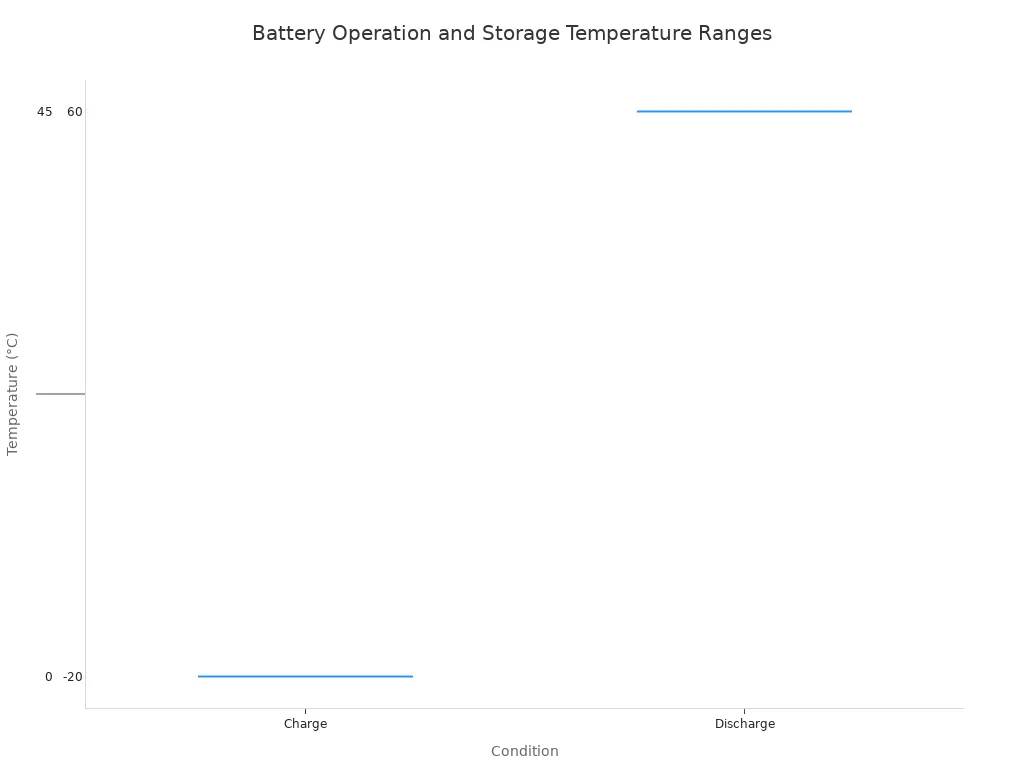
Modern cordless tools, including the rechargeable hair dryer, rely on Lithium-Ion (Li-ion) battery packs. This technology offers the best balance of energy density and weight. The specifications of the battery determine the tool’s capabilities, including its charging speed and operational temperature range.
Note: Operating Conditions Matter 🌡️ A battery’s performance is sensitive to temperature. Using or charging a battery-powered hair dryer outside its optimal temperature range can reduce efficiency and shorten its lifespan.
Battery Lifespan and Degradation
Every rechargeable battery has a limited lifespan, measured in charge cycles. A typical battery hair dryer battery is rated for around 500 cycles. With each cycle of charging and discharging, the battery’s maximum capacity degrades. Over time, a user will notice a shorter battery life, meaning the tool runs for less time on a full charge.
The Cost of Battery Replacement
When the battery no longer holds a useful charge, it must be replaced. For many cordless models, the battery is a significant portion of the total cost. Replacement can be expensive and sometimes difficult, depending on the manufacturer. This long-term expense is a factor that traditional corded dryer users never have to consider.
Weight, Ergonomics, and Design
The physical design of a hair dryer directly influences user comfort and handling. Engineers approach the ergonomics of corded and cordless models from different perspectives, leading to distinct differences in weight distribution, balance, and form factor. These design choices impact everything from wrist strain to storage convenience.
Corded: Balancing Motor and Handle
The design of a corded hair dryer focuses on creating a comfortable balance between the motor in the barrel and the handle. Manufacturers carefully distribute the weight to prevent the tool from feeling top-heavy. This ergonomic balance reduces arm and wrist fatigue during the extended styling sessions that a corded model allows. Professional-grade corded dryers, in particular, are engineered for optimal balance, enabling stylists to work for hours with minimal strain. The design prioritizes in-use comfort over portability.
Cordless: The Weight of the Battery
A cordless hair dryer’s ergonomics are defined by the placement of its heaviest component: the battery. Modern cordless hair dryers typically weigh between 0.6 and 1.4 lbs. While this is an improvement over older models, they are still generally heavier than most corded hair dryers. The battery is almost always housed in the handle, concentrating the weight in the user’s hand. This can lead to a bottom-heavy feel and may cause wrist fatigue more quickly than a well-balanced corded tool. The entire design must accommodate the size and weight of this essential power source.
Ergonomic Trade-Off ⚖️
- Corded: Balanced weight distribution for comfortable, long-term use.
- Cordless: Weight concentrated in the handle due to the battery, potentially causing faster fatigue.
Foldable vs. Rigid Designs
Hair dryers come in two primary forms: foldable and rigid. Foldable designs are common for travel-focused models, including many compact corded dryers and nearly all cordless options. This feature makes the device smaller and easier to pack. Rigid designs are standard for high-performance corded hair dryers. This fixed construction provides greater durability and allows for larger, more powerful motors and components. The choice between these designs often reflects the tool’s intended purpose, with portability favoring foldable models and performance favoring rigid ones.
Which Dryer Fits Your Lifestyle?
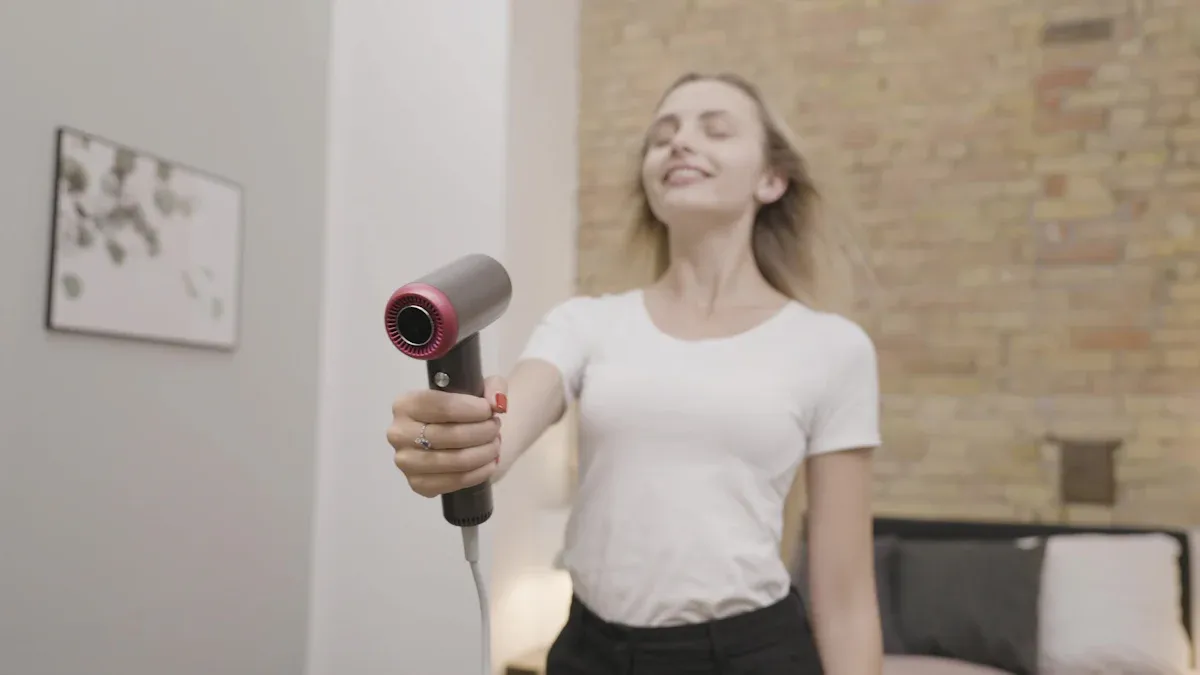
Choosing the right hair dryer depends less on which technology is “better” and more on which tool aligns with a user’s specific daily routines and needs. A person’s lifestyle—whether they are a daily home stylist, a frequent traveler, or a gym enthusiast—is the ultimate deciding factor.
The Daily Home User
For individuals who primarily style their hair at home as part of a daily routine, performance and reliability are the most important factors.
Why Corded is the Clear Winner
A corded hair dryer is the undisputed champion for daily home use. Its design offers several practical advantages that make it the most effective and dependable choice.
- Consistent Power: Corded models provide a continuous, powerful stream of air. This is essential for efficient drying and achieving professional styling results.
- No Recharging Needed: The device is always ready for use. Users never face the inconvenience of a dead battery or a limited runtime.
- Lighter Weight: Without the added bulk of a battery, corded hair dryers are often lighter. This design reduces arm and wrist fatigue during longer styling sessions.
- More Affordable: Corded dryers are generally more budget-friendly, offering superior performance at a lower initial cost.
Managing Long or Thick Hair Daily
Users with long, thick, or coarse hair require significant power and time to achieve a complete dry. A corded model’s unlimited runtime is non-negotiable for this hair type. The consistent high heat and strong airflow can tackle dense hair effectively, ensuring an even dry from root to tip without any drop in performance. A battery hair dryer simply cannot offer the sustained power needed for these demanding daily styling tasks.
The Frequent Traveler
For those constantly on the move, portability and convenience become the top priorities. The challenges of packing light and dealing with unfamiliar spaces redefine what makes a hair dryer useful.
Cordless for True On-the-Go Use
A battery hair dryer offers the ultimate freedom for travel. Its key advantage is the ability to function anywhere, completely independent of power outlets. This portability is perfect for airports, campsites, or hotels with poorly placed plugs. The cordless design provides unmatched travel convenience.
Dual-Voltage Corded Dryers as an Alternative
A compact, dual-voltage corded dryer presents a powerful alternative for international travel. These models are engineered specifically for portability and global compatibility. Key features to look for include:
- Detección Automática de Voltaje: Los modelos avanzados cambian automáticamente entre 110-125V y 220-250V, eliminando los ajustes manuales.
- Diseño Compacto y Ligero: Un mango plegable y un cuerpo ligero ahorran un valioso espacio en el equipaje.
- Tecnología Iónica: Esta característica ayuda a reducir el frizz y añadir brillo, lo cual es especialmente útil al viajar a climas húmedos.
- Múltiples Ajustes y Accesorios: Los versátiles ajustes de calor y velocidad, junto con una boquilla concentradora, ofrecen control de estilizado fuera de casa.
Secadores de Hotel vs. Llevar el Propio
Depender de un secador de pelo proporcionado por el hotel puede ser una lotería. Estas unidades suelen tener poca potencia, un mantenimiento deficiente y ser ergonómicamente incómodas. Un secador de viaje de alto rendimiento ofrece una experiencia significativamente mejor.
“La potencia en vatios se convirtió en el indicador de la fuerza porque era fácil de medir y comercializar. Pero secar el pelo consiste fundamentalmente en mover moléculas de aire a través de las superficies de queratina, no en verter electricidad en una resistencia... El diferenciador real no es cuánta energía consume, sino cómo entrega la energía de manera inteligente donde se necesita, cuándo se necesita y solo en la cantidad necesaria”. — Dra. Lena Cho, Doctora en Ingeniería Eléctrica, MIT
Las diferencias técnicas son marcadas. Un secador de viaje de calidad proporciona un flujo de aire superior y temperaturas estables, protegiendo el cabello del daño mientras reduce el tiempo de secado.
| Característica | Secador de Hotel Típico | Secador de Viaje de Alto Rendimiento |
|---|---|---|
| Flujo de Aire Efectivo (CFM) | 32–41 CFM | 55–65 CFM |
| Consistencia Térmica | Fluctuación de ±25°F | Variación de ±3°F |
| Peso y Ergonomía | 1.8–2.4 lbs; peso frontal | 11–14 oz; peso trasero |
| Nivel de Ruido (dBA) | 92–98 dBA | 76–83 dBA |
Llevar un secador de viaje personal garantiza un rendimiento consistente y fiable, una mejor salud capilar y una experiencia de estilizado más cómoda, sin importar el destino.
El Asiduo al Gimnasio y el Atleta
Para las personas activas, la conveniencia y la velocidad son primordiales. Un secador de pelo debe integrarse perfectamente en una rutina acelerada posterior al entrenamiento.
La Ventaja del Inalámbrico en el Vestuario
El vestuario del gimnasio es un entorno ideal para un secador de pelo a batería. Los enchufes suelen ser limitados y muy demandados. Un modelo inalámbrico elimina la necesidad de esperar por un enchufe libre o moverse por un espacio concurrido con un cable. Esto mejora tanto la seguridad como la conveniencia, permitiendo a los usuarios secarse el pelo en su taquilla o en cualquier banco libre. La portabilidad de un dispositivo inalámbrico es una gran ventaja en este entorno.
Retoques Rápidos Después del Entrenamiento
Después de un entrenamiento intenso o de nadar, un secador de pelo a batería es perfecto para retoques rápidos. Permite a atletas y profesionales secar su cabello rápidamente, ahorrando tiempo antes de ir a la oficina o a una reunión. Esto ayuda a reducir la incomodidad del cabello mojado en espacios con aire acondicionado. El tamaño compacto de un secador de pelo inalámbrico facilita su almacenamiento en una bolsa de gimnasio, asegurando que esté siempre listo para usar.
El Estilista Profesional
En un entorno profesional de salón, las herramientas no son solo accesorios; son instrumentos esenciales para el negocio. Para los estilistas, la elección de un secador de pelo es crítica, y su preferencia es abrumadoramente uniforme.
Por Qué los Profesionales Usan Exclusivamente Con Cable
Los estilistas profesionales usan exclusivamente secadores de alto rendimiento con cable. Su trabajo exige un nivel de potencia que la tecnología de baterías no puede proporcionar actualmente. Los expertos recomiendan secadores con al menos 1800 vatios, ya que una mayor potencia produce un motor más fuerte y un flujo de aire más potente. Esta capacidad permite a los estilistas secar el cabello más rápido, lo cual es crucial para minimizar el daño por calor. Un motor más débil requiere tiempos de secado más largos o más calor, aumentando el riesgo de dañar la cutícula del cabello. La robusta construcción de un modelo profesional con cable también está diseñada para la durabilidad, permitiéndole soportar horas de uso continuo diario sin sobrecalentarse o fallar.
La Necesidad de Potencia, Precisión y Fiabilidad
La reputación de un estilista depende de ofrecer resultados consistentes y de alta calidad. Esto requiere una herramienta que ofrezca potencia, precisión y fiabilidad absoluta.
Un secador de pelo con cable proporciona el trío de requisitos profesionales. La inmensa potencia da al estilista el control para dar forma y esculpir el cabello. Múltiples ajustes de calor y velocidad distintos ofrecen la precisión necesaria para adaptar el flujo de aire a diferentes tipos de cabello y técnicas de estilizado. Finalmente, la fiabilidad de una conexión con cable significa que nunca existe el riesgo de que la batería se agote en medio de un cliente, asegurando un flujo de trabajo fluido y eficiente de principio a fin.
Para un profesional, el tiempo es dinero. El tiempo de funcionamiento infinito de una herramienta con cable es un activo empresarial no negociable.
El Usuario al Aire Libre y Fuera de la Red
Para las personas que adoptan estilos de vida alejados de las redes eléctricas convencionales, las herramientas de cuidado personal deben adaptarse a circunstancias únicas. Aquí es donde las ventajas específicas de un dispositivo inalámbrico encuentran su verdadero propósito.
Camping, Vida en Furgoneta y Autocaravanas
Vivir o viajar en una caravana, furgoneta o autocaravana a menudo significa acceso limitado o nulo a enchufes eléctricos estándar. Un secador de pelo inalámbrico se convierte en una herramienta invaluable en estos escenarios. Ofrece un toque de comodidad moderna en un entorno rústico.
- Independencia de Conexiones: Los usuarios pueden secarse el pelo sin necesidad de estar en un camping con conexiones eléctricas.
- Funcionamiento Silencioso: Evita la necesidad de encender un generador ruidoso y que consume mucha energía solo por un secador de pelo.
- Libertad Total de Ubicación: Una persona puede usar la herramienta dentro de su furgoneta, fuera junto a un lago o en cualquier lugar que la lleve su aventura.
Esta libertad convierte a la opción inalámbrica en un lujo práctico para la vida fuera de la red.
El Inalámbrico como Herramienta de Utilidad Especializada
Para el entusiasta del aire libre, el secador de pelo inalámbrico se ve mejor como una herramienta de utilidad especializada en lugar de un dispositivo de estilizado de alto rendimiento. Su función no es crear un perfecto secado de salón, sino proporcionar un nivel básico de comodidad y conveniencia. Puede secar rápidamente el cabello después de nadar en un río o proporcionar un poco de calor en una mañana fría. En este contexto, las concesiones en potencia y autonomía son aceptables porque la alternativa es no tener secador de pelo en absoluto. La herramienta inalámbrica llena con éxito un nicho muy específico donde los secadores tradicionales con cable simplemente no son una opción.
Coste, Valor y Durabilidad de los Secadores de Pelo con Cable e Inalámbricos
A buyer’s financial commitment extends beyond the initial purchase. The long-term value and lifespan of a hair dryer are critical considerations that differ significantly between corded and cordless models.
Initial Purchase Price
The upfront cost is the most immediate difference between the two technologies.
Corded: Wide Range from Budget to Premium
Corded hair dryers occupy a broad market with options for every budget. A user can find a functional traditional model for a low price or invest in a high-end device with advanced features. This wide price spectrum makes corded technology accessible to all consumers.
| Categoría | Rango de Precio |
|---|---|
| Presupuesto | Aproximadamente $50 |
| Gama media | Around $100 |
| Premium | $200 or more (up to $450) |
Cordless: A Premium Price Tag
Cordless hair dryers are positioned as premium, niche products. The advanced battery technology and compact engineering command a high price. For instance, a model like the VOLO Go Cordless Dryer carries a regular price of $450. This cost reflects its specialized convenience, placing it firmly in the premium category. The cordless option represents a significant initial investment.
Valor a Largo Plazo
The value of a hair dryer over time depends on its durability and ongoing maintenance costs.
Corded: A Durable, Long-Lasting Investment
A quality corded hair dryer is a durable, long-lasting investment. These traditional tools have simple, robust mechanics and no battery to degrade. A well-maintained corded model can provide reliable performance for many years, offering excellent long-term value with no hidden replacement costs. The corded design is built for longevity.
Cordless: Factoring in Battery Replacement
The value of a cordless tool is tied to its battery. All rechargeable batteries have a finite lifespan and lose capacity over time.
The Hidden Cost of Convenience 💸 A user must account for the eventual cost of battery replacement. This future expense can be substantial, impacting the overall long-term value of a cordless device.
This factor makes the traditional corded dryer a more predictable long-term purchase.
Accesorios y complementos
Attachments transform a hair dryer from a simple drying tool into a versatile styling instrument.
Corded: A Universe of Diffusers and Concentrators
The market for corded dryer accessories is vast. Users can find a universe of attachments, including specialized diffusers for curly hair and precision concentrators for smooth blowouts. Many brands offer universal attachments, giving users endless options to customize their styling routine.
Cordless: Basic, Often Integrated Attachments
Attachments for cordless models are typically basic. To maintain portability and minimize weight, manufacturers often provide a single, simple nozzle. Some designs even integrate the attachment directly into the body of the dryer. This minimalist approach prioritizes convenience over the styling versatility offered by corded counterparts.
The Future of Hair Drying
The hair dryer industry is not static. Engineers are constantly pushing the boundaries of technology, seeking to bridge the performance gap between corded and cordless models. The future points toward smarter batteries, more efficient motors, and innovative hybrid designs that could redefine user expectations.
Innovations in Cordless Technology
The primary focus of innovation for the battery hair dryer is its power source. Advances in battery and motor technology are critical for making cordless tools a more viable alternative to their powerful corded counterparts.
Will Batteries Ever Catch Up?
The main limitation of any cordless tool is its battery. Current lithium-ion technology struggles to match the sustained output of a corded dryer. However, researchers are developing next-generation batteries that could change everything. These advancements promise higher energy density, faster charging, and improved safety.
Future Battery Technologies on the Horizon 🔬
- Solid-state batteries: Use a solid electrolyte for higher efficiency and safety.
- Graphene batteries: Promise significantly faster charging and longer lifespans.
- Sodium-ion batteries: Offer a more affordable and safer alternative, though with slightly lower energy density.
These new battery types could one day power a cordless hair dryer that rivals the performance of a corded model, making the trade-off between power and portability a thing of the past.
Advancements in Motor Efficiency
Beyond the battery, motor technology plays a crucial role. The drive for greater efficiency is leading to the development of smaller, more powerful motors that consume less energy. This means a future battery hair dryer could achieve stronger airflow while extending its limited runtime. The creation of more energy-efficient models is a key goal for manufacturers, as it directly improves the user experience by maximizing the power available from the battery.
The Rise of Hybrid Models
A new category of hair dryer is emerging to offer a compromise between corded power and cordless freedom. These hybrid models attempt to provide the best of both worlds.
Plug-in Hybrid Models
A plug-in hybrid rechargeable hair dryer operates in two distinct modes. A user can use it as a cordless device, powered by its internal battery for on-the-go convenience. When more power or unlimited runtime is needed, the user can plug it directly into a wall outlet. This allows it to function just like a traditional corded hair dryer, delivering maximum heat and airflow without draining the battery.
Is a Hybrid the Best of Both Worlds?
For many users, a hybrid model could be the ideal solution. It eliminates the primary weakness of a purely cordless device—limited power and runtime—while retaining its key advantages. A user gets the freedom of a cordless tool for travel or quick touch-ups, combined with the reliable performance of a corded dryer for daily styling at home. This flexibility makes hybrid technology a compelling direction for the future of hair care.
For most users, corded hair dryers remain the superior choice. They offer the power and reliability needed for effective daily drying performance. Cordless hair dryers excel in a specific niche, providing maximum portability and convenience for travel or quick touch-ups where outlets are unavailable. The limited runtime and battery life of a cordless hair dryer make it a supplementary tool, not a replacement for a high-performance corded model. The final decision rests on a user’s primary need: consistent at-home power from a corded device or the absolute freedom of a cordless one.
Preguntas Frecuentes
Are cordless hair dryers bad for your hair?
Cordless hair dryers are not inherently bad for hair. They typically operate at lower temperatures, which can reduce the risk of heat damage. This gentler heat, however, results in longer drying times compared to the high power of corded models.
Can you take a cordless hair dryer on a plane?
A user can take a cordless hair dryer on a plane, but it must be in carry-on luggage. Most airlines prohibit devices with lithium-ion batteries in checked bags due to safety concerns.
Travel Tip ✈️ Always verify the airline’s specific rules on battery size (measured in Watt-hours) before packing to ensure compliance.
How long does a cordless hair dryer last?
The longevity of a cordless hair dryer has two aspects:
- Runtime: A full charge typically provides 15-30 minutes of use on a heated setting.
- Lifespan: The internal battery is generally rated for around 500 charge cycles before its capacity significantly degrades.
¿Por qué los secadores de pelo inalámbricos son tan caros?
Cordless hair dryers command a premium price due to their advanced internal components. The cost reflects the research, development, and manufacturing of high-density lithium-ion batteries and compact, energy-efficient motors necessary for portable operation.
Is a 1200W hair dryer powerful enough?
A 1200-watt hair dryer is sufficient for users with short or fine hair. It provides adequate power for basic drying and touch-ups. However, individuals with long or thick hair will likely find it underpowered, leading to much slower drying sessions.
¿Los estilistas profesionales usan secadores de pelo inalámbricos?
Los estilistas profesionales utilizan exclusivamente secadores de pelo de alto rendimiento con cable. Su trabajo exige la potencia constante, los ajustes de precisión y la fiabilidad absoluta que las herramientas a batería no pueden ofrecer actualmente. Un modelo con cable garantiza un servicio ininterrumpido para los clientes durante todo el día.
¿Puede un secador de pelo inalámbrico reemplazar a uno con cable?
Para la mayoría de los usuarios, un secador de pelo inalámbrico sirve como herramienta complementaria, no como reemplazo. Su ventaja principal es la portabilidad para viajes o el gimnasio. La potencia superior y el tiempo de uso ilimitado de un secador con cable lo convierten en el estándar para un peinado doméstico diario y efectivo.