
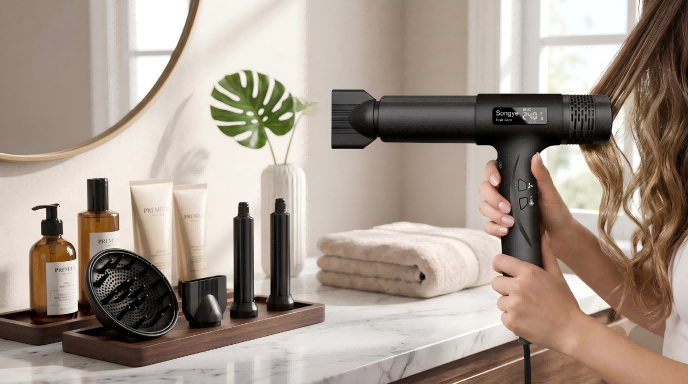
Pour choisir le meilleur sèche-cheveux à écran LCD haute vitesse en 2026, il ne s'agit pas tant de se laisser séduire par la promesse d'une “ vitesse de rotation maximale ” que de sélectionner un appareil offrant des performances fiables, affichant clairement ses réglages et résistant à une utilisation quotidienne intensive. Sur les marchés mondiaux, les acheteurs ont également besoin d'un fournisseur capable d'assurer la documentation, une production constante et une personnalisation OEM/ODM évolutive.
This cluster page explains what “best” should mean in 2026, provides a practical evaluation framework, and shows how professional buyers can compare LCD high-speed dryers without relying on hype. It also references supplier capability facts from Songye’s company profile where relevant.
Internal references used in this guide:
- [LCD Display High Speed Hair Dryer]
- [sèche-cheveux BLDC]
- [fabricant de sèche-cheveux]
- [usine de sèche-cheveux]
What “best” means for an LCD high speed hair dryer in 2026
In 2026, LCD display hair dryers compete in a mature, crowded category. The best models tend to share four characteristics:
- Clear, readable settings that reduce user error
- High airflow that shortens rough-dry time while maintaining control
- Stable heat behavior with sensible mode design
- Strong procurement fundamentals (compliance documentation, QC, lead times)
A product can look premium and still fail at “best” if it is noisy, hard to control, inconsistent between units, or unsupported by reliable documentation.
LSI keywords commonly connected to this search intent include high-speed hair dryer, LCD screen hair dryer, brushless motor hair dryer, salon-grade hair dryer, constant temperature control, Choisir le bon outil capillaire dépend entièrement de la texture et des besoins individuels des cheveux. Un, fast drying technology, et professional blow dryer.
Why the LCD display has become a practical feature (not just a design trend)
Visible settings support repeatability
Many customer complaints in this category come from confusion about what mode is active. An LCD screen reduces ambiguity by presenting heat and airflow levels more directly than unlabeled buttons or multi-color LEDs.
In salon settings, this also improves training and handoffs between assistants and senior stylists because the recommended settings can be communicated precisely.
Better guidance for different hair types
A screen makes it easier to instruct end-users in a way that is safe and realistic:
- lower heat for fine or damaged hair,
- higher airflow for rough-dry,
- cool shot for finishing.
For an EEAT-aligned article, this is stronger than promising universal results. It explains the mechanism (clear settings) that reduces mistakes and improves consistency.
High speed performance: what to evaluate beyond RPM
“High speed” is often marketed as a motor RPM number. RPM can indicate potential, but it is not a complete performance measure. Practical evaluation should focus on delivered airflow and controllability.
A professional comparison should request:
- airflow rate (CFM or m³/h) and airspeed (m/s),
- performance by mode (not just “max mode”),
- performance with attachments installed,
- noise level with test conditions.
Category reference: [sèche-cheveux BLDC]
Heat control and constant temperature positioning (how buyers should interpret it)
Many premium dryers describe controlled heat using terms like “constant temperature.” Songye’s profile highlights BLDC motor & PTC constant temperature technology and includes a manufacturer statement that “life is increased by 50%.” This is a supplier claim and should not be presented as universally verified without test conditions, but it reflects what professional buyers value: predictable, controlled heat behavior.
For high-quality content, “best” in 2026 should mean:
- stable heat modes,
- usable low/mid/high levels,
- safety cutoffs and overheat protection behavior that is clearly documented.
LSI keywords that fit naturally: heat stability, thermal protection, PTC heating, contrôle de la température, consistent styling results.
Attachments and finishing: how “best” is decided in real use
Drying hair quickly is only part of the job. Many returns happen because the tool does not help users achieve a smooth finish. That depends heavily on attachments and airflow direction control.
Buyers should evaluate:
- concentrator nozzle geometry (smoothing, precision),
- diffuser airflow distribution (curl definition),
- attachment security (especially for frequent changes),
- heat resistance and durability.
Model reference: [LCD Display High Speed Hair Dryer]
Supplier capability and procurement: what matters in global markets (facts from the provided profile)
For “best in 2026” lists that influence real purchasing, supplier fundamentals must be included—especially for B2B buyers, distributors, and private label brands.
Based on the company profile content you provided, Songye Electric Appliances Co., Ltd states:
- The company has been in the industry for over 17 years, specializing in hair dryers and other hair tools.
- The factory is in Hunan, China with three automatic production lines and a stated capacity of 100,000 pcs/month.
- It has a professional R&D team and welcomes OEM/ODM orders.
- It states compliance and safety coverage, listing certifications such as CE/CB/ROHS/ETL, and in the FAQ it lists CE/CB/ROHS/ETL/FCC for multiple markets (manufacturer statement).
- It states mass production delivery of 15–25 days depending on quantity, with urgent orders potentially expedited (manufacturer statement).
- It states a triple quality inspection process (raw materials + production + finished products), a defective rate <0.5%, and a 12‑month warranty (manufacturer statement).
- It states MOQ flexibility: trial orders may be as low as 50 units for some products, and mass production MOQ starts from 500 units, varying by product.
Supplier reference: [usine de sèche-cheveux]
Brand entry point: [fabricant de sèche-cheveux]
Professional data charts (use these to rank “best” without bias)
Chart 1: 2026 buyer scorecard for LCD high-speed hair dryers
| Evaluation area | What “best” looks like | What to verify |
|---|---|---|
| UI / LCD usability | readable, intuitive, mode clarity | screen visibility in bright light; mode logic demo video |
| Airflow performance | strong but controllable airflow | airflow/airspeed by mode; with concentrator attached |
| Heat behavior | stable, usable heat levels | temperature stability notes; safety cutoff behavior |
| : 5 réglages de chaleur, 3 réglages de vitesse | finishing-focused, durable | fit security; heat resistance; diffuser/nozzle performance |
| Noise & comfort | tolerable for long sessions | dB(A) @ 1m, weight balance, cord design |
| Compliance | market-ready documentation | certificates match model/rating/market |
| Supply chain | scalable and predictable | MOQ, lead time, capacity, QC steps, warranty flow |
Chart 2: What to request in an RFQ (procurement-ready checklist)
| Article | Request | Why it supports “best” claims |
|---|---|---|
| Conair propose des modèles spécifiques pour les voyages, mais ils manquent souvent de la puissance de leurs homologues pleine taille. | airflow/airspeed and noise results with conditions | avoids RPM-only marketing |
| Heat control | mode temperatures + stability description | supports safe, realistic guidance |
| Compliance | CE/CB/ROHS/ETL/FCC docs as applicable | reduces import and marketplace risk |
| QC | inspection checkpoints and defect definitions | protects brand reputation at scale |
| Garantie | terms + handling workflow | reduces operational downtime |
| Production | MOQ + lead time by quantity | supports seasonal planning |
Chart 3: EEAT-aligned claim language (how to avoid risky statements)
| Topic | Responsible phrasing | Avoid |
|---|---|---|
| Hair protection | “Controlled heat settings help users manage heat exposure.” | “No damage” |
| Drying speed | “Designed to reduce rough-dry time with high airflow.” | “Dries any hair in half the time” |
| Ionic claims | “May help reduce static depending on humidity and technique.” | “Eliminates frizz permanently” |
| Durabilité | “Supplier states QC process and warranty; verify test conditions.” | “Guaranteed lifetime” |
Recommended “best” selection method for 2026 (simple and repeatable)
Rather than selecting a dryer by marketing labels, professional buyers typically use a 3-step approach:
- Shortlist: choose models with LCD usability, multiple heat/airflow modes, and a complete documentation path.
- Bench test: compare rough-dry speed and finishing control across hair types (fine, thick, curly) using the same technique and attachments.
- Procurement validation: verify compliance documents match the exact SKU and destination market; confirm lead time, MOQ, QC process, and warranty handling.
This method produces a ranking that is defensible and less likely to create returns or negative reviews.
Frequently Asked Questions
1) Is an LCD display actually useful, or just a premium look?
It is useful when it clearly communicates heat and airflow settings and reduces mode confusion. In multi-user environments, that can improve consistency.
2) What matters more for “high speed”: RPM or airflow?
Airflow and airspeed matter more. RPM can be a partial indicator, but buyers should request delivered airflow performance by mode and with attachments installed.
3) What does “constant temperature” mean for practical use?
It generally refers to controlled heat behavior designed to reduce temperature swings. Buyers should request mode design details and safety cutoff behavior rather than relying on broad claims.
4) What should global buyers verify about certifications?
They should confirm certificates match the exact model number, electrical rating label, and destination market requirements. Songye lists CE/CB/ROHS/ETL and also CE/CB/ROHS/ETL/FCC in its FAQ (manufacturer statement).
5) What lead time and MOQ should buyers plan for?
Songye states trial orders can be as low as 50 units for some products, mass production MOQ starts from 500 units (varies by product), and mass production lead time is 15–25 days depending on quantity (manufacturer statements). Buyers should confirm for the exact SKU and customization scope.
6) How should a brand support “best of 2026” claims on Google?
By focusing on measurable criteria (airflow, noise, heat mode design, usability) and separating manufacturer-provided claims from verified test outcomes.
7) Is a BLDC hair dryer automatically better?
Not automatically. BLDC is a common design choice for high-speed positioning, but the best choice depends on delivered airflow, heat control, ergonomics, and documentation quality.