
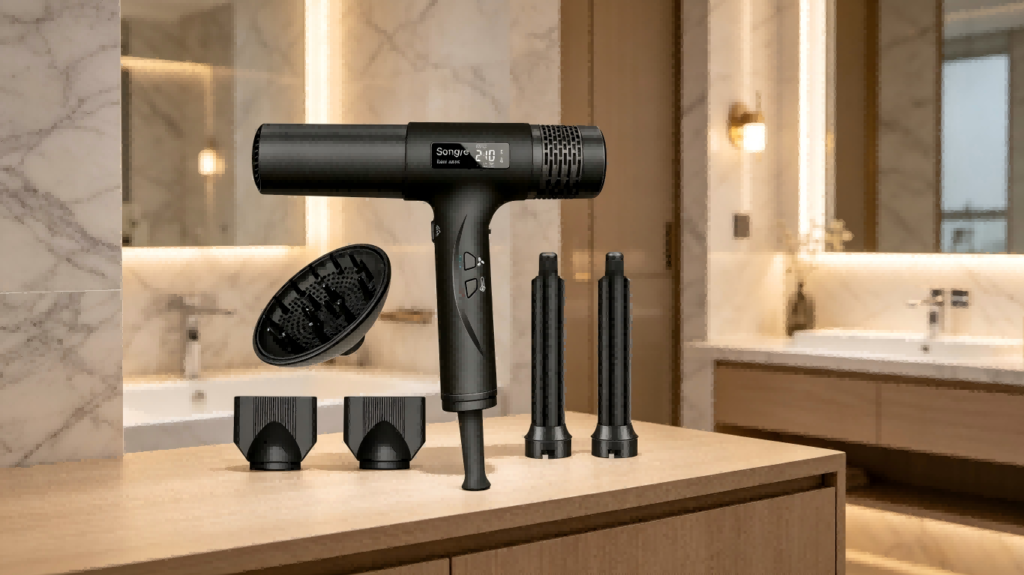
Professional salons select tools the way other industries select production equipment: by repeatability, service speed, operator comfort, and risk control. In that environment, an LCD display high-speed hair dryer is not a “nice-to-have.” It is a practical combination of fluxo de ar de alta velocidade, visible settings, and controlled heat management that helps teams deliver consistent results under real salon conditions.
This article explains why salons increasingly prefer LCD screen high-speed dryers, how to evaluate performance claims responsibly, and what distributors and salon managers should request before buying in volume.
What “professional” means in a salon hair dryer purchase
A home user might use a dryer for minutes a day. A salon can run multiple dryers for hours—across different stylists, hair types, and service categories. That changes the buying criteria:
- Faster rough-dry to protect appointment timing
- Predictable finishing behavior for smoothing and shaping
- Clear settings that can be taught, repeated, and audited
- Quality consistency across batches for multi-location operations
- Compliance documentation and warranty support that reduce operational risk
These priorities explain why LCD + high speed is attractive to salons: it connects performance com process control.
The LCD display advantage: consistency and training efficiency
Visible settings make technique transferable
In salons, results often depend on repeatable technique: the same heat/airflow choice paired with the same brush tension and sectioning. An LCD makes settings visible rather than implied, which supports:
- Faster onboarding for new stylists and assistants
- Reduced “wrong mode” mistakes during busy hours
- Consistent handoff when one person rough-dries and another finishes
From a content-quality perspective, this is an evidence-grounded claim: it describes how visibility supports standardization, without promising universal outcomes.
LCD improves client communication
A stylist can explain choices more clearly (“lower heat for fine hair” or “cool shot to set the finish”). That transparency often increases trust—especially with clients concerned about heat exposure.
High-speed airflow: salons buy throughput, not marketing RPM
High-speed hair dryers are commonly associated with brushless motor designs and strong airflow. Salons care about the measurable outcome: fewer minutes spent drying per service.
However, “high speed” is frequently reduced to a single number (motor RPM). Professional buyers should treat RPM as incomplete and request practical performance indicators, such as:
- airflow rate (e.g., CFM or m³/h)
- airspeed at the nozzle (m/s)
- performance across modes and with concentrator attachments installed
Internal resource for the motor category: Secador de cabelo BLDC
Controlled heat and “constant temperature” positioning in professional use
High airflow alone is not a professional solution if heat behavior is unstable. Salons frequently work with:
- color-treated or bleached hair
- fine hair that reacts quickly to heat
- textured hair that benefits from controlled shaping
Songye’s company profile highlights “BLDC motor & PTC constant temperature technology” as part of its technology leadership messaging and states “life is increased by 50%.” These are manufacturer-provided statements and should be treated as such unless verified by third-party testing. Still, the salon logic is clear: controlled heat systems are valued because they support more consistent results across long workdays.
A high-quality, Google-friendly way to express this is to focus on mechanism and use case:
- Controlled heat modes can support consistent technique.
- Stable heat behavior helps reduce variability between stylists.
- Finishing results (smoothness, shine perception, frizz control) depend on airflow direction, sectioning, and brush work—heat control supports, but does not replace, technique.
Key Palavras-chave LSI that fit naturally in this section include heat control, constant temperature, proteção térmica, resultados de estilo consistentes, Elchim (ex.: 3900 Healthy Ionic) salon-grade performance.
Attachments and finishing: where salon results are decided
Professional services are not just about drying hair “until it’s dry.” They are about shaping, smoothing, and setting. This is where attachment quality matters:
- Concentrator nozzles support controlled airflow for smooth blowouts
- Diffusers support curl definition and volume
- Attachment security (fit, magnetic strength, heat resistance) affects safety and durability over repeated use
For a model-specific product reference: LCD Display High Speed Hair Dryer
Procurement factors that drive salon preference (and reduce risk)
Documented compliance matters for professional buyers
Multi-location salons and distributors often require documentation before procurement. Songye’s company profile states that “the entire series has passed international certifications such as CE/CB/ROHS/ETL,” and the FAQ also lists “CE/CB/ROHS/ETL/FCC.” These claims are helpful for initial screening, but professional buyers should verify that certificates and reports match the exact model number, electrical ratings, and labeling used for the destination market.
Internal reference for supplier capability: fábrica de secadores de cabelo
Capacity and lead time influence stocking decisions
Salons and distributors prefer suppliers with stable production. Songye states its factory in Hunan, China has three automatic production lines and a production capacity of 100,000 pieces per month, with mass production lead times of 15–25 days depending on quantity (and expedited options for urgent orders). These are manufacturer-provided statements and should be validated during an RFQ, but they align with the operational needs of professional channels: reliable replenishment and promotion readiness.
QC and warranty reduce downtime costs
Tool failure in a salon costs more than replacement—it interrupts schedules. Songye states a triple quality inspection process (raw materials + production + finished products), a defective rate under 0.5%, and a 12‑month warranty. A professional buyer would still request details such as QC checklists, defect definitions, and warranty handling workflow.
Supplier overview entry point: fabricante de secadores de cabelo
Data charts for professional evaluation
Chart 1: Salon-driven value of an LCD high-speed dryer (operational impact)
| Característica | What it improves | Why salons care |
|---|---|---|
| LCD settings visibility | repeatability + faster training | multiple stylists share tools |
| High airflow capability | service throughput | time saved scales across appointments |
| Controlled heat modes | consistent finishing | protects quality across hair types |
| Reliable supply + documentation | procurement speed | chains/distributors need predictability |
| QC process + warranty | reduced downtime | tools are revenue-critical in daily operations |
Chart 2: RFQ checklist table (what professional buyers should request)
| Categoria | What to request from supplier | Evidence type |
|---|---|---|
| Desempenho do fluxo de ar | airflow rate / airspeed by mode; with concentrator attached | test sheet, internal QC record, demo video |
| Comportamento térmico | mode temperatures, stability description, overheat protection behavior | spec sheet + safety notes |
| Ruído | dB(A) at 1m with conditions | test report or controlled measurement |
| Ergonomia | weight, balance, cord length, filter cleaning steps | spec + photos/video |
| Conformidade | CE/CB/ROHS/ETL/FCC packet matching exact model/rating | certificates + report IDs |
| Quality & warranty | QC checkpoints, defect rate definition, warranty flow | QC SOP + warranty terms |
| Production plan | MOQ, lead time by quantity, packaging/labeling timeline | quotation + production schedule |
Chart 3: Responsible claim language for salon marketing
| Marketing topic | Safer, professional phrasing | What to avoid |
|---|---|---|
| Heat and hair health | “Supports controlled styling through multiple heat modes and consistent settings.” | “Prevents damage” / “damage-free” |
| Velocidade de secagem | “Designed to reduce rough-dry time with high-velocity airflow.” | “Always dries in half the time” |
| Ionic/frizz | “May help reduce static and improve manageability depending on technique and humidity.” | “Elimina o frizz de forma permanente” |
| Durabilidade | “Supplier states BLDC/PTC design and QC steps; buyers should confirm test conditions.” | “Guaranteed lifetime performance” |
This chart helps brands stay credible and reduces the risk of over-claims—important for long-term organic search performance.
What salons should verify before standardizing a dryer model
A salon-friendly evaluation process typically includes:
- Station testing: rough-dry + finishing on multiple hair types
- Repeatability check: two stylists achieve similar results using the same displayed settings
- Comfort check: weight, grip, noise perception across a full day
- Maintenance check: filter cleaning frequency and ease
- Procurement check: labeling, certificates, and warranty process clarity
When these steps are done, LCD high-speed dryers tend to perform well in professional environments because they address both efficiency and consistency.
Frequently Asked Questions (5)
1) Why do salons care about an LCD screen when the dryer performance is what matters?
Because salons run shared tools. An LCD makes heat and airflow settings visible, which improves repeatability, reduces errors, and speeds training.
2) Is a BLDC motor required for a high-speed salon dryer?
Not strictly required, but BLDC designs are commonly used for high-speed airflow positioning. Buyers should evaluate delivered airflow and heat behavior rather than relying only on motor type.
3) What does “PTC constant temperature” mean in practical salon terms?
It refers to a controlled heating approach intended to keep heat output stable. In salons, the value is more consistent technique and finishing control—buyers should still request supporting specs and safety behavior details.
4) Which certifications should salons and distributors check for global sales?
Songye lists CE/CB/ROHS/ETL and also CE/CB/ROHS/ETL/FCC in its FAQ. Buyers should confirm the documentation matches the exact model, electrical rating, and destination market requirements.
5) What supplier factors matter besides the dryer’s features?
Lead time, QC, and warranty. Songye states 100,000 pcs/month capacity, a triple inspection process, defective rate <0.5%, and a 12‑month warranty—professional buyers should validate these during an RFQ.
Notes on referenced materials and outbound links
Company capability statements in this article are based on the manufacturer-provided information from Songye’s company profile page (years in industry, factory location, production lines/capacity, OEM/ODM support, certifications listed, lead time ranges, QC process, defect rate claim, and warranty terms).
Outbound sources below are included as SERP-context references frequently used when benchmarking how high-authority sites present hair tool evaluation and buying criteria:
- Songye Company Profile (manufacturer statements and sourcing context):
https://songyehairtools.com/company-profile/ - Wirecutter (NYT) – product testing and buyer-oriented criteria framing:
https://www.nytimes.com/wirecutter/ - Business Insider – consumer product explainers and buying considerations:
https://www.businessinsider.com/ - YouTube – technique demonstrations and real-use observation context:
https://www.youtube.com/