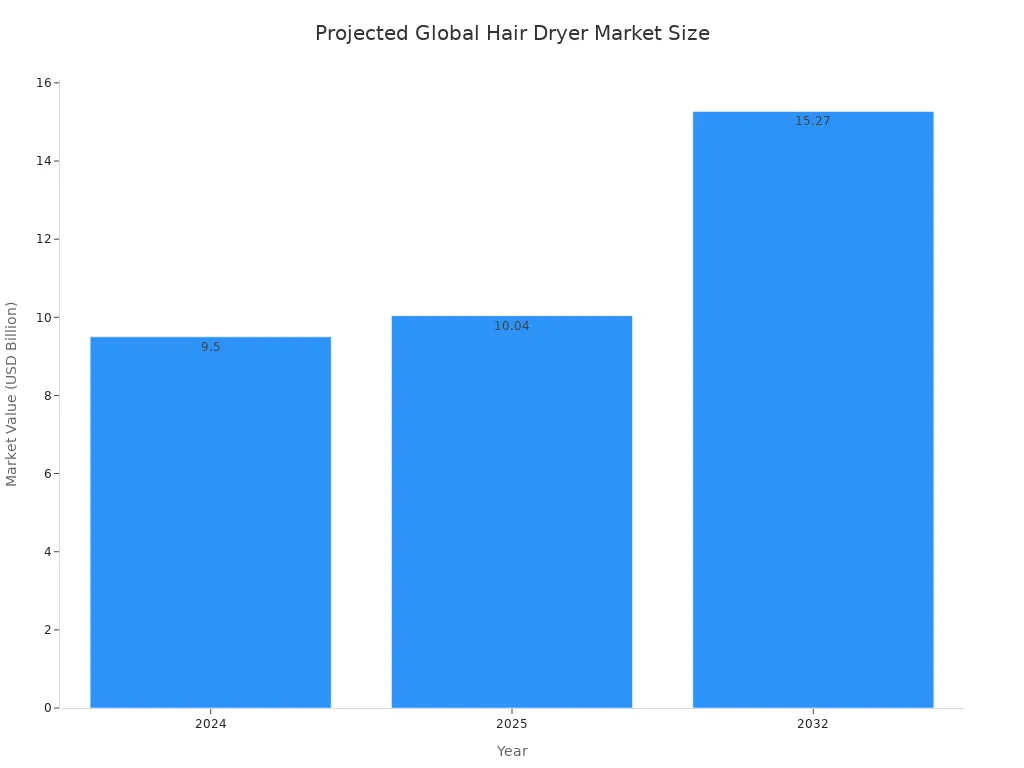
The global hair dryer market is expanding rapidly, with projections showing significant growth. Brands entering this competitive space must partner with the right hair dryer manufacturers. The choice often comes down to two primary models: OEM or ODM.
An OEM (Original Equipment Manufacturer) partnership involves a de secadores de pelo producing a tool based on your brand’s unique design. Conversely, an ODM (Original Design Manufacturer) approach lets you select a market-ready model, like a Secador de pelo BLDC o Secador de pelo AC, from a de secadores de pelo‘s catalog for rebranding.
The OEM Model: Building Your Unique Hair Dryer
La Original Equipment Manufacturer (OEM) model offers brands the ultimate control over their product’s destiny. This path involves commissioning a El sistema de control de calidad (CC) y garantía de calidad de un fabricante to produce a hair dryer based entirely on a brand’s exclusive design, specifications, and technological requirements. It is the route for visionaries aiming to introduce a truly unique product to the market.
What is OEM Manufacturing?
The Core Concept of OEM
The OEM model is a partnership where a brand brings a fully realized product concept to a manufacturer for production. The brand dictates every detail, from the motor’s power and the heating element’s material to the handle’s ergonomics and the shell’s finish. The manufacturer’s role is to execute this vision with precision. This approach ensures complete design control and allows for the integration of proprietary features, but it demands a significant upfront investment and a longer development timeline. The high consumer demand for innovative beauty tools often justifies this investment.
Your Role vs. The Manufacturer’s Role
Clarity in roles and responsibilities is critical for a successful OEM partnership. The brand acts as the architect, while the manufacturer serves as the expert builder. This division of labor ensures a focused and efficient workflow.
| Role | The Brand (Your Company) | The OEM Manufacturer |
|---|---|---|
| Hyperdymium™ (rápido, silencioso, potente) | Provides 100% of the design, schematics, and specifications. | Executes the provided design without alteration. |
| IP | Owns all intellectual property for the design and technology. | Owns the manufacturing process IP. |
| Tooling | Funds and owns the custom molds and tooling. | Creates, maintains, and operates the tooling. |
| R&D | Conducts initial research and development for the concept. | Provides engineering feedback and prototyping services. |
| Costs | Covers all development, tooling, and prototyping costs. | Provides a per-unit cost for mass production. |
The Step-by-Step OEM Process
The OEM journey is a structured, multi-stage process that transforms an idea into a mass-produced reality. Each step requires close collaboration and meticulous attention to detail to meet market demand.
Ideation and Specification The process begins with the brand developing a detailed product requirements document (PRD). This document outlines everything: target performance metrics, materials, color codes, desired user experience, and any cutting-edge technology to be included.
Engineering and Prototyping The manufacturer’s engineering team reviews the PRD to assess feasibility. They then develop functional prototypes. This stage involves rigorous testing and refinement to ensure the final product’s performance and safety, representing a key phase of technological innovation.
Tooling and Mold Creation Once the prototype is approved, the manufacturer creates the custom tooling and injection molds needed for mass production. This is often the most time-consuming and expensive part of the OEM process, as these tools are unique to the brand’s product.
Mass Production and Quality Control With the molds ready, mass production begins. The manufacturer implements a strict quality control protocol, defined by the brand, to test products at various stages. This ensures every unit meets the required standards for performance and enhances the overall user experience.
When to Choose the OEM Path
Opting for the OEM model is a strategic decision that aligns with specific long-term business goals. It is not for every brand, but it is essential for those with a particular vision for their place in the market.
Nota: The OEM path is a commitment to building a lasting brand asset. The initial investment in design and tooling pays dividends through market exclusivity and strong brand identity, meeting the high demand for unique luxury products.
For Maximum Brand Differentiation
Brands choose OEM to create a product that is impossible to replicate. When the market is saturated with similar-looking dryers, a unique design and superior user experience can capture consumer attention and justify a premium price. This differentiation is crucial for meeting the demand of discerning customers.
When You Own Unique Technology
If a brand has developed proprietary heating elements, a revolutionary motor, or other advanced technologies, OEM is the only viable path. It allows the brand to protect its intellectual property while bringing its technological innovation to life. This is how brands introduce cutting-edge technology to the market.
For Building a Premium Brand
Luxury is built on exclusivity and superior quality. The OEM model allows a brand to control every element that contributes to a high-end user experience, from the weight and balance of the dryer to the sound of its motor. This meticulous control is fundamental to achieving premium brand association and commanding a luxury price point, satisfying a specific market demand for high-performance, luxury tools.
The ODM Model: Fast-Tracking Your Market Entry
The Original Design Manufacturer (ODM) model provides a streamlined path for brands to enter the hair dryer market. It allows a company to launch a product quickly by selecting a pre-designed hair dryer from a manufacturer’s existing portfolio and rebranding it. This approach prioritizes speed and cost-efficiency over unique design development.
What is ODM Manufacturing?
The “White Label” Approach
At its core, the ODM model is a “white label” or “private label” solution. Manufacturers invest their own R&D to create a range of market-ready hair dryers. Brands then select a product that meets their needs, apply their own branding, and introduce it as their own. This ODM partnership eliminates the need for extensive design and engineering, making it an attractive option for many businesses. The manufacturer handles the technical complexities, allowing the brand to focus on marketing and sales.
Navigating a Manufacturer’s Catalog
The ODM process begins with a brand exploring a manufacturer’s product catalog. These catalogs are often filled with models that reflect current market trends and address existing consumer demand. A brand can find everything from high-performance professional dryers to compact travel models. The manufacturer provides detailed specifications for each product, helping the brand evaluate which option best aligns with its target audience and desired user experience.
The Streamlined ODM Process
The ODM journey is designed for efficiency, moving from concept to delivery in a fraction of the time required for OEM. This accelerated timeline provides significant value for wholesale buyers.
Product Selection and Evaluation
El primer paso es que la marca seleccione un modelo base del catálogo. Esta decisión es crítica. Las marcas deben evaluar rigurosamente la calidad de fabricación del producto, las certificaciones de seguridad y su rendimiento en condiciones reales. Una excelente experiencia de usuario es primordial, por lo que obtener muestras para pruebas es una parte no negociable del proceso. Esta evaluación garantiza que el producto elegido cumple con los estándares de la marca y satisfará la demanda del cliente.
Personalización e Identidad de Marca
Aunque el diseño central es fijo, el modelo ODM permite personalizaciones superficiales. Las marcas pueden especificar típicamente:
- Color: Aplicar colores específicos de la marca.
- Acabado del Material: Elegir entre acabados mate, brillo o tacto suave.
- Identificación de Marca: Añadir logotipos y otros elementos distintivos de la marca.
- Embalaje: Diseñar cajas e interiores personalizados.
Estos cambios, aunque sencillos, pueden elevar un producto estándar para crear una sensación casi de lujo y una experiencia de usuario distintiva, mejorando su atractivo.
Realización del Pedido y Producción
Una vez que la marca aprueba la muestra personalizada, realiza un pedido de producción en masa. El fabricante ODM inicia entonces la producción. Dado que el utillaje y la ingeniería ya están completos, esta fase es notablemente rápida. El enfoque está en el ensamblaje eficiente y el control de calidad para mantener un rendimiento consistente y satisfacer la demanda esperada. El cronograma para un lanzamiento ODM es significativamente más corto que para un proyecto OEM.
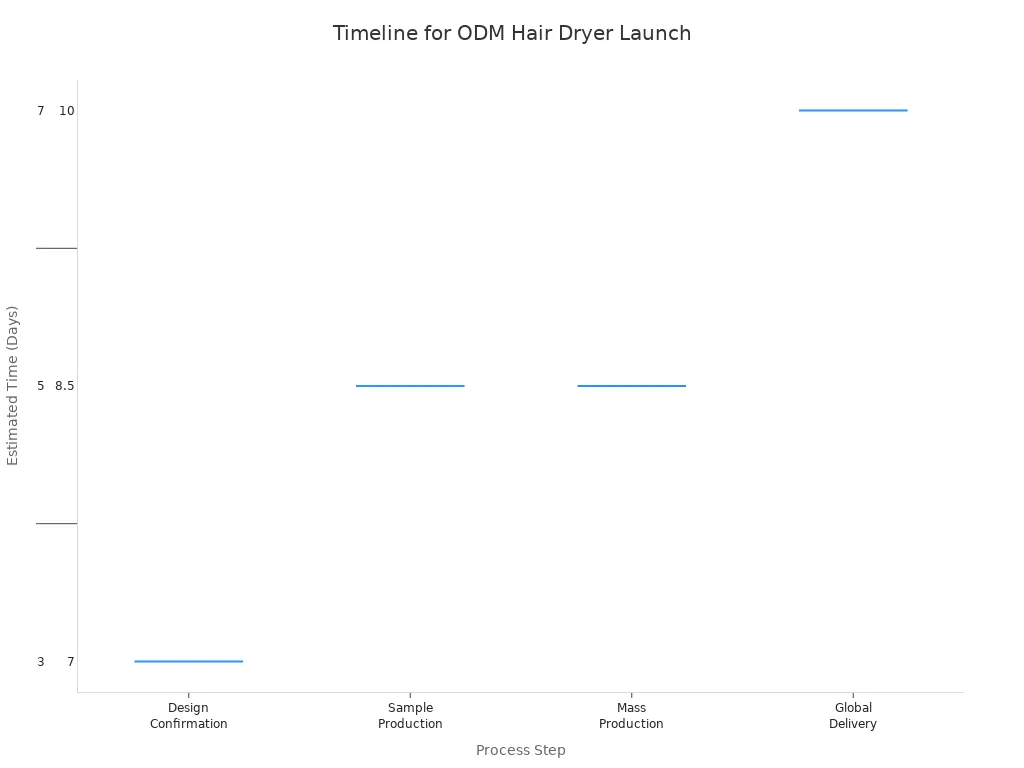
| Paso | Tiempo Estimado |
|---|---|
| Confirmación del Diseño | 3–7 días |
| Producción de Muestras | 7–10 días |
| Producción en Masa | 25–35 días |
| Entrega Global | 7–15 días |
Entrega Final
Tras la producción y los controles de calidad finales, el fabricante embala los secadores y los envía a la ubicación designada por la marca. Todo el proceso ODM, desde la selección hasta la entrega, puede completarse en solo unos meses.
Cuándo Elegir la Vía ODM
El modelo ODM es una elección estratégica más adecuada para objetivos y circunstancias empresariales específicas.
Consejo Profesional: La vía ODM ofrece un valor increíble para compradores mayoristas y nuevas marcas. Reduce las barreras de entrada al proporcionar acceso a productos probados y de alto rendimiento sin una alta inversión inicial, permitiendo a las marcas satisfacer rápidamente la demanda del mercado.
Para Velocidad y Eficiencia
Cuando el tiempo de lanzamiento al mercado es la máxima prioridad, ODM es la clara ganadora. Al omitir las largas fases de I+D, creación de prototipos y fabricación de utillaje, una marca puede lanzar un nuevo secador en meses, no en años. Esta velocidad permite a una marca capitalizar tendencias rápidamente.
Con un Presupuesto Limitado
La fabricación ODM evita los costos sustanciales asociados con el utillaje y la ingeniería personalizados, que pueden ascender a decenas o incluso cientos de miles de dólares. Esto la convierte en la opción ideal para startups, pequeñas empresas o marcas con capital limitado. Les permite ofrecer una experiencia de usuario de alta calidad y un toque de lujo sin un presupuesto de lujo.
Para Pruebas de Mercado
El modelo ODM es una excelente herramienta de bajo riesgo para pruebas de mercado. Una marca puede lanzar un producto para medir la demanda del consumidor y probar su posición en el competitivo mercado de secadores. Si el producto tiene éxito, la marca puede considerar una inversión mayor o incluso un futuro proyecto OEM. Este enfoque valida el rendimiento y la experiencia de usuario de un producto antes de comprometer recursos significativos.
OEM vs. ODM: Una Comparación Directa para Marcas de Secadores
Elegir entre un fabricante OEM y un fabricante ODM es una de las decisiones más críticas que tomará una marca de secadores. Esta elección impacta directamente en la singularidad del producto, la inversión financiera y la velocidad de lanzamiento al mercado. Comprender las diferencias fundamentales ayuda a una empresa a alinear su estrategia de fabricación con sus objetivos comerciales principales y a satisfacer la demanda del consumidor de manera efectiva.
Control del Diseño y Singularidad
El nivel de control creativo que una marca puede ejercer es una distinción principal entre los dos modelos. Este factor determina cuánto puede destacar un producto en un mercado saturado.
Control Total con OEM
La vía OEM otorga a una marca autoridad absoluta sobre el diseño de su producto. Una empresa proporciona al fabricante El sistema de control de calidad (CC) y garantía de calidad de un fabricante planos exactos y requisitos técnicos . Este control total permite una verdadera innovación y diferenciación. Las marcas pueden dictar cada aspecto del secador.. Configuración del Motor:.
- Especificar motores bobinados a medida para una potencia superior o un funcionamiento silencioso. Elementos Calefactores:.
- Diseñar tecnologías de calentamiento patentadas para un secado más rápido y seguro. Ergonomía y Estética:.
- Crear una forma, peso y tacto únicos que definan la identidad de la marca. Características Patentadas:.
- Integrar tecnología exclusiva que los competidores no puedan replicar. Este enfoque es esencial para marcas que buscan construir una reputación duradera de calidad e innovación, especialmente en el mercado de lujo, donde las características únicas justifican un precio premium. El modelo OEM es la única manera de dar vida a un concepto verdaderamente novedoso y satisfacer la demanda de herramientas de alta gama y a medida.
Personalización Limitada con ODM.
El modelo ODM ofrece un enfoque de diseño más restringido, aunque eficiente. Las marcas seleccionan un producto prediseñado del catálogo de un fabricante. Aunque la ingeniería central es fija, el fabricante ODM permite varias personalizaciones superficiales para alinear el producto con la identidad de la marca.
Estas modificaciones son cruciales para crear una presencia distintiva en el mercado sin la profunda inversión de una construcción totalmente personalizada. Para marcas dirigidas al segmento de lujo, seleccionar acabados premium y embalajes sofisticados puede elevar significativamente un modelo estándar.
Las opciones de personalización comunes incluyen:.
Color y Acabado:
- Aplicar colores específicos de la marca y elegir entre texturas mate, brillo o tacto suave. Añadir logotipos y elementos distintivos de la marca al secador y sus accesorios.
- Identificación de Marca: Diseñar cajas e interiores personalizados para una experiencia de desembalaje única.
- Embalaje: Características Especializadas:.
- Specialized Features: Solicitar la inclusión de tecnologías existentes, como calentamiento iónico o cerámico, si están disponibles para ese modelo.
Trabajar directamente con los fabricantes para pedidos mayoristas grandes a veces puede desbloquear personalizaciones más extensas, pero el diseño fundamental sigue siendo propiedad intelectual del fabricante.
Inversión y Costos
Las implicaciones financieras de OEM frente a ODM son marcadamente diferentes. El capital inicial requerido y la estructura de costos general determinan qué camino es viable para una marca.
Altos Costos Iniciales en OEM
El proceso OEM requiere una inversión inicial sustancial. Una marca debe financiar todas las fases de investigación, desarrollo e ingeniería. El gasto más significativo es la herramientería, que implica crear moldes personalizados para los componentes del secador de pelo. Estos costos pueden alcanzar fácilmente decenas o incluso cientos de miles de dólares antes de que se produzca una sola unidad. Esta alta barrera de entrada es una compensación por crear un producto único que pueda justificar un precio de lujo y satisfacer una demanda de mercado específica.
Bajos Costos de Desarrollo en ODM
El modelo ODM es mucho más accesible desde un punto de vista financiero. Dado que el fabricante ya ha cubierto los costos de I+D y herramientería para sus productos de catálogo, la marca no tiene gastos de desarrollo. Los costos principales son el precio por unidad y cualquier tarifa por personalizaciones menores. Este punto de entrada de bajo costo permite a las startups y pequeñas empresas competir en el mercado, probar el ajuste producto-mercado y responder a la demanda del consumidor sin arriesgar un capital significativo. Democratiza el acceso al mercado, permitiendo que más marcas ofrezcan productos con un toque de lujo.
Tiempo de Lanzamiento al Mercado
El cronograma desde el concepto inicial hasta el lanzamiento del producto varía drásticamente entre los dos modelos de fabricación. Este puede ser un factor decisivo para las marcas que buscan capitalizar tendencias emergentes.
Plazos Más Largos para OEM
Desarrollar un producto desde cero es un proceso largo. El camino OEM implica múltiples etapas, cada una requiere tiempo para desarrollo, pruebas y refinamiento.
| Etapa | Duración Típica |
|---|---|
| Diseño e Ingeniería | 2–6 meses |
| Creación de Prototipos y Refinamiento | 1–3 meses |
| Creación de Herramientería y Moldes | 2–4 meses |
| Producción en Masa y Control de Calidad | 1–2 meses |
Este cronograma extendido, a menudo de un año o más, es necesario para perfeccionar un producto único. Es una inversión estratégica para marcas enfocadas en el liderazgo de mercado a largo plazo más que en la velocidad a corto plazo. El objetivo es satisfacer la demanda futura con un producto verdaderamente superior.
Lanzamiento Rápido con ODM
La velocidad es el sello distintivo del proceso ODM. Al aprovechar un diseño existente y probado en el mercado, una marca puede omitir las etapas más lentas del desarrollo del producto. El cronograma se comprime significativamente, enfocándose solo en la personalización y producción. Una marca puede pasar de la selección del producto a tener inventario listo para enviar en solo unos meses. Esta agilidad permite a las empresas responder rápidamente a cambios repentinos en la demanda del consumidor o ingresar al mercado para capturar una tendencia, ofreciendo una experiencia casi de lujo sin la espera.
Propiedad de la Propiedad Intelectual (PI)
La propiedad de la propiedad intelectual (PI) es una diferencia definitoria entre los modelos OEM y ODM. Este factor tiene implicaciones a largo plazo para la ventaja competitiva y la posición en el mercado de una marca.
La Marca Posee la PI en OEM
En una asociación OEM, la marca retiene el 100% de la propiedad del diseño del producto, los esquemas y cualquier tecnología patentada. La marca proporciona el plano, y el fabricante es contratado únicamente para construirlo. Esta propiedad es un activo poderoso.
- Exclusividad: Impide legalmente que cualquier otra empresa venda el mismo producto.
- Valor de Marca: Permite a una marca construir su reputación sobre un diseño único, lo cual es esencial para establecer una identidad de lujo.
Valor a Largo Plazo:La PI del diseño se convierte en un activo valioso de la empresa que puede licenciarse, venderse o usarse como base para productos futuros. - Este control es fundamental para las marcas que desean satisfacer la demanda del mercado por una verdadera innovación y proteger su inversión en investigación y desarrollo. El Fabricante Posee la PI en ODM.
El modelo ODM opera bajo el principio opuesto. El fabricante posee la propiedad intelectual del diseño, ingeniería y herramientería del producto. La marca esencialmente licencia un producto preexistente para su rebranding. Este arreglo tiene consecuencias significativas. Consideración Clave: Si bien un producto ODM puede personalizarse con colores y logotipos, el diseño central no es exclusivo. El mismo modelo base puede venderse a marcas competidoras, lo que potencialmente diluye la presencia en el mercado de una marca.
Este modelo está diseñado para satisfacer la demanda inmediata del mercado de manera eficiente. Sin embargo, no ofrece protección a largo plazo contra productos imitadores, un riesgo crítico para las marcas que apuntan a un segmento de mercado premium o de lujo.
Cantidades Mínimas de Pedido (MOQ).
La Cantidad Mínima de Pedido (MOQ) se refiere al número más pequeño de unidades que un fabricante está dispuesto a producir en una sola tanda de producción. Este número varía significativamente entre los modelos de fabricación e impacta directamente el desembolso financiero inicial de una marca. MOQs Típicamente Más Altas para OEM.
El proceso OEM inherentemente requiere MOQs más altas. Un fabricante debe configurar una línea de producción dedicada, calibrar maquinaria para componentes personalizados y gestionar materias primas únicas. Para que este esfuerzo sea financieramente viable, necesitan un pedido inicial grande. Estas MOQs a menudo comienzan en miles de unidades. Una marca debe confiar en su pronóstico de ventas y en la demanda del consumidor por su producto único. Este compromiso mayor es una parte estándar de la creación de un producto a medida, especialmente en el espacio de los electrodomésticos, donde el control de calidad y la herramientería única justifican la escala. Consideración Clave: MOQs Frecuentemente Más Bajas para ODM Valor a Largo Plazo: El camino ODM ofrece mucha más flexibilidad con las cantidades de pedido, reduciendo la barrera de entrada para muchas marcas. Dado que los fabricantes ya están produciendo estos modelos, pueden agregar una producción con marca para un nuevo cliente sin cambios significativos en la configuración. Esta eficiencia permite MOQs mucho más bajas.
Muchos proveedores ofrecen términos flexibles para satisfacer la demanda fluctuante del mercado. Si bien las MOQs de producción en masa para un secador de pelo ODM pueden comenzar desde 500 unidades, los fabricantes a menudo admiten pedidos de prueba de pequeños lotes. Algunos productos incluso tienen MOQs tan bajas como 50 unidades, permitiendo a una marca probar el mercado. Para pedidos estándar, la MOQ típicamente oscila entre 200 y 500 unidades por modelo. Esta flexibilidad es invaluable para startups o marcas que prueban un nuevo concepto, ya que les permite satisfacer la demanda inicial del consumidor sin una inversión masiva en inventario.
Consideraciones Especiales para un Secador de Pelo Profesional.
Las exigencias de un entorno profesional de salón son mucho más rigurosas que las del uso doméstico. Los estilistas profesionales requieren herramientas que ofrezcan durabilidad, comodidad ergonómica y rendimiento superior. La elección entre fabricación OEM y ODM impacta directamente la capacidad de una marca para satisfacer estas necesidades especializadas.
The oem process inherently requires higher MOQs. A manufacturer must set up a dedicated production line, calibrate machinery for custom components, and manage unique raw materials. To make this effort financially viable, they need a large initial order. These MOQs often start in the thousands of units. A brand must be confident in its sales forecast and the consumer Consideración Clave: for its unique product. This larger commitment is a standard part of creating a bespoke product, especially in the Valor a Largo Plazo: appliance space where quality control and unique tooling justify the scale.
Often Lower MOQs for ODM
The odm path offers far more flexibility with order quantities, lowering the barrier to entry for many brands. Since manufacturers are already producing these models, they can add a branded run for a new client without significant setup changes. This efficiency allows for much lower MOQs.
Many suppliers offer flexible terms to meet fluctuating market Consideración Clave:. While mass production MOQs for an odm hair dryer may start from 500 units, manufacturers often support small batch trial orders. Some products even have MOQs as low as 50 units, allowing a brand to test the waters. For standard orders, the MOQ typically ranges from 200 to 500 units per model. This flexibility is invaluable for startups or brands testing a new Valor a Largo Plazo: concept, as it enables them to meet initial consumer Consideración Clave: without a massive inventory investment.
Special Considerations for a Professional Hair Dryer
The demands of a professional salon environment are far more rigorous than those of home use. Professional stylists require tools that offer durability, ergonomic comfort, and superior performance. The choice between OEM and ODM manufacturing directly impacts a brand’s ability to meet these specialized needs.
OEM for Performance Innovation
The OEM path is the premier choice for brands aiming to introduce true technological innovation into the professional market. It allows for the ground-up creation of high-performance hair dryers that set new industry standards.
Developing Custom Motors and Heating
A brand can collaborate with an OEM manufacturer to engineer components that deliver superior performance. This process involves creating custom, high-speed motors, such as BLDC motors that reach up to 110,000 RPM for rapid drying. It also enables the integration of advanced technologies.
- Low-noise features for a quieter, more peaceful salon experience.
- Blue light technology designed to promote healthier hair.
- Customizable ionic outputs for personalized hair care.
This level of technological innovation ensures the final product performance is unmatched.
Ergonomics for Salon Use
Professional stylists use their tools for hours each day, making ergonomics a critical factor. The OEM model allows a brand to design a hair dryer with a unique shape, weight, and balance. This custom design minimizes hand fatigue and improves usability for the professional user. Creating a tool that is both powerful and comfortable is essential for high-end salons where efficiency and stylist well-being are paramount.
ODM for Proven Salon-Grade Models
The ODM model offers a practical route for brands to launch reliable, professional-grade tools without the extensive development timeline of OEM. This approach focuses on selecting and customizing existing designs that are already built for heavy-duty use.
Consejo Profesional: When reviewing an ODM catalog, prioritize models with a proven track record in professional settings. Look for detailed specifications on motor life, material durability, and safety features to ensure the product can withstand constant use.
Selecting High-Durability Options
Brands should carefully evaluate a manufacturer’s catalog for features that indicate professional quality. A truly professional tool should have a powerful motor, typically between 1800W and 2200W, for fast drying. Other key indicators include:
- Durable, heat-resistant body materials.
- An extended power cord (1.8–2.5 meters) for mobility.
- A lightweight design (under 1.5 lbs) to reduce strain.
Selecting a model with these features ensures the product delivers the superior performance expected by a professional.
Certifications for Professional Use
Safety is non-negotiable in a professional environment. An ODM partner must provide products that meet stringent international standards. Brands must verify that the hair dryers carry essential certifications like UL, CE, and RoHS. This compliance guarantees the product is safe for professional use and protects the brand from liability. It is a fundamental requirement for any brand selling cutting-edge technology to the professional market.
Navigating the Global Landscape of Hair Dryer Manufacturers
Selecting the right partner is a global decision. Brands must evaluate the distinct advantages offered by hair dryer manufacturers in different regions. The two primary hubs for production are China and Western countries, each presenting unique strengths for building a professional product line.
Working with Chinese Hair Dryer Brands
Chinese hair dryer brands have become a dominant force in the industry. Their capabilities extend far beyond simple production, offering a blend of innovation, quality, and affordability. In 2021 alone, China exported 131 million hair dryers, a testament to their global reach and trusted manufacturing prowess.
Strengths in ODM Flexibility
Many Chinese hair dryer brands excel at the odm model. They offer extensive catalogs of market-ready professional tools. Their strong R&D teams support new ideas and can quickly adapt existing designs. This flexibility allows brands to launch a professional product with a low MOQ, ensuring even small orders meet exact specifications. This approach provides a fast and efficient path to market for a professional brand.
Cost-Effective OEM Solutions
Beyond ODM, Chinese hair dryer brands provide highly cost-effective oem solutions. Their modern facilities and efficient production lines reduce the overall cost of creating a custom professional tool. They maintain strict quality control, with comprehensive testing for every component and finished unit. This ensures a high-quality professional product without the premium price tag often associated with custom engineering.
Navigating Communication and Culture
A successful partnership with Chinese hair dryer brands requires clear communication. Brands should provide highly detailed specification documents to avoid misunderstandings.
Consejo: Working with a local sourcing agent or a manufacturer with a dedicated international sales team can bridge cultural and language gaps. This ensures a smooth workflow for any professional project.
Partnering with Western Hair Dryer Brands
Western hair dryer brands are often synonymous with high-end engineering and cutting-edge innovation. These partners are an excellent choice for brands building a premium professional identity.
Strengths in High-End Engineering
Western hair dryer brands typically lead in developing highly specialized technologies. They are ideal partners for creating a truly bespoke professional tool with proprietary features. Their engineering focus is on performance and luxury, which appeals to the top tier of the professional market. Many Western hair dryer brands are pioneers in this space.
Proximity and Regulatory Alignment
Working with Western hair dryer brands offers logistical advantages for companies in the same region. Shared time zones simplify collaboration. Furthermore, these manufacturers are already aligned with local safety standards like UL, which is critical for professional-grade electronics. This proximity makes Western hair dryer brands a reliable choice.
Comparing Cost Structures
The primary difference lies in cost. Western hair dryer brands generally have higher labor and operational expenses, leading to a higher per-unit price. However, brands may save on shipping costs and import tariffs. The investment in Western hair dryer brands often translates to unparalleled engineering for a specific type of professional tool, justifying the expense for luxury market positioning.
Making the Final Decision for Your Brand
Choosing a manufacturing partner is a defining moment for any brand entering the competitive hair dryer market. The decision between OEM and ODM shapes a company’s financial future, brand identity, and market trajectory. A structured approach helps clarify which path aligns best with a brand’s unique circumstances and long-term vision.
A Framework for Your Choice
A clear framework removes guesswork from the decision-making process. Brands should evaluate four critical areas to determine the most suitable manufacturing model for their goals.
Assess Your Development Budget
Financial resources are often the most significant constraint. The OEM path requires substantial upfront capital for research, engineering, and custom tooling. This investment is necessary for creating a unique professional product. Brands must determine if they can afford these high initial costs. In contrast, the ODM model eliminates development expenses, making it ideal for startups or businesses with limited budgets. This low-cost entry allows a brand to allocate more funds toward marketing and inventory.
Define Your Brand Strategy
A brand’s long-term strategy is a fundamental factor. The choice between manufacturing models is a strategic decision that dictates market positioning.
- OEM supports a strategy built on brand uniqueness and long-term differentiation. It is the path for brands whose core value is product superiority and innovation. This approach is essential for building a defensible, high-margin professional brand that avoids price wars.
- ODM supports a strategy focused on speed, efficiency, and market testing. It is perfect for brands whose strength lies in marketing and distribution rather than product engineering.
A smart hybrid strategy involves starting with an ODM model to test the market and meet initial consumer demand. Once the brand establishes a foothold and understands customer needs, it can transition to OEM to develop a proprietary professional product line.
Evaluate Your Timeline
Time to market can be a decisive advantage. Brands must consider how quickly they need to launch their product. The OEM process is methodical and lengthy, often taking a year or more from concept to shelf. This extended timeline is a trade-off for creating a truly innovative professional tool. The ODM process, however, is built for speed. A brand can launch a product in just a few months, allowing it to capitalize on trends and respond quickly to shifting consumer demand.
Consider Your Team’s Expertise
A brand must honestly assess its internal capabilities. Does the team include skilled designers and engineers? A strong in-house or contracted design team is crucial for a successful OEM partnership. If a brand’s core strength is marketing, sales, and brand building, the ODM model is a more logical fit. This approach allows the team to focus on what it does best while relying on the manufacturer’s technical expertise to deliver a quality professional product.
Real-World Scenarios
Examining how different types of brands leverage these models provides practical insight. Each scenario highlights a strategic alignment between a brand’s goals and its manufacturing choice.
OEM: The Tech-Forward Startup
A tech-forward startup with a revolutionary idea for a secador de pelo must choose the oem path. This brand’s value proposition is its unique technology, such as a patented airflow system or smart features. Manufacturers like Sincere Tech exemplify this model, having built their success on integrating cutting-edge technology like Bluetooth connectivity and infrared heating. For this type of startup, protecting its intellectual property is paramount. The high upfront investment is a necessary step to create a defensible professional product that can disrupt the market and meet consumer demand for genuine innovation.
ODM: The E-commerce Market Entrant
An e-commerce brand aiming for a fast and low-risk market entry will find the odm model ideal. This brand can select a high-quality, professional-grade hair dryer from a manufacturer’s catalog and customize it with unique branding and packaging. This strategy minimizes initial investment and accelerates the launch timeline. A great example is TINECO, a brand that originated from an OEM/trading company and successfully expanded into various home appliances, including hair dryers. By leveraging existing designs, an e-commerce entrant can focus its resources on digital marketing and building a strong online presence to capture a share of the professional and consumer markets.
Hybrid: The Established Brand Expansion
An established brand looking to expand its product line can use a hybrid approach. This strategy combines the speed of ODM with the uniqueness of OEM. The brand might start with a proven ODM professional hair dryer as a base. Then, it provides significant, OEM-level specifications to modify and improve it, such as requesting a custom motor or integrating a proprietary heating element. This allows the brand to launch a differentiated professional product faster and with less risk than a full OEM build. This evolutionary model provides a pathway toward a more independent product portfolio while satisfying immediate market needs.
How to Find and Vet Your Manufacturing Partner
Identifying the right manufacturing partner is a crucial step toward launching a successful professional hair dryer. A brand must first source potential partners and then rigorously vet them. This process ensures the chosen supplier can meet quality standards and production demands for a professional product.
Sourcing Potential Partners
Brands can discover potential partners through several effective channels. Each channel offers unique advantages for connecting with qualified suppliers.
B2B Online Marketplaces
Digital platforms are a primary resource for sourcing suppliers. B2B websites like Alibaba.com y BeauteTrade.com connect buyers with global hair dryer manufacturers. These marketplaces list numerous companies, facilitating direct communication and making it easier to find partners for private label or bulk professional orders.
International Trade Shows
Industry trade shows provide an invaluable opportunity for face-to-face interaction. Brands can physically inspect products, observe demonstrations, and discuss capabilities directly with factory representatives. This hands-on approach helps in assessing the real-world quality of a potential professional tool.
Using Sourcing Agents
A sourcing agent can be a strategic asset, especially when working with international suppliers. These agents navigate cultural and language barriers, manage logistics, and help ensure project specifications for a professional product are clearly understood.
Essential Vetting Criteria
Thorough vetting is essential to avoid significant quality differences between samples and the final production run. A brand must evaluate every potential partner against a strict set of criteria to secure a reliable professional relationship.
Reviewing Certifications and Compliance
Compliance with international safety standards is non-negotiable for any professional electronic device. A manufacturer must provide documentation for key certifications.
| Market | Mandatory Certifications/Compliance |
|---|---|
| US | UL Certification, CPSC Compliance |
| EU | CE Marking (LVD, EMC, RoHS Directives) |
Verifying these certifications protects the brand and ensures the product is safe for professional use.
Assessing Production Capacity
A brand must confirm that a manufacturer can handle its order volume. Key indicators include factory size, the number of employees, and dedicated departments for R&D and quality control. This assessment guarantees the supplier can scale production to meet future demand for a successful professional product.
Evaluating Quality Control Systems
A robust quality control system prevents inconsistencies and ensures superior product performance. Brands should insist on receiving physical samples to verify craftsmanship and spot potential quality differences. Reputable suppliers, like Sokany, demonstrate their commitment to quality through rigorous testing and low minimum order quantities for trial orders, which is a great benefit for a new professional brand.
Checking Communication and Transparency
Clear and prompt communication is the foundation of a successful partnership. A responsive manufacturer who provides transparent updates is a reliable partner. This is especially important for complex professional projects where details matter. Strong communication helps build trust between a brand and its chosen hair dryer manufacturers.
A brand’s final decision must align with its core strategy. The oem path permite a una marca crear un producto profesional verdaderamente único, ofreciendo un control inigualable para una ventaja a largo plazo. El modelo ODM proporciona una ruta más rápida al mercado, permitiendo a las marcas lanzar una herramienta profesional probada con menor inversión.. Elegir el socio ODM adecuado es crucial para ofrecer una experiencia profesional de calidad. Esta elección estratégica determina la capacidad de una marca para satisfacer la demanda del consumidor de herramientas profesionales superiores en el competitivo mercado de secadores de pelo.
Preguntas Frecuentes
¿Cuál es la principal diferencia entre OEM y ODM?
OEM (Fabricante de Equipo Original) implica que un fabricante produce un producto único y personalizado según el diseño de una marca. ODM (Fabricante de Diseño Original) permite a una marca seleccionar un producto prediseñado del catálogo de una fábrica y comercializarlo con su marca. La diferencia principal es la propiedad del diseño y el nivel de personalización.
¿Qué modelo es mejor para una nueva marca?
El modelo ODM suele ser mejor para las nuevas marcas. Requiere menos capital y ofrece una entrada más rápida al mercado de secadores de pelo. Este enfoque permite a las empresas probar productos y construir una presencia en el mercado con un riesgo financiero significativamente menor.
¿Puede una marca personalizar un secador de pelo ODM?
Sí, las marcas pueden personalizar los productos ODM. Las modificaciones comunes incluyen:
- Colores y acabados específicos de la marca
- Aplicación del logotipo
- Diseño de embalaje personalizado
Sin embargo, la ingeniería central y la forma del secador de pelo permanecen fijas como el diseño original del fabricante.
¿Cuánto cuesta la herramientería OEM?
Los costos de herramientería OEM varían ampliamente. La inversión puede oscilar entre decenas de miles y más de cien mil dólares. El precio final depende de la complejidad del diseño del producto, los materiales utilizados y la estructura de precios del fabricante específico.
¿Quién posee el diseño en una asociación ODM?
El fabricante conserva la plena propiedad intelectual (PI) del diseño del producto en una asociación ODM. La marca esencialmente licencia el producto para su comercialización con su marca. Esto significa que el fabricante puede vender el mismo modelo base a otras empresas.
¿Cómo puede una marca garantizar la calidad del producto?
Las marcas garantizan la calidad evaluando minuciosamente a los fabricantes potenciales. Este proceso incluye revisar las certificaciones de seguridad, evaluar la capacidad de producción y probar muestras físicas. La comunicación clara y las especificaciones detalladas del producto son esenciales para el éxito en el competitivo mercado de secadores de pelo..